Night does not fall all at once. Instead, it advances. Light thins. Sound stretches. Familiar shapes lose their edges. Long before full darkness arrives, the body begins adjusting itself for danger.
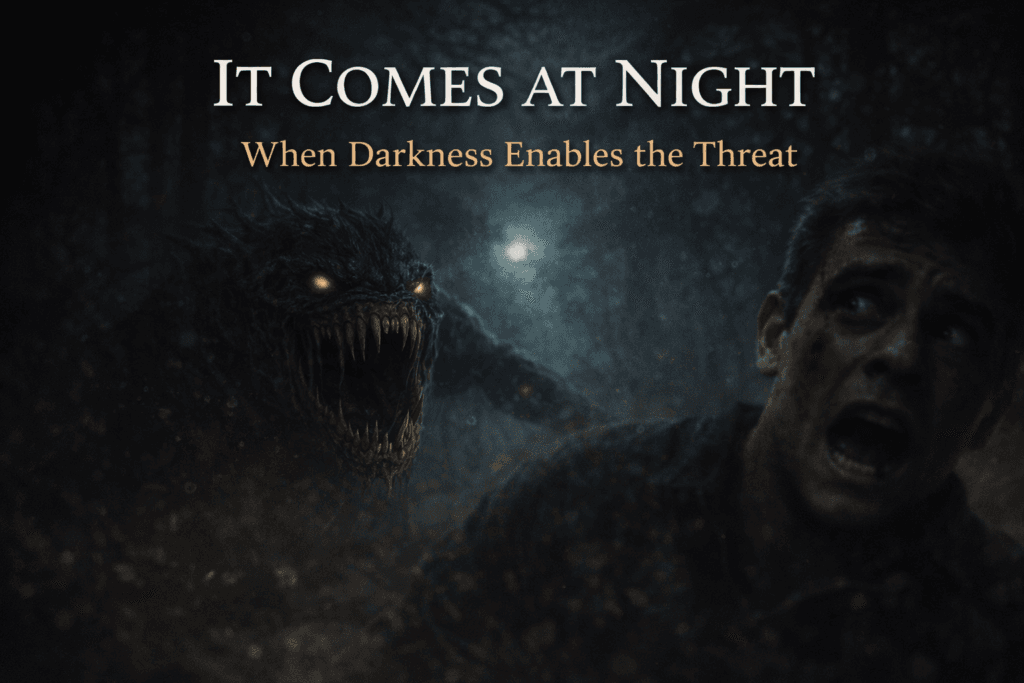
In nocturnal creature horror, this adjustment is not imagination. It is preparation. Darkness does not merely conceal threats. It activates them.
You feel this shift before you can explain it. Breathing changes. Muscles tighten. The urge to remain still competes with the instinct to flee. Meanwhile, something else waits for the same transition.
Something understands night better than you do.
Why Nocturnal Creature Horror Depends on Time
Unlike pursuit-driven fear, nocturnal creature horror thrives on anticipation. The threat does not rush. It waits. It measures the hour. It allows darkness to strip the environment of certainty first.
Because visibility collapses at night, the body compensates by listening harder. However, heightened attention does not bring clarity. Instead, it magnifies uncertainty. Every sound feels intentional. Every silence feels watchful.
This is why nocturnal creature horror sits firmly within the lineage of Creature Feature Horror Stories that weaponise environment rather than speed. Here, time replaces motion. Darkness replaces distance.
The creature does not need to chase. Night brings you to it.
The First Hours of Darkness Are a Test
Fear at night escalates in phases.
At first, you reassure yourself. Darkness feels temporary. You still believe in morning. You still trust walls, doors, routines.
Then time stretches. Familiar sounds vanish. New ones appear. The body remains alert, yet confirmation never arrives. Consequently, tension accumulates without release.
In nocturnal creature horror, this prolonged uncertainty is deliberate. The threat does not want panic yet. It wants fatigue. It wants erosion.
Because once exhaustion sets in, resistance weakens.
Darkness Collapses Distance
On land, distance equals safety. You see what approaches. You calculate speed. You choose direction. At night, those calculations fail.
Vision narrows to whatever light remains. Everything beyond that becomes unknown space. As a result, distance loses meaning.
A sound behind you could be far away.
Or it could be close.
Nocturnal creature horror exploits this ambiguity relentlessly. The threat does not announce itself. It lets darkness erase the buffer between you and it.
By the time you realise how close it is, it has already been close for a while.
Why Turning on the Light Makes Things Worse
Light promises control. Revelation. Proof. Yet nocturnal creature horror repeatedly undermines this instinct.
Light fixes your position faster than it reveals the threat. Movement becomes visible. Shadows sharpen. Meanwhile, the darkness beyond the light deepens by contrast.
Creatures bound to night understand this imbalance. They remain just outside illumination. They wait where light cannot reach.
This is the mechanical logic behind The Tooth Collector. The creature does not torment randomly. It operates on a schedule. It waits for night because night exposes the body’s routines—sleep, vulnerability, stillness.
When the light goes out, the rules change.
Sound Becomes the Language of the Night
At night, sound replaces sight. Footsteps echo longer. Breathing feels intrusive. Even swallowing feels loud.
In nocturnal creature horror, sound becomes evidence. Every noise confirms presence. Every silence implies intention.
Because of this, the body begins policing itself. Breathing slows. Movement becomes deliberate. Muscles lock mid-action.
However, restraint does not equal safety. It only increases tension. And tension creates mistakes.
Fatigue Is the Creature’s Greatest Ally
Night introduces a deadline without announcing it. As hours pass, attention fades. Reflexes dull. Judgment softens.
The body wants rest. Yet rest feels dangerous. Sleep feels like surrender. Consequently, the body exists in suspension—exhausted, yet alert.
Nocturnal creature horror exploits this contradiction. The creature does not force error. It waits until the body creates it.
This is where The Tooth Collector excels. The torment does not require constant presence. It requires anticipation. The body breaks itself by waiting.
When Night Becomes Predictable for the Creature
Some nocturnal creatures do not hunt blindly. They observe. They learn. They recognise patterns.
They notice when lights go off.
They note when breathing slows.
They wait for stillness.
This intelligence aligns with It Learns You, where repetition replaces surprise. Once the creature understands your routines, night becomes predictable—for it, not for you.
The body realises too late that habit has become access.
Darkness Isolates Even the Not-Alone
Night separates people even when they remain close. Rooms feel farther apart. Voices feel distant. Help feels theoretical.
In nocturnal creature horror, isolation is psychological before it is physical. You may know others are nearby, yet reaching them feels dangerous.
This dynamic intersects with It Was Never Alone, where darkness does not hide a single threat, but many. The absence of sight multiplies possibility.
You are not just afraid of what you cannot see.
You are afraid of how many you cannot see.
Childhood and Precision Night Fear
Night fear requires no explanation for children. It arrives fully formed.
Smaller bodies. Shorter sightlines. Louder heartbeats. Darkness overwhelms proportion.
The Midnight Giggle weaponises this vulnerability through timing rather than force. Sound at night does not comfort. It destabilises. Innocence becomes access.
In nocturnal creature horror, childhood does not soften threat.
It sharpens it.
The Moment Anticipation Ends
The most devastating moment in nocturnal creature horror is not the first sound. It is confirmation.
A shape responds to your movement.
A sound reacts to your breath.
Something acknowledges awareness.
At that instant, dread solidifies. Because the threat waited, you have already spent energy. Fear has already exhausted you.
The night has done its work.
Why Escape Fails After Dark
Running at night feels reckless. Paths vanish. Obstacles appear without warning. Orientation collapses.
Even familiar terrain turns hostile. Shadows distort depth. Noise betrays position.
Therefore, nocturnal creature horror rarely rewards flight. The body cannot move confidently without sight. Meanwhile, the creature navigates effortlessly.
Escape becomes a gamble with worsening odds.
Survival Does Not Reset the Night
If survival occurs, it does not cleanse memory. Darkness never returns to neutrality. Night becomes charged forever.
Sleep fractures. Silence feels intentional. Light feels temporary.
Nocturnal creature horror insists that the body remembers when danger came, not just what it was.
And night always returns.
Why Anticipatory Dread Converts Readers
Readers drawn to nocturnal creature horror are not seeking immediate violence. They are drawn to tension stretched across time.
They understand that fear deepens when it waits. That inevitability sharpens when delayed.
Books like The Tooth Collector and The Midnight Giggle convert because they respect patience. They allow fear to mature before striking.
These readers do not want reassurance.
They want the hour before certainty.
Final Truth About the Night
Nocturnal creature horror reveals a simple fact: darkness does not create monsters.
It enables them.
Night removes witnesses. It erases distance. It exhausts the body. And once it has done so, the creature steps forward.
You waited for proof.
The night waited for weakness.
And when it finally comes, it does not need to run.
It only needs to arrive.