At first, you think the problem is scale.
One sound where there should be silence. One movement where nothing should be. One shape in the corner of your vision that disappears when you look directly at it.
Creature swarm horror begins with this mistake.
You assume there is one threat. Something singular. Something trackable. Something you might be able to watch, avoid, or destroy.
That assumption is the last thing that keeps you functional.
Why Creature Swarm Horror Escalates Faster Than Any Other Fear
Most horror allows focus. You know where to look. You know what to listen for. Even if escape is unlikely, at least the danger feels bounded.
Creature swarm horror removes that boundary.
The fear does not come from strength or intelligence alone. It comes from quantity. From the moment you realise the threat does not occupy a single point in space, survival logic collapses.
You cannot watch everything.
You cannot defend every angle.
You cannot respond fast enough.
This is why creature swarm horror occupies a unique escalation tier within Creature Feature Horror Stories. Once multiplicity is confirmed, the rules that govern confrontation no longer apply.
The First Error: Counting the Threat
Early on, the mind insists on numbers.
You count footsteps. You count shapes. You count movement. You reassure yourself that if you can account for them, you can manage them.
However, creature swarm horror weaponises miscounting.
The threat appears manageable at first because it wants to. A few at the edge of perception. A handful in places you expect. Enough to suggest containment.
Then one appears where it shouldn’t.
Then another.
Then you realise the count was never accurate to begin with.
When Space Stops Belonging to You
Swarm horror does not need speed. It needs coverage.
Walls lose their function. Ceilings stop being barriers. Corners stop being safe. The environment fills in, not all at once, but progressively.
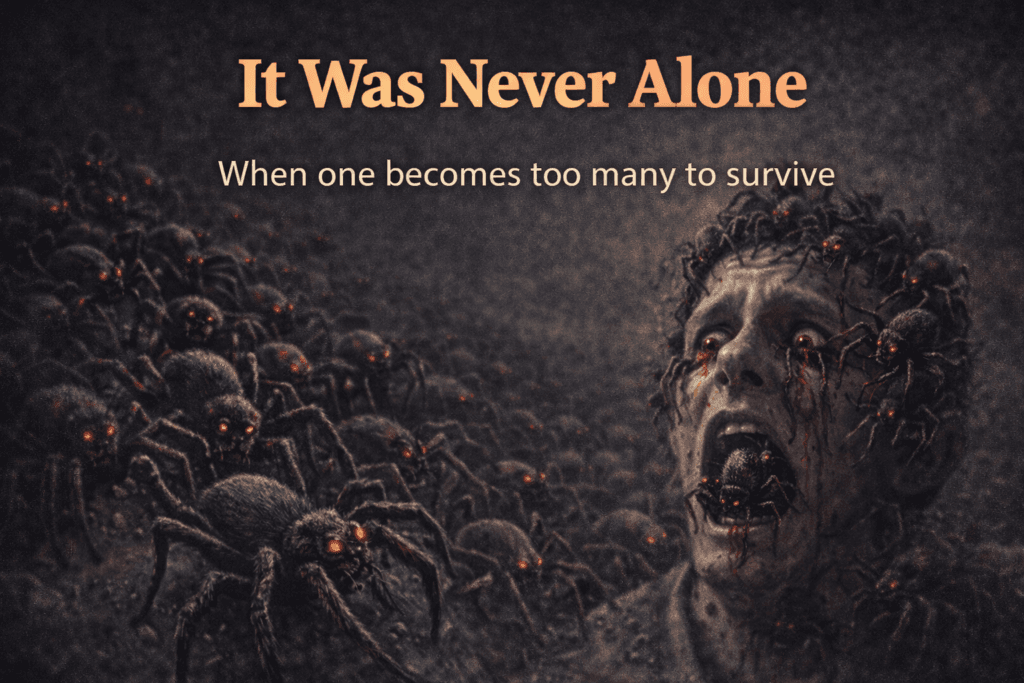
In Signed in Blood, the spiders do not rush immediately. They spread. They claim surfaces. They transform empty space into hostile terrain.
At that point, the environment itself becomes part of the swarm.
Movement turns dangerous because every direction is occupied.
Why Multiplicity Breaks Human Strategy
Human survival depends on prioritisation.
You identify the biggest threat.
You focus resources.
You eliminate variables.
Creature swarm horror removes that possibility.
There is no primary target.
There is no decisive strike.
There is no meaningful sequence.
Every action addresses one threat while ignoring dozens more. Every movement exposes you somewhere else.
This is the moment panic becomes rational.
Escalation Without a Peak
Most horror builds toward a climax. A final confrontation. A moment where everything converges.
Creature swarm horror refuses that structure.
Escalation continues without resolution. The threat does not consolidate. It disperses. It multiplies. It becomes harder to perceive as a single problem.
In Signed in Blood, the spiders do not form a single mass. They spread across surfaces, objects, and bodies. Their danger comes not from coordination, but from inevitability.
No matter where you turn, something is already there.
Why Darkness Makes Swarms Worse
Limited visibility is dangerous against one threat.
Against many, it is catastrophic.
Darkness introduces delay. Delay introduces error. Error multiplies consequences.
This escalation logic mirrors It Comes at Night, where uncertainty sharpens dread. However, in swarm horror, uncertainty compounds exponentially.
You are not waiting for one thing to move.
You are waiting for everything to move.
When the Body Becomes a Surface
Swarm horror crosses a crucial line when the body stops being separate from the environment.
Once creatures crawl, bite, burrow, or cling, the boundary between self and space dissolves. You are no longer in the environment.
You are part of it.
In Signed in Blood, this violation is relentless. The spiders do not merely surround. They attach. They invade. They turn skin into terrain.
At this point, resistance becomes reflexive rather than strategic.
Why Killing One Does Nothing
Instinct demands elimination.
You crush one.
You burn another.
You tear one away.
Nothing improves.
Creature swarm horror teaches a brutal truth: removal does not reduce threat density. For every one destroyed, others remain unseen.
Worse still, each act of violence costs time, energy, and focus: resources you cannot afford to lose.
This logic aligns with the despair of You Can’t Kill It. Even though individual creatures can be destroyed, the swarm itself is effectively immortal.
Persistence replaces singular survival.
The Illusion of Containment
At some point, you believe you’ve found a boundary.
A room you can seal.
A space they can’t reach.
A surface they avoid.
Swarm horror exists to shatter that belief.
Containment fails because swarms exploit micro-gaps. Cracks. Openings you didn’t know existed. Pathways too small to register as threats.
Once the first breach occurs, containment ceases to matter.
When Fear Becomes Mathematical
Swarm horror forces the mind into calculation.
How many?
How fast?
How much space remains?
This mental shift is devastating because numbers provide clarity—but clarity reveals futility.
You do not need exact figures to understand the truth.
There are more of them than you can handle.
Escalation Without Malice
One of the most unsettling aspects of creature swarm horror is the absence of intent.
The swarm does not hate you.
It does not target you personally.
It does not need to.
It behaves according to impulse, instinct, or attraction. Its danger emerges from scale, not cruelty.
This makes negotiation impossible.
You are not being punished.
You are being overrun.
Why Escape Rarely Works
Escape assumes a clear exit.
Swarm horror denies that assumption.
Exits become occupied.
Paths become contested.
Movement triggers response.
Even if you manage to leave the immediate area, the swarm’s reach often extends further than expected. It spreads faster than you can relocate.
You are not outrunning a creature.
You are outrunning multiplication.
Why Escalation Dread Converts Readers
Readers drawn to creature swarm horror are not seeking mystery or surprise. They are drawn to overwhelm.
They want to experience the moment when counting fails. When strategy collapses. When the body realises it cannot keep up.
Signed in Blood converts because it commits fully to this logic. It does not allow the swarm to remain background threat.
It forces confrontation with scale.
Final Truth of the Swarm
Creature swarm horror delivers a devastating realisation:
You were never dealing with a threat.
You were dealing with a condition.
Once that condition emerges, survival stops being a question of skill.
It becomes a question of time.
And time always runs out faster when the threat multiplies.