Some houses do not frighten because they are hostile.
They frighten because they are patient.
In Gothic Horror Stories, there comes a point where the struggle between self and environment no longer feels active. The doors are still there. The rooms remain accessible. Nothing overtly prevents escape. Yet the house begins to feel more permanent than the person inside it. The self does not shatter or vanish. It thins. It disperses. It becomes less necessary.
This is the condition at the heart of becoming-the-house horror: identity does not end. It is absorbed.
The house does not take you.
It incorporates you.
When Living Somewhere Becomes Being Shaped by It
At first, residence feels temporary.
You live in the house. You notice its quirks. You adapt where necessary but assume the arrangement is provisional. The self remains intact and dominant.
Over time, however, adaptation deepens. Routines adjust. Movement slows. You stop questioning certain features and begin working around them. You learn which rooms to avoid at certain hours. You anticipate noises before they occur.
Eventually, you stop thinking of these accommodations as compromises. They become habits.
In gothic horror, this is the first erosion: when the house no longer feels external. When it becomes something you collaborate with rather than occupy.
The danger lies not in confinement, but in familiarity.
Alignment Without Consent
Gothic houses rarely coerce.
They align.
They reward predictability. They resist disruption subtly, through discomfort rather than force. When characters try to alter the space—change routines, renovate, leave rooms unused—the house responds not with violence but with friction. Things feel wrong. Restlessness grows. Sleep falters.
Returning to old patterns restores calm.
This feedback loop trains obedience without commands. Over time, the house becomes a regulating system. The self begins to measure decisions against the house’s preferences rather than personal desire.
Identity erosion begins not when autonomy is removed, but when autonomy feels inefficient.
Memory Becomes Environmental
As this alignment deepens, memory shifts.
It no longer behaves like a personal archive. Instead, it becomes spatial. Certain rooms carry emotional weight disproportionate to their size. Corridors trigger physical responses—tension, calm, hesitation—without conscious thought.
The house remembers with you.
Eventually, it remembers for you.
This is where gothic horror distinguishes itself from psychological horror. The erosion of identity is not internal alone. It is distributed. The self offloads memory, grief, and decision-making into the environment.
The house becomes a cognitive extension.
The Relief of Surrender
What makes this stage unsettling is how functional it feels.
Maintaining a full self is exhausting. Choice creates strain. Resistance requires energy. The house offers continuity without effort. It holds patterns stable. It preserves rituals. It absorbs emotional excess.
Letting go does not feel like loss.
It feels like relief.
In Marked by the Deep, this relief is central. The environment does not overpower the character. It waits until the character is ready to stop insisting on separation. Identity thins not because it is destroyed, but because it is no longer required to carry everything alone.
The house becomes a support structure—one that does not ask who you are, only how you move.
When Leaving Feels Like Self-Erasure
By the time identity erosion is visible, escape has changed meaning.
Leaving no longer feels like freedom. It feels like disintegration.
Outside the house, memory becomes unstable. The self must operate independently again—without the scaffolding of routine, architecture, and preserved history. The world beyond the threshold feels abstract, undefined, incomplete.
Inside, everything is known.
This inversion is critical. Gothic horror does not trap characters by removing exits. It traps them by making departure feel like loss of coherence. The house offers continuity. The self adapts to preserve that continuity.
Staying becomes the safer option—not physically, but psychologically.
Identity as a Shared Function
At this stage, identity no longer belongs solely to the person.
It becomes shared between inhabitant and structure.
You anticipate the house’s needs instinctively. You adjust behavior to maintain its equilibrium. You correct disruptions automatically. Without realizing it, you begin performing the same regulatory functions the house once performed on you.
The relationship reverses.
You are no longer maintained by the house.
You help maintain it.
This is the transition from resident to caretaker, from subject to mechanism. Identity does not vanish—it diffuses into role.
The House as Continuity Engine
Gothic houses endure because they preserve cycles.
They do not care who occupies them, only that occupation continues. When one self erodes, another may arrive. The house adapts both.
This continuity is what links identity erosion back to inherited structures explored earlier in Old Estates, Old Crimes. There, houses preserve history across generations. Here, they preserve function across selves.
The house does not require your individuality.
It requires your participation.
And participation, once normalized, becomes indistinguishable from identity.
The Self as Atmosphere
As erosion deepens, the self becomes less localized.
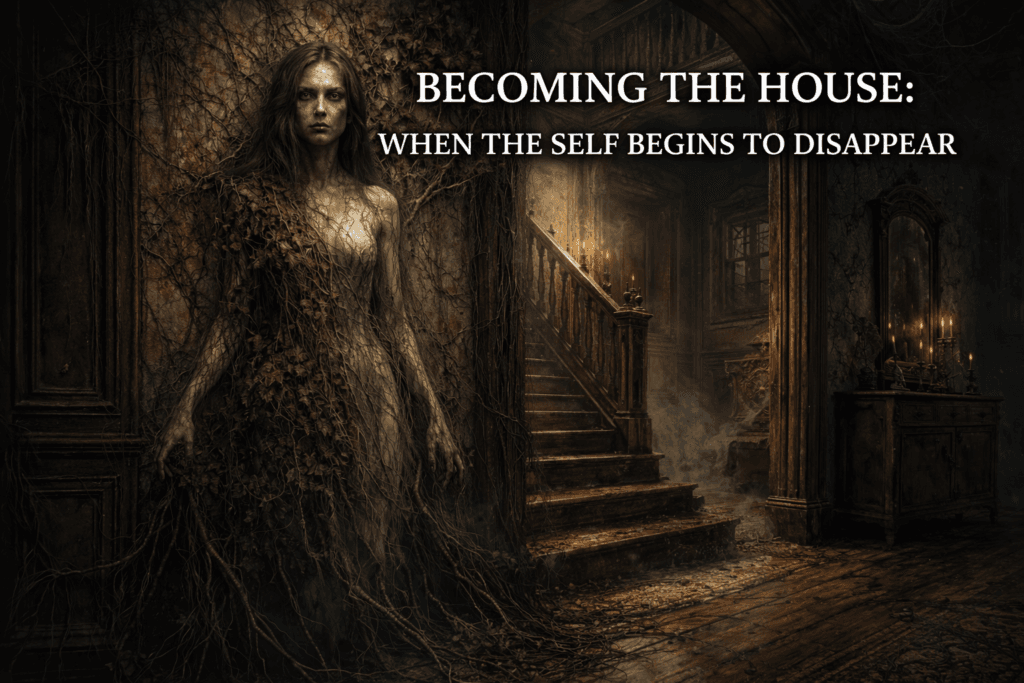
You are no longer fully contained within your body. Your presence is distributed across routines, rooms, and expectations. Others may sense you without seeing you. Your absence may feel more noticeable than your presence.
This is not death. It is dissolution.
The self becomes atmosphere.
This condition is why gothic horror often replaces ghosts with caretakers, watchers, or silent figures who seem inseparable from the house itself. They are not possessed. They are integrated.
They do not haunt.
They maintain.
Why Resistance Weakens Over Time
Resistance fades not because the house grows stronger, but because the self grows tired.
Fighting erosion requires constant reaffirmation of boundaries: I am separate. I am autonomous. I will leave. Each repetition consumes energy. The house consumes nothing.
Over time, the imbalance becomes unsustainable.
The house remains unchanged.
The self adapts.
Eventually, adaptation feels rational. The self relinquishes functions one by one—not under duress, but under pragmatism.
This is the true horror of becoming-the-house narratives: the logic of surrender is sound.
The Door That Still Matters
Importantly, the door never disappears.
The threshold remains. The option to leave persists. What changes is its meaning. Crossing it would require reconstructing a self no longer fully intact. The cost feels disproportionate to the benefit.
The house does not lock you in.
It convinces you that staying preserves more of what remains.
This is where identity erosion differs from imprisonment. There is no antagonist, no decisive moment, just as described in my previous post, Gothic Prison. There is only ongoing accommodation.
Becoming a Transitional Figure
As erosion stabilizes, the character often becomes a transitional presence.
They welcome newcomers. They explain rules gently. They enforce silence where needed. They present the house as manageable, even kind.
Without recognizing it, they become part of the house’s onboarding process.
This role does not require awareness.
It requires consistency.
In this way, identity erosion sustains itself. The house does not need to change. The self changes to support it.
When the House Gains a Keeper
In The Foundation Beneath Us, the house outlasts the need for separation. Identity thins as the self adapts to routines and silences, shifting from inhabitant to caretaker. The foundation carries the weight the self no longer does.
Not an Ending, But a State
Becoming the house is not a conclusion.
It is a condition that allows variation, delay, and further transformation. Some selves resist longer. Some erode faster. Some maintain fragments of autonomy indefinitely.
The house accommodates all of them.
This openness is why identity erosion remains fertile ground for expansion. The condition does not resolve. It deepens. It shifts. It expresses differently depending on who enters and what they bring with them.
The self is never fully gone.
It is redistributed.
Why This Horror Persists
Readers respond to becoming-the-house horror because it reflects real experience.
People adapt to environments that demand less resistance. They accept roles that offer stability at the cost of autonomy. They remain where identity feels supported, even if diminished.
Gothic horror does not invent this process. It isolates it.
By doing so, it reveals how easily the self can thin without breaking—and how permanence can belong to place rather than person.
The Corridor Remains Open
At this point in the gothic journey, nothing is finished.
The house continues.
The self continues changing.
Identity erosion is not a destination. It is a slope—one that does not end, only levels temporarily. New stories may enter. New pressures may arise. The house will adjust. The self will adapt again.
The transformation is ongoing.
And that is what makes it unsettling