Body horror does not begin with monsters.
It begins with recognition.
At some point, the body stops feeling like shelter and starts feeling like evidence. Something shifts. Flesh behaves strangely. Pain follows patterns you did not choose. Change arrives without permission. In the most effective body horror stories, terror does not come from violence alone—it comes from the moment you realise the body is no longer aligned with the self.
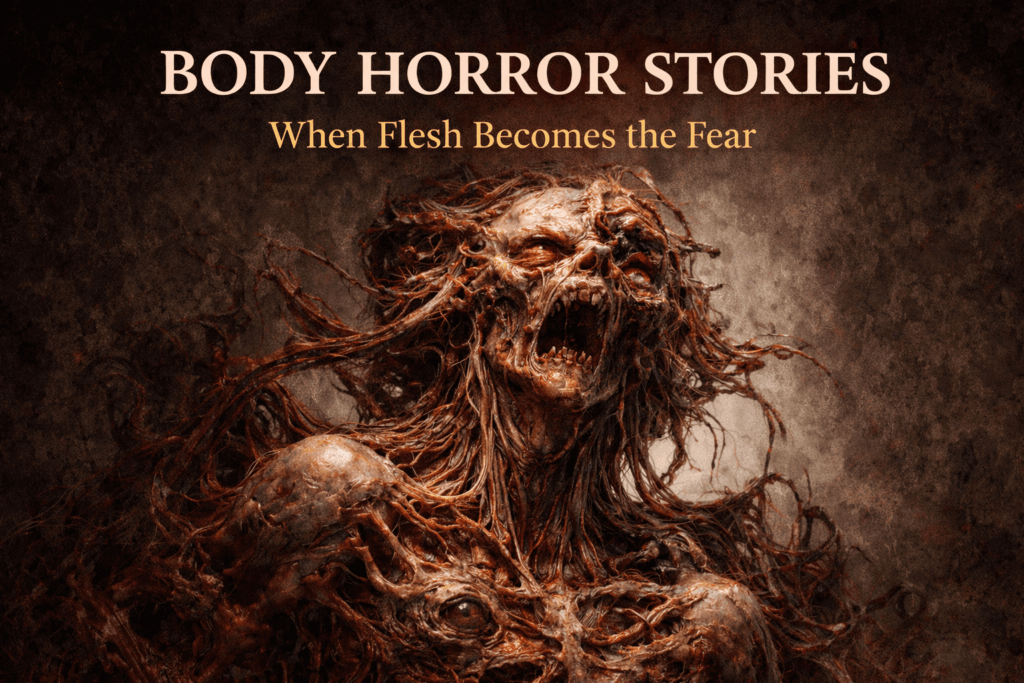
This is the defining feature of body horror as a genre. The threat is not external for long. Instead, the body becomes the site of fear. It transforms, betrays, absorbs, expels, or fails. The mind watches, often helplessly, as flesh carries out acts that feel deliberate yet uncontrollable.
Readers drawn to body horror are not looking for spectacle. They are looking for confrontation. They want stories that force an uncomfortable question: What if the body has its own agenda?
What Body Horror Actually Explores
Body horror explores loss of ownership.
Unlike psychological horror, which destabilises perception, or supernatural horror, which introduces an outside force, body horror turns inward. The body becomes unstable, hostile, or compromised. Pain has structure. Transformation has intent. The flesh behaves as though it remembers something the mind does not.
Several recurring themes define strong body horror stories:
- The body acting without consent
- Physical change as punishment or consequence
- Invasion, infection, or contamination
- Extraction, removal, or consumption of flesh
- The body becoming a vessel rather than a self
These stories disturb because they remove the final assumption of safety: that the body belongs to you.
Why Body Horror Feels So Personal
Body horror bypasses distance.
You can close a door against a monster. You can flee a haunted house. You cannot leave your body. Because of this, body horror creates a uniquely intimate dread. Every sensation becomes suspicious. Every ache feels loaded with meaning.
Moreover, the genre often avoids clear villains. The body itself becomes the antagonist—not through malice, but through inevitability. Change occurs. Damage accumulates. Resistance fails.
This is why body horror stories linger long after reading. They do not resolve fear. They embed it.
The Body as a Site of Punishment
Many body horror narratives frame physical suffering as earned, even when the reason is unclear.
The body becomes a ledger. Flesh is altered, removed, or damaged to balance a debt the character may not understand. Pain arrives with ritual precision. The horror comes not from chaos, but from order.
This form of body horror resonates deeply with readers who are drawn to stories of consequence rather than randomness. The idea that the body can be judged—and forced to pay—creates a moral unease that pure violence cannot achieve.
One of the clearest examples of this theme appears in The Tooth Collector, where extraction is not incidental. Removal becomes deliberate. The body is not attacked; it is used. Each act reinforces the sense that flesh is currency rather than self.
Transformation Without Escape
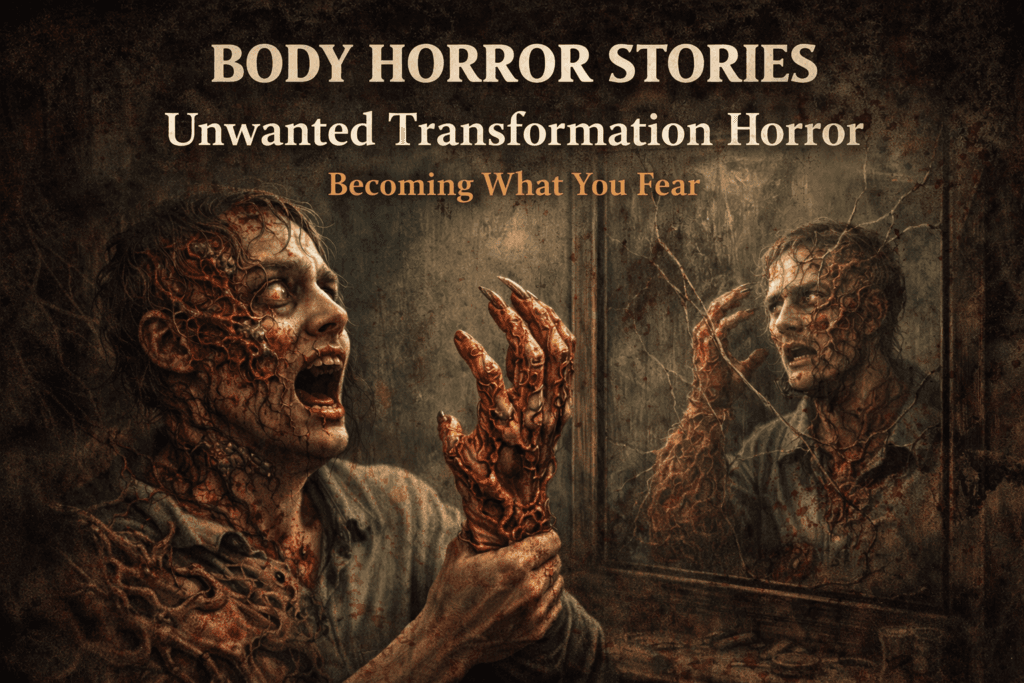
Transformation sits at the heart of body horror.
Unlike metamorphosis stories that promise rebirth, body horror transformations rarely improve anything. Change degrades. It limits. It traps. The body becomes something else, and that “something” is worse.
Crucially, transformation in body horror is rarely reversible. Once the body changes, it does not return. This finality creates dread rooted in permanence.
Readers who gravitate toward this theme are often responding to a deeper fear: that identity is fragile, and the body may not preserve it.
This slow, inevitable alteration defines Marked by the Deep, where the body does not merely endure harm—it absorbs it. Change unfolds gradually, but it never stops. The horror comes from watching the self dissolve as the body adapts to something it should not survive.
The Body as a Vessel
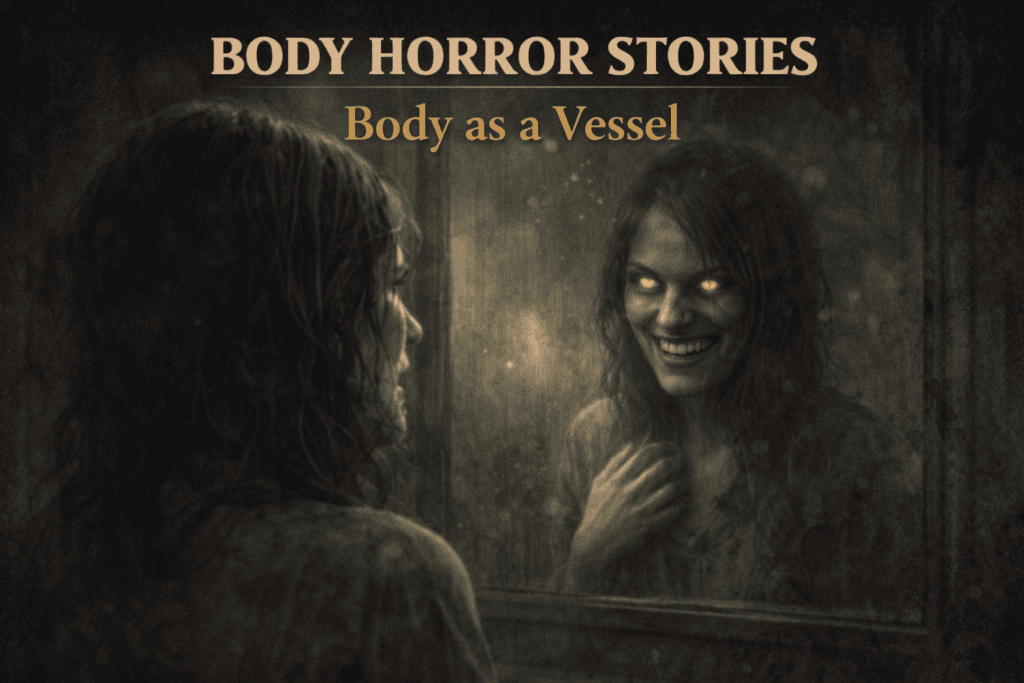
Another core pillar of body horror is the idea that the body can be occupied.
Sometimes the invading force is literal—parasites, entities, or growths. Other times it is abstract: impulses, compulsions, or urges that feel foreign. Regardless of form, the result is the same. The body becomes a container rather than a home.
This theme resonates strongly with readers who fear loss of agency more than death. The horror lies not in dying, but in continuing to live while something else takes control.
In The Bedtime Story, vulnerability and coercion turn the body into a compliant object. The terror does not escalate through gore, but through surrender. The body obeys even when the mind resists.
Extraction, Removal, and Use
Body horror frequently returns to acts of removal.
Teeth, organs, skin, blood—what is taken matters less than why it is taken. Extraction in body horror is rarely medical or merciful. It is ritualistic. It serves a purpose beyond healing.
Removal reduces the body’s wholeness. Each loss reinforces the idea that the body exists to be consumed, harvested, or broken down.
This is where body horror overlaps with themes of exploitation and control. The body is no longer an integrated self. It is a resource.
Readers drawn to this theme are often responding to anxieties around autonomy, labour, and consent—translated into flesh.
Why Infection and Contamination Terrify
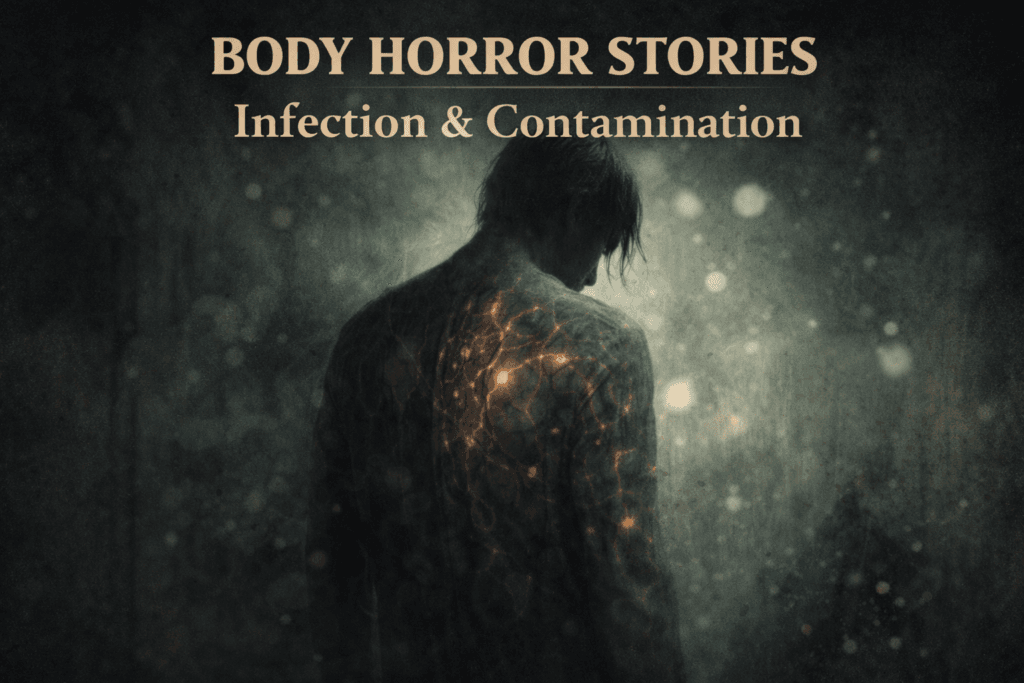
Infection-based body horror introduces inevitability.
Once contamination begins, it spreads. The body becomes hostile terrain. The self loses the ability to contain what is happening. Clean boundaries dissolve.
The horror intensifies because infection ignores intention. Good behaviour does not stop it. Awareness does not reverse it. The body responds on its own terms.
This theme amplifies the core fear of body horror: that the body does not require permission to change.
Evidence, Aftermath, and the Living Body
Some of the most unsettling body horror stories do not focus on the act itself, but on what remains.
Bruises appear. Pain lingers. Scars form without explanation. The body carries proof of events the mind cannot recall or rationalise.
This emphasis on aftermath forces the reader into an investigative role. The body becomes a crime scene. Each sensation is a clue.
The fear deepens because the body continues to live. Evidence walks around inside skin. There is no distance from the damage.
This logic reaches its most complete expression in Signed in Blood, where the body carries consequences forward. Harm is not isolated to a moment. It persists, reinforcing the idea that the body remembers what the self would rather forget.
Why Readers Seek Body Horror Stories
Readers who seek body horror are not thrill-seekers. They are recognition-seekers.
They want stories that articulate fears they already carry: fear of illness, loss of control, aging, coercion, invasion, and irreversibility. Body horror gives these anxieties form.
The genre offers no comfort. Instead, it offers honesty. It acknowledges that bodies fail, betray, change, and suffer—often without explanation.
For many readers, that acknowledgement is more compelling than resolution.
Body Horror as a Complete Descent
At its best, body horror functions as a closed system.
The body begins as shelter.
It becomes unstable.
It transforms, betrays, or is used.
It remains altered.
There is no return to innocence. The body does not reset. The self must adapt—or disappear.
This is why body horror stories feel complete even when they are brief. They do not need elaborate worlds. They need only flesh, consequence, and inevitability.
Featured Body Horror Reads
For readers who want to explore the full range of body horror’s thematic depth, the following works embody the genre’s core fears:
- The Tooth Collector — ritual extraction and the body as payment
- Marked by the Deep — irreversible transformation and absorption
- The Bedtime Story — vulnerability, coercion, and bodily surrender
- Signed in Blood — consequence carried forward in flesh
Each approaches body horror differently. All share one conviction: the body cannot be trusted to remain yours.
Why Body Horror Endures
Body horror endures because it does not depend on trends.
As long as bodies age, fail, and suffer, the genre will remain relevant. It adapts easily to new fears—medical, social, psychological—while retaining its core premise.
The body is not a neutral vessel. It remembers. It acts. It changes.
For readers who want horror that does not look away from that truth, body horror remains one of the genre’s most uncompromising forms.