
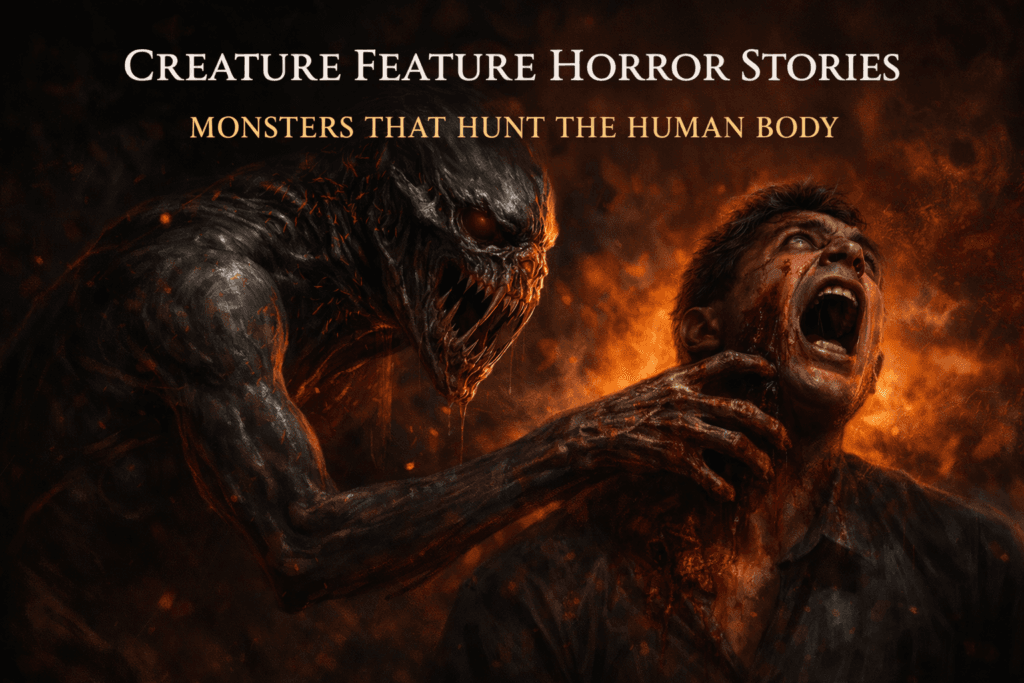
Creature feature horror stories do not begin with uncertainty. Instead, they begin with contact. Something has already entered the environment. Something has already adapted to it. Therefore, by the time the human body becomes aware of danger, the encounter has already started.
Because of this, these stories operate on a different psychological frequency than other horror forms. Rather than asking what might happen, they establish what will happen once the body is discovered. Consequently, fear does not arise from mystery alone. It arises from recognition.
You may not see the creature immediately. However, your breathing changes. Your muscles tense. Your instincts sharpen. And although your mind searches for reassurance, your body already understands the truth.
You are not safe.
What Defines Creature Feature Horror Stories
Creature feature horror stories are defined by consequence rather than atmosphere. While mood still matters, physical outcome matters more. Therefore, these stories focus relentlessly on what happens to the body once the creature closes distance.
Unlike psychological horror, which corrodes perception over time, creature feature horror stories apply pressure immediately. The threat is external. The damage is measurable. And once the encounter escalates, recovery rarely follows.
Because the creature exists independently of belief, the story does not pause to justify its presence. Instead, it demonstrates impact. Teeth puncture skin. Pressure collapses lungs. Darkness removes orientation. Water steals breath. As a result, the reader does not imagine fear—they inhabit it.
This is why creature feature horror stories feel visceral even on the page. The body reacts before language finishes its work.
The Core Fear: The Body Is Not Safe Anywhere
At the center of all creature feature horror stories lies a single, unyielding fear: the human body is accessible. It can be tracked, cornered, entered, altered, harvested, or erased.
Although modern life encourages the illusion of control, these stories dismantle that belief methodically. Even when characters prepare, plan, or fortify themselves, their bodies remain vulnerable. Therefore, safety becomes temporary rather than absolute.
The body cannot relocate fast enough. It cannot heal instantly. It cannot adapt as quickly as the creature. Consequently, once contact occurs, the body begins to fail in stages.
First comes hesitation. Then panic. Then fatigue. Finally, injury removes choice altogether.
Because of this progression, creature feature horror stories do not rely on surprise endings. Instead, they rely on inevitability.
Why Readers Seek Creature Feature Horror Stories
Readers who search for creature feature horror stories are not casual browsers. Rather, they are threat-oriented readers. They want to understand danger. They want to measure it. And more importantly, they want to see how resistance collapses.
First, creature feature horror stories provide clarity. The threat is tangible. The rules are biological. Therefore, fear does not feel abstract. It feels earned.
Second, these stories remove comforting ambiguity. Although many horror subgenres allow escape through cleverness or morality, these type of horror stories deny those exits. Intelligence delays harm. Courage prolongs suffering. Neither guarantees survival.
Third, these stories replace hope with escalation. Once the creature appears, the narrative narrows. Space contracts. Time accelerates. And because the body cannot outrun consequence forever, the ending feels honest even when it is brutal.
As a result, readers who enjoy creature feature horror stories are not searching for relief. They are searching for truth.
Categories of Threat Within Creature Feature Horror Stories
Creature feature horror stories fracture into distinct threat types. Although each category exploits different vulnerabilities, all of them target the body directly.
Aquatic Creatures and the Failure of Breath
In aquatic creature feature horror stories, the environment becomes an accomplice. Water restricts movement. Sound distorts. Visibility collapses. As a result, the body enters survival mode almost immediately.
Because humans do not belong beneath the surface, even calm water introduces risk. Breath becomes currency. Panic accelerates oxygen loss. Muscles tire faster. Consequently, the creature does not need to rush.
Instead, it circles. It waits. It allows exhaustion to do most of the work.
This form of terror defines Marked by the Deep and Dark Waters. In both, the body fails long before the creature delivers the final act. Water removes fairness. Depth removes options.
Therefore, survival becomes conditional rather than achievable.
Nocturnal Creatures and the Collapse of Vision
Darkness functions as more than absence of light in creature feature horror stories. Instead, it operates as a weapon.
Once visibility disappears, orientation follows. Then confidence. Then speed. Because the human body evolved to rely on sight, darkness destabilises decision-making almost instantly.
Creatures that hunt at night understand this weakness. They move confidently while the body hesitates. They track sound while the body freezes. Consequently, fear compounds error.
They Only Visit When it’s Dark embodies this logic precisely. The creature does not overwhelm through strength alone. Instead, it waits until night removes the last illusion of safety.
In darkness, the body betrays itself.
Domestic Creatures and the Betrayal of Familiar Space
Some creature feature horror stories are most effective because they occur where the body expects protection. Homes. Bedrooms. Childhood routines.
When a creature enters a domestic environment, the body delays response. Familiarity overrides caution. As a result, the moment of recognition arrives too late.
The body freezes not because it is weak, but because it is confused.
The Tooth Collector weaponises this delay. It turns ritual into exposure. It transforms innocence into access. Consequently, the body becomes vulnerable precisely because it trusts its surroundings.
Once the creature establishes itself inside the home, escape becomes psychological before it becomes physical. The body remains trapped because it believes it should be safe.
Harvesting Creatures and the Violation of Ownership
Some creature feature horror stories do not kill immediately. Instead, they take. Teeth. Skin. Blood. Memory.
These creatures introduce a different fear: survival without integrity. The body remains alive, yet altered. Pain lingers. Identity fractures. And because the damage cannot be undone, escape loses meaning.
This category proves that death is not the worst outcome. Transformation is.
Once the creature claims ownership over part of the body, the body no longer feels like home.
Why Survival Rarely Lasts
Survival fails in creature feature horror stories because the creature adapts faster than the body.
Humans rely on patterns. Creatures exploit them. Humans trust senses. Creatures distort them. Humans assume rules apply. Creatures rewrite them.
Even temporary escape carries cost. Injury slows movement. Fear clouds judgment. Fatigue removes precision. Consequently, the creature does not need to win immediately.
It only needs time.
Because the body cannot maintain peak performance indefinitely, collapse becomes inevitable. The creature understands this. The body does not.
Inevitability as the Engine of Fear
What separates creature feature horror stories from thrillers is inevitability. Thrillers promise escape. Creature stories promise consequence.
Once the creature becomes aware of the body, the narrative enters a countdown. Choices narrow. Space contracts. Time accelerates. Because the body cannot negotiate biology, the outcome becomes a matter of duration rather than possibility.
This is not nihilism. It is realism.
Bodies age. Bodies break. Bodies fail.
Creature feature horror stories simply remove the buffer.
Why These Stories Create Buyer-Ready Readers
Readers who finish creature feature horror stories rarely stop with one. Instead, the experience creates appetite. Once the body has been threatened in one way, the reader wants to explore how it fails elsewhere.
This is why collections such as Marked by the Deep, Dark Waters, The Tooth Collector, and They Only Visit When it’s Dark resonate so strongly. Each explores a different method of bodily vulnerability, yet all confirm the same conclusion.
There is no safe version of the human body.
These books do not sell comfort. They sell inevitability. And readers who seek creature feature horror stories recognise the value of that honesty.
Final Reckoning
Creature feature horror stories do not ask for belief. Instead, they demand recognition. The body understands danger long before language frames it, and once that understanding settles in, it does not fade quietly.
These stories linger because they expose a truth that cannot be argued away: flesh can be tracked, cornered, opened, and changed. Safety is temporary. Familiarity is exploitable. Survival is conditional.
Once the creature notices you, the outcome no longer depends on courage or intelligence. It depends on how long the body lasts—and how much of it remains when the encounter ends.