
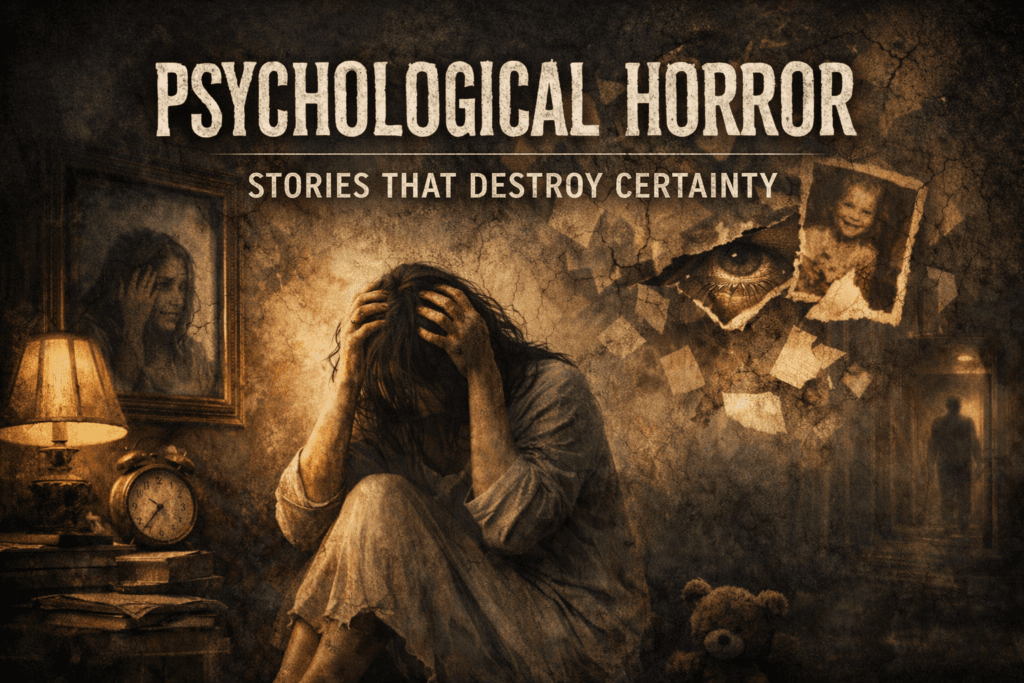
The most disturbing horror doesn’t rush you. It doesn’t shout. It doesn’t even try to scare you outright.
It sits quietly in your mind and begins to rearrange things.
Psychological horror works by erosion. It chips away at certainty—about what you saw, what you remember, and what you thought you understood about yourself. The fear doesn’t arrive as a moment. It unfolds as a realization. Something is wrong, but you can’t quite prove it.
These stories don’t rely on gore or spectacle. They don’t need monsters to stalk the hallways or violence to hold your attention. Instead, they infect the reader with doubt. They make you question the reliability of the narrator. The safety of familiar spaces. The stability of memory itself.
If you’ve ever finished a story and felt unsettled not because of what happened—but because of what might have happened—then you already understand the power of psychological horror.
This guide exists for readers who seek that experience deliberately.
What Psychological Horror Actually Attacks
Psychological horror isn’t defined by what it contains. It’s defined by what it undermines.
Rather than threatening the body, these stories threaten perception. They distort the mental scaffolding that keeps reality feeling solid. You don’t fear what’s outside the door—you fear what your own mind might be hiding from you.
At its core, psychological horror targets a few fragile human assumptions:
- That memory is reliable
- That perception can be trusted
- That identity is stable
- That reality behaves consistently
When those assumptions crack, fear seeps in.
The dread in psychological horror often builds slowly, almost politely. The reader is allowed to settle into normalcy before subtle inconsistencies begin to appear. A thought that doesn’t quite belong. A memory that won’t line up. A voice that might be internal—or might not.
The horror comes from recognizing the pattern before the characters do.
For Readers Who Don’t Want Gore to Do the Work
Many horror readers eventually discover a limit—not because they’re squeamish, but because shock wears thin. Gore delivers an immediate reaction, but it fades quickly. Once the image passes, so does the fear.
Psychological horror offers something different.
Instead of forcing fear through intensity, it earns fear through intimacy. It lingers because it feels personal. The threat isn’t external—it’s internal, woven into thought patterns and emotional responses the reader recognizes.
If you’ve ever found yourself bored by excessive violence or unmoved by jump-scare writing, that doesn’t mean you’ve outgrown horror. It means your taste has sharpened.
Psychological horror rewards readers who want to feel watched, doubted, or mentally cornered rather than startled.
When Reality Starts to Slip
One of the most powerful tools in psychological horror is reality instability.
These stories don’t announce their distortions. They introduce them quietly—through conflicting memories, unreliable narrators, or documents that contradict lived experience. The reader is forced into an uncomfortable position: deciding what to trust without enough information to be confident.
This uncertainty is deliberate.
When a story refuses to confirm whether events are supernatural, psychological, or something in between, it traps the reader in the same confusion as the characters. The tension comes not from answers, but from their absence.
A particularly effective example of this approach is found in found-text psychological horror stories like The Diary of Cabin 313, where journals and written accounts begin to contradict one another—and eventually, the narrator himself. The fear doesn’t come from what’s written on the page, but from realizing the writing may be rewriting the truth.
In stories like this, every new detail destabilizes rather than clarifies.
Horror That Corrupts the Familiar
Psychological horror is especially effective when it targets comfort.
Childhood routines. Domestic spaces. Bedtime rituals. These are places where the mind expects safety. When horror infiltrates them, the violation feels deeper—and harder to shake.
Stories that twist innocence don’t rely on cruelty. They rely on contrast. A gentle tone paired with unsettling intent. A loving gesture that feels slightly wrong. A familiar act that becomes oppressive through repetition.
This is why slow-burn psychological horror stories such as Bedtime Story resonate so strongly. The terror grows from concern, not threat. From care, not malice. The reader feels unease precisely because the situation should feel safe.
When fear hides behind tenderness, it becomes far more effective.
Sound, Silence, and Sensory Dread
Not all psychological horror relies on complex narrative structures. Some of the most effective stories use sensory triggers—particularly sound.
A noise that shouldn’t repeat. A giggle where silence should exist. A rhythm that doesn’t stop.
Auditory horror bypasses logic. Sound reaches the mind before meaning does, which makes it ideal for unsettling the reader without explanation. Repetition amplifies this effect. The longer a sound persists, the more invasive it feels.
In psychological horror stories like The Midnight Giggles, sound becomes a presence rather than an event. It doesn’t escalate dramatically—it persists. And persistence is often more disturbing than intensity.
Silence plays an equal role. Long stretches without confirmation allow the reader’s mind to fill the gaps. Psychological horror trusts the imagination to do more damage than explicit description ever could.
Isolation Without Escape
Another defining feature of psychological horror is inescapability.
Characters aren’t trapped because of locked doors or remote locations alone. They’re trapped because no one else can fully perceive what they’re experiencing. Even when others are present, help feels inaccessible.
This type of isolation isn’t about being alone—it’s about being unbelieved.
Psychological horror often places characters in environments where seeking help would require admitting something impossible, irrational, or shameful. The longer they hesitate, the more the situation worsens.
Stories built around this tension create claustrophobia without physical confinement. The mind becomes the smallest room of all.
Slow-Burn Horror That Pays Off
Psychological horror rarely rewards impatience.
These stories are structured to simmer rather than explode. The pacing mirrors mental unraveling: gradual, uneven, and difficult to reverse. Each small disturbance compounds the last until the reader realizes they’ve crossed a threshold without noticing.
This slow-burn approach creates a deeper payoff. Instead of a single scare, the reader is left with lingering unease. The story continues to echo after it ends.
Readers who appreciate this style often find themselves thinking about the story days later—replaying scenes, questioning interpretations, wondering what they missed the first time.
That lingering quality is not accidental. It’s the goal.
Horror That Doesn’t Let You Go
The most effective psychological horror doesn’t end cleanly.
It doesn’t offer reassurance or resolution. It leaves questions unanswered—not because the author forgot to answer them, but because certainty would weaken the impact.
These stories resist closure. They settle into the reader’s mind like an unresolved thought, resurfacing unexpectedly. The fear isn’t relived—it’s reinterpreted.
When readers say a story “stayed with them,” this is what they mean. Not constant terror, but persistent unease. A subtle shift in how familiar things feel.
That after-effect is the true mark of psychological horror done well.
Choosing the Right Psychological Horror for You
Psychological horror is not a single flavor. Some readers gravitate toward ambiguity and unreliable narration. Others prefer sensory dread or slow corruption of the familiar. Knowing what unsettles you most makes the experience far more effective.
If you’re drawn to fractured narratives and mental collapse, The Diary of Cabin 313 explores the terror of not trusting your own written thoughts.
If corrupted innocence and domestic dread unsettle you, Bedtime Story channels fear through care, routine, and parental instinct.
If sound, repetition, and lingering unease disturb you more than spectacle, The Midnight Giggles offers horror that lives in echoes rather than images.
Each of these psychological horror stories attacks the mind from a different angle—but none rely on shock value to do the work.
Start Where You Feel Least Comfortable
Psychological horror works best when it meets resistance. When it presses against a fear you’d rather avoid naming.
If uncertainty unsettles you, start there.
If familiarity turning hostile makes you uneasy, lean into it.
If quiet persistence disturbs you more than violence ever could, follow that instinct.
These stories aren’t designed to overwhelm. They’re designed to stay.
If this kind of horror unsettles you, start here.