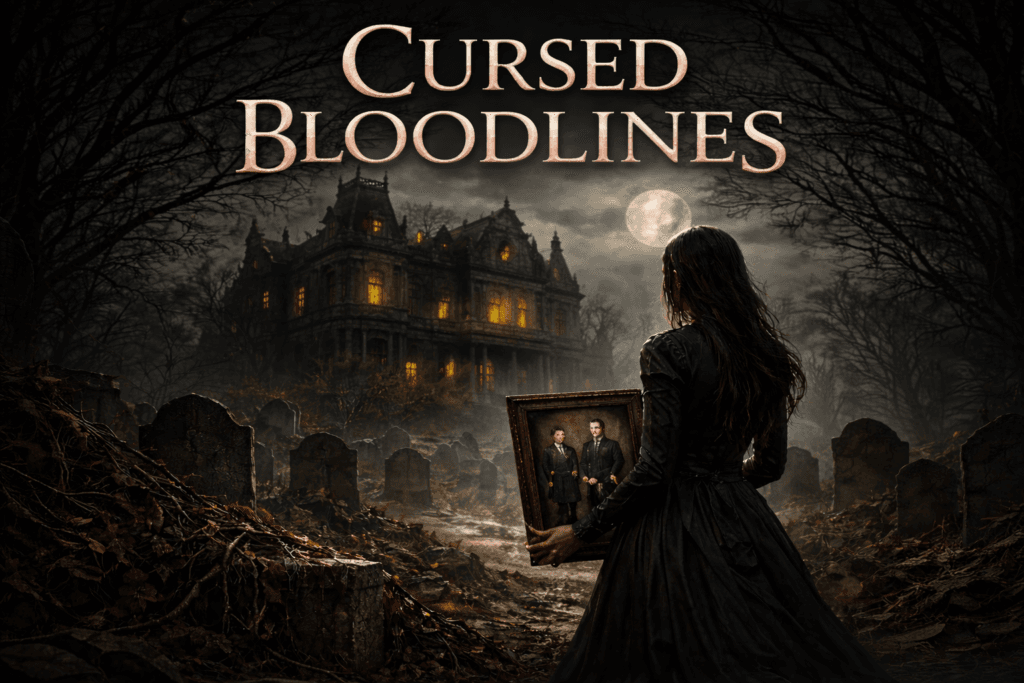
Some guilt does not belong to the one who feels it.
It arrives earlier than memory. It settles before choice. In gothic horror, blood is never neutral—it carries weight, obligation, and consequence long before a character understands what has been inherited. This is the quiet terror at the heart of cursed bloodlines horror: responsibility without consent, punishment without crime, and guilt that exists without origin.
This inherited dread sits at the very core of the genre itself. Gothic horror has always been less concerned with what characters do than with what they are forced to carry. That broader framework—where memory, lineage, and place converge—is explored throughout Gothic Horror Stories, where inheritance is treated as destiny rather than background.
Nothing announces the curse at first. Instead, it manifests as unease—patterns that repeat, mistakes that feel rehearsed, lives that unfold along tracks laid down generations earlier. By the time recognition dawns, the burden already feels permanent.
Blood as Memory, Not Biology
Gothic horror treats lineage as memory rather than biology.
Names repeat. Faces echo. Choices mirror earlier failures with unsettling precision. In cursed bloodlines horror, ancestry does not merely influence the present—it directs it. Characters do not stumble into ruin by chance. They inherit it fully formed.
This inheritance rarely comes with explanation. Records remain incomplete. Stories contradict one another. What survives are fragments: warnings never clarified, rituals performed without understanding, silences carefully preserved.
The absence of clarity does not weaken the curse.
It strengthens it.
Without a clear origin, guilt becomes communal. No single generation bears full responsibility, yet none escape consequence.
Why the Past Refuses to Stay Buried
In gothic storytelling, the past never ends cleanly.
Instead, it seeps forward through habits, expectations, and unspoken rules. Families develop instincts they cannot explain. Certain paths feel forbidden without reason. Certain sacrifices feel inevitable.
This persistence creates one of the genre’s most unsettling truths:
the past does not haunt because it is unresolved—it haunts because it is still active.
Cursed bloodlines horror draws its power from this continuity. The present generation believes itself modern, enlightened, free. Yet when pressure mounts, they respond exactly as their ancestors did.
Not because they must.
Because they were trained to.
The Estate as a Bloodline Archive
Gothic families rarely live in neutral spaces.
Estates, manors, and ancestral homes do more than shelter generations—they preserve them. These structures function as moral archives, storing grief, crimes, and silences that bloodlines quietly obey. Walls remember what families refuse to say. Corridors enforce habits long after their purpose is forgotten.
This architecture of inheritance is examined deeply in Old Estates, where place and lineage become inseparable. The estate does not merely witness history—it conditions the present, shaping behaviour until deviation feels unnatural.
In cursed bloodlines horror, the home does not accuse.
It confirms.
This same logic underpins The Foundation Beneath Us, where inheritance is not symbolic but structural. The characters do not live with the past—they live on top of it, supported by foundations already compromised long before they arrived.
Guilt Without a Crime
Perhaps the most disturbing element of cursed bloodlines horror is guilt without agency.
Characters feel responsible for outcomes they did not cause. They carry shame for actions they did not commit. Even when they behave ethically, consequence arrives unchanged.
This imbalance produces a specific dread:
what if morality does not matter?
Gothic horror does not answer this question directly. Instead, it forces characters to live inside it. Attempts at virtue feel futile. Redemption feels inaccessible. The only certainty is continuation.
This is not nihilism.
It is inheritance taken seriously.
The Illusion of the Original Sin
Many cursed bloodline narratives gesture toward an origin point—a betrayal, a pact, a crime that “started everything.” Yet gothic horror rarely allows this origin to remain stable.
Accounts differ. Motives blur. Evidence erodes.
Over time, the idea of a single original sin collapses. What remains is a pattern of harm so old that no one remembers its beginning. The curse persists not because of what happened once, but because of what keeps happening.
This uncertainty removes the possibility of repair.
If no one knows where the fault lies, no one knows how to atone.
And so the cycle continues.
Love as the Curse’s Most Effective Mask
Cursed bloodlines rarely survive through fear alone.
They survive through love.
Parents protect children by withholding truth. Children honour parents by repeating mistakes. Loyalty becomes obedience. Care becomes silence.
In this way, affection sustains the curse more effectively than any supernatural force. Characters choose preservation over confrontation, believing that maintaining family identity matters more than personal freedom.
This quiet endurance mirrors the inevitable decline explored in The Beauty of Ruin, where collapse feels predetermined rather than tragic. In both cases, survival replaces resistance.
The family persists.
The individual erodes.
When Leaving Feels Like Betrayal
Gothic bloodline horror punishes escape subtly.
Those who attempt to leave are not chased—they are reframed. They become the selfish one, the traitor, the source of shame. The family preserves itself by rewriting departure as cruelty.
Yet even exile offers no true freedom. Distance dulls the immediate pressure, but inheritance persists. Memories return. Patterns resurface. The guilt follows.
In cursed bloodlines horror, escape is not forbidden.
It is incomplete.
Fate Disguised as Choice
One of the genre’s most effective techniques is disguising fate as choice.
Characters believe they are deciding freely. They make the same mistakes willingly. Only later do they realise every option led to the same outcome.
This delayed recognition creates dread without spectacle. The horror does not lie in the loss of freedom, but in the realisation that freedom never existed.
Cursed bloodlines horror thrives on this revelation.
By the time it arrives, resistance feels pointless.
Inheritance as the Final Prison
Unlike haunted houses or decaying relationships, bloodline curses cannot be abandoned easily.
You can leave a building.
You can end a relationship.
You cannot leave your name.
Long before names repeat and sins resurface, the estate itself has already enforced memory. That silent preparation—of space shaping behaviour—is central to Old Estates, where architecture becomes the first inheritor of guilt.
This permanence gives cursed bloodlines horror its enduring power. The threat does not wait in shadows or walls. It lives inside identity itself.
And because identity feels essential, surrender feels inevitable.
The Reader’s Recognition
Gothic horror does not invent ancestral dread.
It names it.
Readers recognise the quiet weight of expectations passed down without explanation. They understand how guilt can exist without wrongdoing, how obligation can outlive love.
The genre does not offer escape.
It offers clarity.
And clarity, in gothic horror, often arrives too late to matter.
Where the Corridor Leads
Once blood becomes burden, the gothic corridor narrows sharply.
What follows is not discovery, but consequence. Identity dissolves into role. The self gives way to the inheritance accepted long ago.
Cursed bloodlines horror does not promise resolution.
It promises continuation.
Because some sins do not end.
They wait to be inherited.