Some horror harms the body by accident.
However, flesh-as-punishment horror harms the body on purpose.
In the most uncompromising extreme horror fiction, suffering does not arrive randomly. Instead, it is assigned. Someone decides that pain is owed. Consequently, the body becomes the ledger where that debt is paid.
This cluster does not deal in misfortune. It deals in judgment. The flesh is not collateral damage; rather, it is the currency. Readers drawn to this form of extreme horror are not searching for comfort or implication alone. Instead, they want narratives where suffering has meaning and where escape is morally denied.
What Flesh as Punishment Horror Actually Is
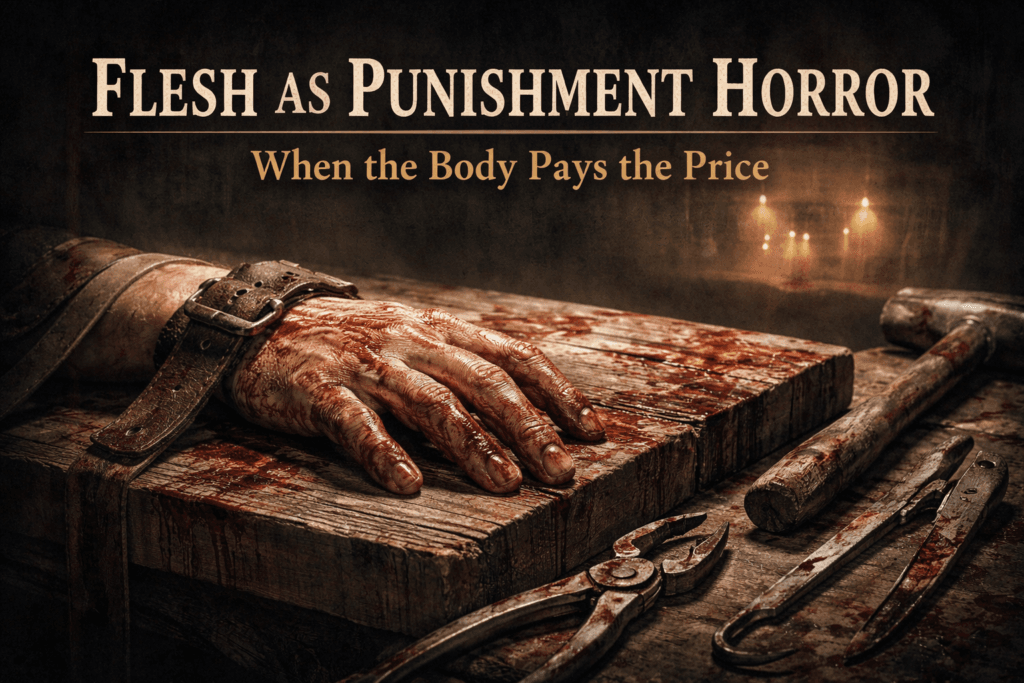
Flesh as punishment horror centres on intentional suffering as consequence.
Unlike vulnerability-driven horror, the body here may still function. Unlike extraction stories, removal may not be the primary goal. Instead, the act exists to enforce judgment. Pain becomes the message. Damage becomes proof.
Several traits define flesh-as-punishment narratives within extreme horror fiction:
- Harm is deliberate, not accidental
- Suffering follows a rule, law, or belief
- The body becomes the site of judgment
- Relief is withheld because punishment must be completed
As a result, the horror feels heavier. The reader understands that nothing about the suffering is incidental.
Why Punishment Is More Disturbing Than Violence
Violence implies chaos. Punishment implies order.
In extreme horror fiction, punishment terrifies because it suggests that pain is justified. Someone has weighed the act. Someone has decided that the body deserves what happens next. Therefore, suffering carries authority.
This authority removes hope. If harm is deserved, then resistance becomes irrelevant. The body must endure because endurance completes the sentence.
Consequently, flesh-as-punishment horror lingers longer than random brutality.
The Body as a Moral Surface
In flesh-as-punishment stories, the body records judgment.
Marks appear. Damage accumulates. Pain persists. Each change functions as evidence that punishment has occurred. The body becomes a visible archive of wrongdoing.
Because the punishment is embodied, it cannot be argued away. Words do not erase scars. Appeals do not restore flesh. As a result, the horror becomes permanent.
This permanence distinguishes flesh-as-punishment horror from momentary harm.
Punishment Requires Control Before Pain
Punishment cannot proceed without control.
Before judgment can be enforced, autonomy must disappear. The body must stop resisting. For this reason, flesh-as-punishment horror connects directly to Loss of Bodily Autonomy, even when the narrative focus shifts elsewhere.
Moreover, punishment often progresses into Extraction & Harvesting. Once suffering is justified, removal becomes acceptable. Flesh can be taken because it has already been condemned.
This escalation transforms pain into process.
Ritual, Law, and the Illusion of Fairness
Flesh-as-punishment horror often hides behind systems.
Rituals demand payment. Laws prescribe consequence. Traditions enforce suffering. Because these systems appear orderly, the horror feels rationalised rather than sadistic.
In extreme horror fiction, this rationalisation is deeply unsettling. The reader watches characters comply with cruelty because rules demand it. Resistance becomes heresy rather than survival.
As a result, the body becomes trapped inside belief.
When the Body Betrays the Self
Punishment does not always come from outside.
In many flesh-as-punishment narratives, the body itself enforces judgment. Pain intensifies without external cause. Injuries worsen. Healing refuses to occur. The flesh seems to agree with the sentence.
This internalisation aligns flesh-as-punishment horror with Body Betrayal, where the body turns against the self as consequence. The character cannot escape because their own flesh has accepted the verdict.
This betrayal deepens the horror by removing the final refuge.
Endurance as the Only Option
Flesh-as-punishment horror rarely offers escape.
Characters do not outwit the system. They do not overpower their judges. Instead, they endure. Survival becomes secondary to completion. The body must absorb suffering until the punishment concludes—or until nothing remains.
In extreme horror fiction, this endurance is the point. The reader is not meant to feel relief. They are meant to feel the weight of inevitability.
Why Extreme Horror Fiction Thrives on Punishment
Extreme horror fiction excels at flesh-as-punishment narratives because it does not soften consequence.
The genre allows suffering to remain unresolved. It permits endings where punishment outlasts the story. Therefore, the reader carries the sentence forward.
Because the horror is intentional, it feels earned rather than exploitative. The story does not shock for shock’s sake. It enforces meaning through pain.
Flesh as Punishment Within Body Horror Stories
Within Body Horror Stories, flesh-as-punishment occupies the severity peak.
This cluster does not introduce harm. It finalises it. Where vulnerability exposes the body and extraction uses it, punishment condemns it. The body no longer represents possibility; instead, it represents cost.
For high-tolerance readers, this cluster delivers the most uncompromising form of body horror.
Featured Extreme Horror Read: The Tooth Collector
Few works embody flesh-as-punishment horror as cleanly as The Tooth Collector.
In this story, removal is not random. Teeth are taken as payment. Each act reinforces judgment. Pain functions as accounting, not chaos.
The horror unfolds through deliberation. Nothing is rushed. Nothing is forgiven. The body pays exactly what is owed.
For readers seeking extreme horror fiction where suffering carries meaning, The Tooth Collector stands as a precise example.
Why Flesh as Punishment Horror Endures
Flesh-as-punishment horror endures because it confronts a primal fear: the fear that suffering might be justified.
If pain has purpose, then innocence offers no protection. The body becomes vulnerable not because it is weak, but because it has been judged.
For readers who want extreme horror fiction that does not flinch, flesh-as-punishment remains one of the genre’s most unforgiving expressions.