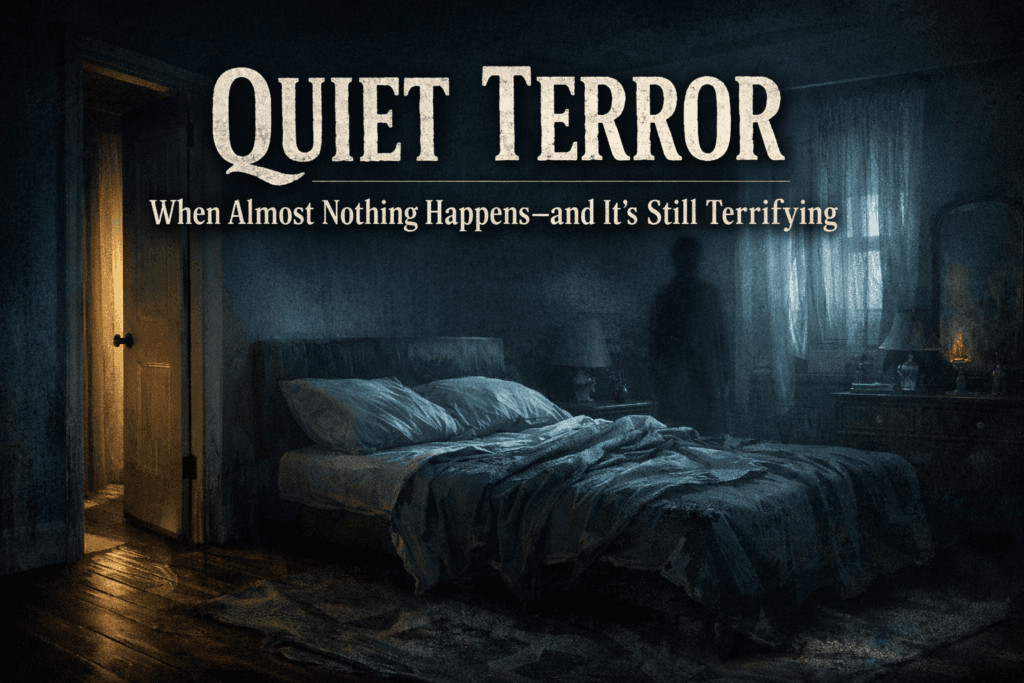
Some horror relies on escalation.
Quiet terror relies on restraint.
In supernatural horror, there exists a strain of fear that does not announce itself with spectacle or violence. Instead, it settles into the background of a story, almost imperceptible at first. Scenes unfold with minimal disruption. Events appear ordinary. Nothing obvious happens. Yet, the reader feels increasingly uneasy, unable to identify a single cause. That unease is not accidental. It is engineered.
Quiet terror operates by denying release. Rather than shocking the reader, it keeps them suspended in anticipation. The absence of action becomes the threat. The silence becomes oppressive. As a result, fear accumulates gradually and refuses to dissipate.
For experienced readers, this approach often proves more disturbing than overt horror. The stories that linger are not the ones that overwhelmed them, but the ones that never let them relax.
What Quiet Terror Actually Is
Quiet terror does not mean subtle horror in the decorative sense.
It means structural restraint.
In stories driven by quiet terror, the narrative withholds escalation. Scenes stretch longer than expected. Ordinary interactions feel strained. Familiar environments seem slightly altered, though never dramatically enough to justify alarm. The reader senses that something is wrong, but the story refuses to confirm it.
This refusal forces the reader into a state of vigilance. Instead of reacting to events, they wait for them. That waiting becomes the source of dread.
Unlike faster horror, which cycles through tension and release, quiet terror sustains tension continuously. Nothing resolves. Nothing reassures. The reader remains inside unease for extended periods.
Why the Absence of Action Creates Stronger Fear
Fear intensifies when expectation goes unmet.
In quiet terror, the reader expects escalation. They anticipate intrusion, confrontation, or explanation. When those moments fail to arrive, anxiety grows rather than fades. The story trains the reader to expect something, then denies them the relief of confirmation.
This denial creates psychological pressure. Each scene feels like it is holding something back. Every pause becomes meaningful. The reader starts to fear not what happens, but what might.
Because the story never offers release, fear compounds. Instead of peaking, it deepens.
The Relationship Between Quiet Terror and Pacing
Quiet terror depends on pacing that feels deliberate rather than slow.
Scenes linger just long enough to become uncomfortable. Conversations feel slightly off. Actions repeat without clear purpose. The narrative appears calm on the surface while tension builds underneath.
This approach aligns naturally with why slow-burn supernatural horror is more disturbing, where fear accumulates through repetition and patience rather than acceleration. Both styles reject urgency in favor of sustained pressure.
However, quiet terror goes a step further by minimizing visible change altogether. The story does not merely delay escalation—it questions whether escalation will happen at all.
When Ordinary Spaces Become Unsettling
Quiet terror often embeds itself in familiar environments.
Homes, bedrooms, hallways, and domestic routines provide a sense of safety. When those spaces feel subtly altered—without obvious cause—the reader experiences unease that cannot be dismissed easily. Nothing appears overtly threatening, yet nothing feels secure.
This spatial discomfort proves particularly effective because it mirrors real anxiety. In life, fear rarely arrives with dramatic signals. Instead, it creeps in through subtle disruptions: a change in tone, an unexplainable silence, a sense of being watched without evidence.
That realism explains why quiet terror often overlaps with supernatural horror that feels real rather than theatrical. The fear emerges from believable emotional responses, not exaggerated events.
Why Quiet Terror Refuses Explanation
Explanation weakens quiet terror.
Once a story explains what is happening, fear gains boundaries. The reader can categorize the threat, anticipate its behavior, and prepare for it. Quiet terror resists this process entirely.
Instead of clarifying, these stories allow ambiguity to persist. The reader never knows whether the unease is justified, imagined, or something else entirely. That uncertainty prevents closure.
By withholding answers, quiet terror keeps the reader mentally engaged long after the story ends. The fear remains unresolved, which makes it linger.
When Waiting Becomes the Horror
One of the defining features of quiet terror is enforced waiting.
The reader waits for:
- confirmation
- escalation
- interruption
- relief
None arrives.
This waiting produces a specific kind of dread. The reader becomes hyper-aware of time, silence, and absence. Every moment feels loaded with possibility, even when nothing happens.
This structure transforms anticipation into torment. The fear does not come from an event—it comes from the knowledge that something should happen and hasn’t.
The Fear of Being Alone With No Intervention
Quiet terror often strips away external support.
Characters experience unease in isolation, without help, witnesses, or validation. When they attempt to explain what they feel, nothing convinces anyone else. The fear remains private and therefore unaddressed.
This dynamic intensifies dread because it removes the possibility of rescue. The character cannot rely on intervention. The reader cannot rely on interruption.
That sense of abandonment connects directly to supernatural horror where there is no help—stories in which the absence of assistance becomes part of the threat itself. The terror lies not in attack, but in inevitability.
Why Quiet Terror Attaches to Memory
Quiet terror often reveals itself through memory rather than action.
Characters replay moments, searching for meaning. Ordinary interactions feel retrospectively wrong. Past scenes acquire new weight without new information. The reader experiences the same retroactive unease.
This backward-facing fear is particularly effective because it destabilizes trust in experience itself. If memory cannot be relied upon, nothing can.
Rather than progressing forward, the horror deepens inward.
When the House Feels Aware
Quiet terror reaches its most unsettling form when the environment appears conscious.
Rooms seem to watch. Reflections feel delayed. Silence feels intentional. The story never confirms agency, yet the reader senses it.
This is where domestic quiet terror becomes especially potent. The threat does not need to act. Its presence alone destabilizes the space.
That approach defines quiet supernatural horror where the home itself becomes a source of dread. By allowing unease to accumulate within familiar architecture, the story transforms safety into confinement without ever resorting to spectacle. The terror emerges not from intrusion, but from recognition.
Why Quiet Terror Rejects Shock Entirely
Shock disrupts quiet terror.
Jump scares, sudden revelations, or violent escalation would collapse the tension these stories rely on. Quiet terror depends on continuity. Any interruption provides relief, even briefly.
Instead of shocking the reader, quiet terror exhausts them emotionally. The fear becomes ambient rather than episodic. It does not arrive in bursts—it saturates.
This is why readers who prefer quiet terror often avoid horror that relies on constant stimulation. They are not seeking reaction; they are seeking immersion.
The Aftereffect of Quiet Terror
Quiet terror rarely ends with resolution.
The final scene may appear calm, but the unease persists. The reader closes the story still waiting for something that never arrived. That unresolved anticipation follows them.
Because the horror never fully manifested, the reader continues imagining it afterward. The fear does not end—it relocates.
This lingering effect explains why quiet terror remains one of the most enduring forms of supernatural horror. It does not burn out. It settles in.
How Quiet Terror Fits Into the Larger Genre
Quiet terror occupies a foundational position within supernatural horror.
It intersects with slow escalation, realism, isolation, and psychological pressure. Readers who respond to it often develop a deeper relationship with the genre, seeking stories that respect patience and restraint.
These connections converge most clearly in supernatural horror reader’s guide, where quiet terror functions as a core mechanism rather than a stylistic variation.
Who Quiet Terror Is For
Quiet terror suits readers who value:
- atmosphere over action
- anticipation over payoff
- immersion over stimulation
- psychological unease over spectacle
It does not suit readers who want immediate escalation or clear answers. Understanding this distinction prevents disappointment and deepens satisfaction.
Final Thought
Quiet terror does not demand attention.
It waits for it.
By denying spectacle and withholding resolution, it creates fear that accumulates silently and refuses to fade. Nothing dramatic happens—and that is precisely why it works.
For readers who want supernatural horror that lingers in absence rather than action, quiet terror remains the genre’s most patient and punishing form.