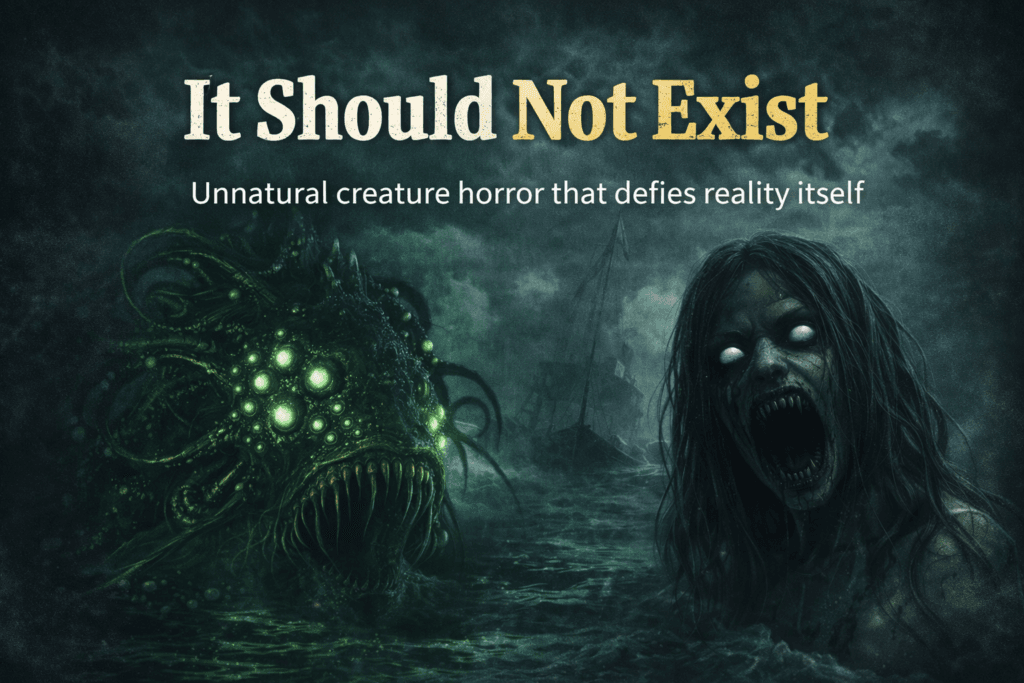
Something is wrong before you can explain it.
The environment still looks familiar. The rules still appear intact. Yet reactions no longer match causes. Effects arrive without triggers. Your senses report information your mind refuses to accept.
In unnatural creature horror, danger does not announce itself through pursuit. It reveals itself through contradiction. The creature’s presence makes the world behave incorrectly.
You do not fear what it might do to you.
You fear what its existence implies.
Why Unnatural Creature Horror Feels Different
Most creature stories threaten the body. This one threatens understanding.
Unnatural creature horror removes the assumption that reality is stable. The creature does not merely occupy space. It corrupts perception. It interferes with cause and effect. It collapses certainty.
This is why unnatural creature horror stands apart within Creature Feature Horror Stories. Here, survival fails not because the body is weak, but because the rules that govern survival stop working.
Once those rules break, nothing functions the way it should.
The First Sign: Perception Becomes Unreliable
The earliest warning is subtle.
You notice inconsistencies.
You question memories.
You doubt sensory input.
However, nothing confirms the doubt. Objects remain solid. Time moves forward. People respond normally.
In unnatural creature horror, this delay is essential. The creature does not shatter reality immediately. It introduces uncertainty first.
By the time you realise perception cannot be trusted, the damage has already spread.
Knowledge Does Not Clarify… It Corrodes
Instinct demands explanation. You gather data. You investigate patterns. You look for precedent.
This is where unnatural creature horror becomes lethal.
The more you learn, the less stable reality becomes. Information does not resolve fear. It multiplies it. Each answer introduces further contradiction.
In Marked by the Deep, the creature cannot be documented. There are no photographs. No remains. No proof that obeys scientific logic. The absence of evidence becomes evidence of something far worse.
Knowledge does not illuminate the threat.
It confirms that the threat does not belong.
When the Creature Is Seen — and the Mind Breaks
At some point, denial fails.
The creature is seen directly.
This moment does not produce clarity. It produces overload. The mind cannot categorise what it perceives. Familiar biological rules collapse. Scale feels wrong. Structure feels impossible.
The body responds before thought can form. Blood pressure spikes. Vision tunnels. Consciousness fails.
In unnatural creature horror, sight does not empower. It incapacitates. Seeing the creature does not prepare you for survival.
It proves that survival was never the point.
Why Hallucination Is Not the Threat… It Is the Weapon
Reality erosion often manifests as hallucination. However, these are not internal failures. They are induced.
In Dark Waters, the siren does not attack immediately. It manipulates perception. Crew members experience different realities simultaneously. Trust collapses. Violence erupts between humans.
This is not madness.
It is environmental sabotage.
The creature rewrites what is perceived as real. Once that happens, coordination fails. Logic dissolves. Survival strategies turn inward and destructive.
By the time the creature feeds, reality is already unusable.
When Other People Become Part of the Horror
Unnatural creature horror does not isolate victims through distance. It isolates them through disagreement.
People see different things.
Hear different warnings.
React to different threats.
This fragmentation destroys collective response. There is no shared reality to organise around. Help becomes theoretical. Authority becomes meaningless.
In this way, the creature does not need to kill everyone directly.
It lets humans do the damage themselves.
The Creature Does Not Hunt… It Invalidates
Predatory monsters chase. Environmental monsters trap. Unnatural creatures invalidate.
They make effort meaningless.
They make planning irrelevant.
They make resistance incoherent.
The N’Gahari in Marked by the Deep does not need to pursue aggressively. Its existence draws the protagonist toward it. Dreams align. Obsession intensifies. Choice narrows until movement toward the creature feels inevitable.
The creature does not force action.
Reality bends until action feels correct.
Why Escape Fails Before It Is Attempted
Most survival narratives allow hope through movement. Unnatural creature horror removes that option.
Escape requires understanding. It requires reliable perception. It requires consistent cause and effect.
Once those collapse, movement becomes guesswork. Direction loses meaning. Safety becomes hypothetical.
This logic intersects with You Can’t Kill It, where endurance replaces victory. However, here, endurance fails faster.
You cannot outlast a reality that no longer supports you.
When the Body Becomes Secondary to the Mind’s Collapse
Physical harm arrives late in unnatural creature horror.
First comes doubt.
Then obsession.
Then distortion.
Only then does the body suffer.
By the time violence occurs, the mind has already surrendered its authority. Pain feels distant. Injury feels expected.
This sequence distinguishes unnatural creature horror from You Are Becoming the Monster. There, the body betrays the self. Here, the self dissolves before the body matters.
You do not become the monster.
You become irrelevant to it.
The Illusion of Choice
At a certain point, characters believe they are choosing.
They choose to investigate.
They choose to approach.
They choose to confront.
Yet these decisions occur within a narrowed reality. Alternatives no longer feel valid. The creature has already influenced the range of possible actions.
In Marked by the Deep, the final approach feels voluntary. In Dark Waters, the siren’s influence masquerades as desire and curiosity.
Choice exists.
Freedom does not.
Why These Creatures Cannot Be Contained
Containment relies on categorisation.
You label the threat.
Define boundaries.
Establish rules.
Unnatural creatures resist all three.
They have no stable form.
No consistent behaviour.
No reliable habitat.
Even when encountered face-to-face, they do not submit to explanation. Language fails. Measurement fails. Memory fragments.
The creature cannot be studied safely.
It cannot be neutralised rationally.
It cannot be integrated into understanding.
Survival Is Not the Opposite of Death Here
In unnatural creature horror, survival is ambiguous.
Living does not restore normalcy.
Knowledge cannot be unlearned.
Reality does not reset.
Even if the body survives, certainty does not. The world remains suspect. Perception remains compromised.
This is why endings feel unresolved. The creature does not need closure. Its existence is enough.
Why Existential Unease Converts Readers
Readers drawn to unnatural creature horror are not seeking action. They are seeking destabilisation.
They want stories where answers make things worse. Where discovery destroys comfort. Where reality itself feels unsafe.
Books like Marked by the Deep and Dark Waters convert because they refuse reassurance. They do not promise escape.
They promise revelation — and its cost.
Final Truth of What Should Not Exist
Unnatural creature horror delivers a single devastating realisation:
The world is not structured for your safety.
Your understanding is provisional.
And something exists that was never meant to be seen.
Once that truth surfaces, fear no longer needs escalation.
Reality has already failed.