Obsession, in gothic horror, does not announce itself as danger.
It presents as care. As attentiveness. As devotion that feels protective rather than possessive. The terror of gothic obsession horror lies in this misrecognition: by the time love begins to enclose, it has already been accepted as necessary.
The door does not slam shut.
It closes quietly—one choice at a time.
What begins as intimacy becomes confinement. What begins as attachment becomes architecture. And once enclosure takes shape, escape feels less like freedom and more like betrayal.
Obsession as Enclosure, Not Excess
Gothic obsession horror rarely depicts fixation as frenzy.
Instead, it frames obsession as narrowing. Options disappear. Space contracts. The world grows smaller around a single person, a single relationship, a single emotional obligation.
The obsessed character does not feel overwhelmed.
They feel focused.
This focus is seductive. It offers clarity in a world already strained by decay, inheritance, and loss. Where uncertainty once reigned, obsession creates rules. Where fear lingered, obsession provides structure.
The enclosure feels stabilising—until it becomes absolute.
When Love Stops Opening Doors
In gothic narratives, healthy intimacy expands the self. Obsession does the opposite.
Boundaries soften. Independence erodes. The beloved becomes the primary reference point for meaning, safety, and identity. Over time, the relationship ceases to connect outward. It folds inward instead.
This inward folding is the hallmark of gothic obsession horror. The relationship does not break violently. It seals itself.
Conversation narrows.
Movement becomes predictable.
Absence feels intolerable.
The locked room is built emotionally long before it appears symbolically.
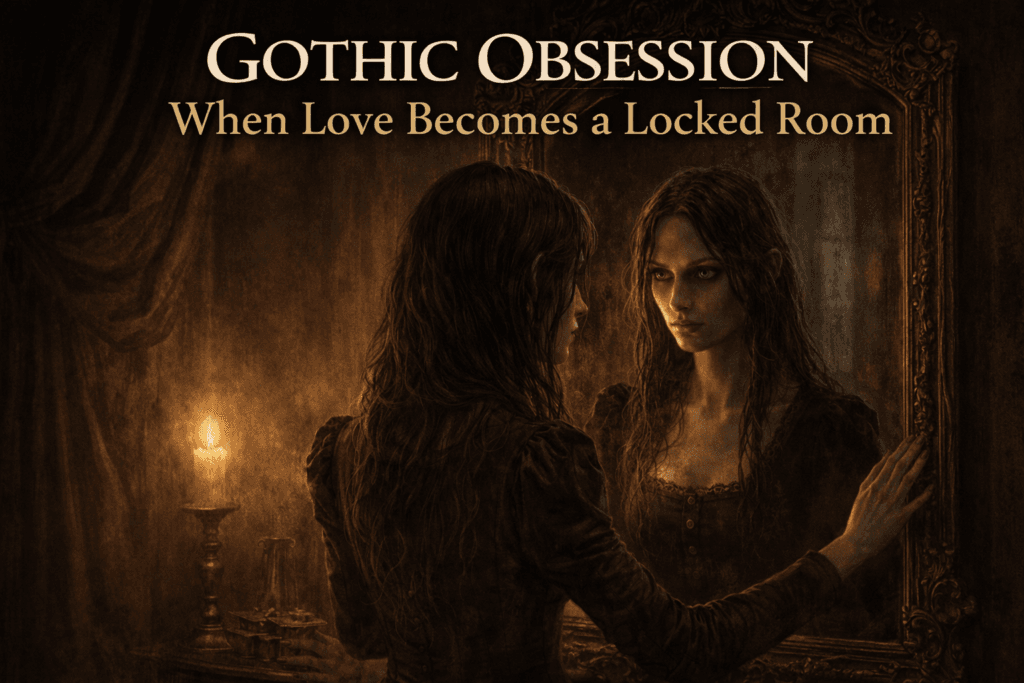
The Mirror as a Chamber of Fixation
Few gothic objects express enclosure as effectively as the mirror.
Reflection suggests self-knowledge, yet in gothic horror it often produces distortion. The character begins to see themselves only in relation to another. Desire refracts inward. Identity reshapes around preservation rather than growth.
This internal enclosure lies at the heart of The Mirror, where obsession does not erupt suddenly. It consolidates. The character watches themselves loving, watches themselves needing, until self-surveillance replaces self-direction.
The mirror does not lie.
It confines.
Here, gothic obsession horror reveals its most intimate cruelty: the prison is maintained from the inside.
Obsession as a Moral Obligation
One reason obsession persists so powerfully is that it rarely feels immoral.
In gothic horror, obsession often masquerades as responsibility. The obsessed character believes they are protecting something fragile—love, memory, stability. Withdrawal feels cruel. Distance feels dangerous.
This moral framing transforms fixation into duty.
Leaving becomes abandonment.
Questioning becomes betrayal.
Independence becomes harm.
Once obsession adopts ethical language, enclosure feels justified. The locked room no longer looks like imprisonment. It looks like care.
From Emotional Decay to Emotional Confinement
Obsession rarely emerges from healthy intimacy.
It grows from erosion.
As affection corrodes—quietly, gradually—the need to preserve what remains intensifies. The character clings not to love as it is, but to love as it was. This dynamic continues the emotional unraveling explored in When Love Rots, where attachment persists even after nourishment disappears.
Decay creates fear of loss.
Fear of loss creates fixation.
Fixation creates enclosure.
Gothic obsession horror thrives in this progression, because each step feels reasonable in isolation.
The Prison That Builds Itself
Unlike physical imprisonment, gothic enclosure does not require force.
The character chooses the narrowing path repeatedly. They sacrifice space for certainty. They trade freedom for reassurance. Over time, the walls rise naturally.
This self-constructed confinement aligns with the deeper structures of gothic captivity examined in Gothic Prison, where escape feels conceptually impossible even when doors remain unlocked.
The prison is not secured by locks.
It is secured by belief.
Once belief hardens, escape feels unnecessary.
Claustrophobia Without Walls
One of the most unsettling aspects of gothic obsession horror is that enclosure can exist without physical confinement.
The character may move freely through the world, yet feel unable to act independently. Decisions require approval. Desire feels conditional. Silence becomes surveillance.
The space contracts emotionally rather than spatially.
This claustrophobia does not trigger panic. It triggers compliance. The character adapts to the enclosure because resistance feels disruptive rather than liberating.
The locked room travels with them.
Why Obsession Feels Safe at First
Obsession offers relief from ambiguity.
Where other gothic fears expose uncertainty—about identity, inheritance, morality—obsession simplifies. It reduces complexity to a single axis of meaning. The world becomes manageable because it becomes small.
This reduction feels comforting.
In gothic obsession horror, safety is not the absence of danger. It is the absence of choice.
Once choice disappears, responsibility fades. The character follows the path already laid. The enclosure becomes routine.
Routine becomes permanence.
The Cost of Containment
Eventually, enclosure extracts payment.
Identity thins. Desire loops endlessly. The character exists to maintain the relationship rather than experience it. At this point, obsession no longer protects love—it replaces it.
Yet even here, gothic horror resists dramatic rupture. The character does not suddenly realise the truth. Recognition arrives slowly, and by then, the enclosure feels irreversible.
The locked room does not open.
It settles.
Why This Horror Persists
Readers recognise gothic obsession horror because it reflects a common fear: losing oneself without noticing.
Many relationships begin with closeness and end with confinement. Many acts of care slip quietly into control. Gothic horror does not exaggerate this process. It isolates it, slows it, and forces attention.
The genre does not warn.
It demonstrates.
That demonstration lingers because it feels plausible, intimate, and disturbingly familiar.
Where the Room Finally Closes
By the time obsession fully encloses, the corridor has narrowed beyond return.
The character no longer asks whether they are trapped.
They ask only how to endure.
Gothic obsession horror does not resolve this question. It allows the enclosure to remain, complete and unchallenged.
Because once love becomes a locked room, the door does not exist for exit.
It exists to keep everything else out.