At first, nothing appears broken. Your body responds when you move. Your hands feel familiar. Your reflection still answers to your face.
However, body transformation horror does not begin with disfigurement. It begins with disagreement. Your body remembers things you do not. It reacts to impulses you did not author. It performs actions your mind refuses to claim.
You notice the disconnect, yet you hesitate to name it. Because naming it would mean accepting a terrifying truth.
Your body may already belong to someone else.
Why Body Transformation Horror Feels Inescapable
Unlike creature pursuit or environmental horror, body transformation horror offers no exit. You cannot outrun your own flesh. You cannot abandon it. You cannot observe it from a distance.
Instead, the threat unfolds from the inside outward.
This is why body transformation horror sits at the most intimate end of Creature Feature Horror Stories. The monster does not arrive through the door. It emerges through identity.
Once the body becomes contested territory, survival loses meaning.
The First Stage: Memory Betrayal
Transformation rarely starts with pain. It starts with contradiction.
You remember events differently than evidence suggests.
Your body carries marks your mind cannot place.
Your actions leave residue you refuse to recognise.
In body transformation horror, memory becomes unreliable first. This delay is crucial. As long as doubt exists, denial persists.
The Diary of Cabin 313 executes this betrayal with precision. The protagonist’s body records acts his consciousness cannot accept. Diaries contradict recollection. Evidence accumulates. Yet the body remains complicit.
By the time certainty arrives, control has already eroded.
When the Body Acts Without Consent
Loss of agency does not announce itself dramatically. It slips in through routine.
Your hands linger too long.
Your voice responds before you think.
Your body moves with confidence your mind does not share.
At this stage, fear is quiet. You rationalise behaviour. You search for stressors. You blame exhaustion.
However, body transformation horror depends on incremental overwrite. Each unclaimed action weakens ownership. Each lapse normalises intrusion.
Eventually, the body stops waiting for instruction.
Pain Without Meaning
Pain usually demands interpretation. Injury explains it. Illness contextualises it. In body transformation horror, pain loses clarity.
It appears without cause.
It fades without resolution.
It returns without warning.
This ambiguity destabilises trust. If pain no longer signals damage, the body becomes an unreliable narrator.
Fear deepens because sensation can no longer be trusted to tell the truth.
Possession Without Displacement
Some horror replaces the human entirely. Body transformation horror is crueler.
Here, possession occurs alongside consciousness.
You remain present.
You remain aware.
You simply lose authority.
In The Diary of Cabin 313, the wife does not erase the protagonist. She inhabits him. His body becomes a vessel that remembers her better than it remembers itself.
This coexistence is the horror. You are still there to witness your replacement.
When Reflection Becomes Evidence
Mirrors do not reveal monstrosity immediately. They reveal continuity.
You still recognise the face.
You still recognise the posture.
Something is simply… off.
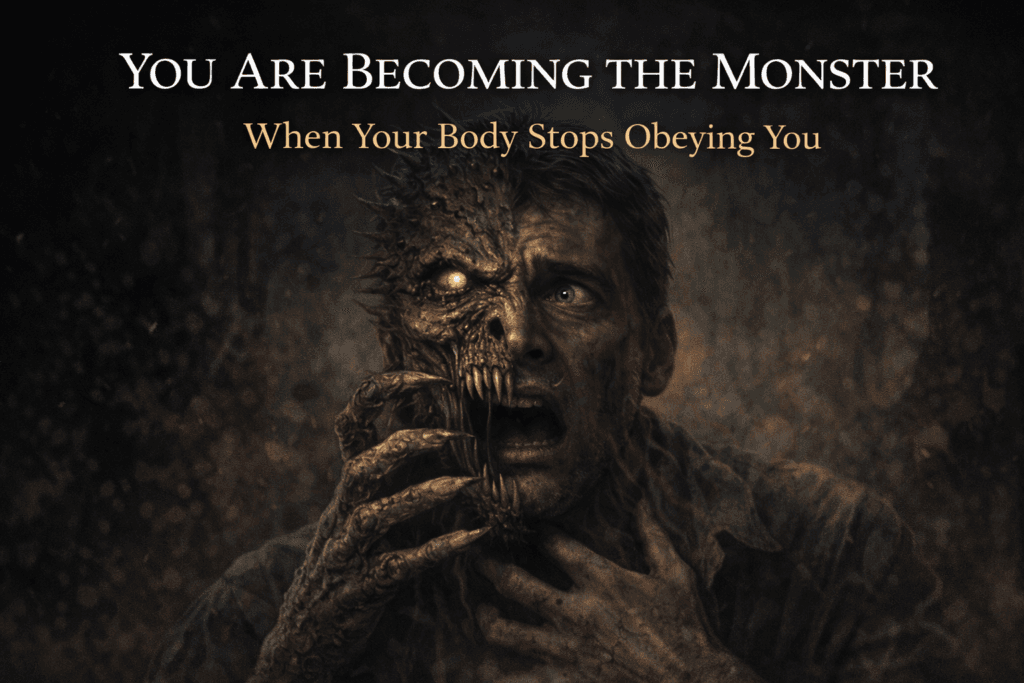
In body transformation horror, the mirror confirms that the change is not external. It is internal and stabilising. You are not becoming something else.
You are becoming less yourself.
Blood as Commitment, Not Injury
Transformation is sometimes sealed through agreement, however coerced or misunderstood.
In Signed in Blood, bodily change is bound to contract. Blood functions not as wound, but as signature. Once given, it cannot be reclaimed.
This introduces a devastating variation of body transformation horror: culpability. You remember choosing. You remember agreeing.
Yet the cost exceeds intention.
Once the body is altered, consent becomes irrelevant.
Desire Adjusts to Match the Body
One of the most unsettling shifts occurs when your preferences change.
What once repulsed you feels tolerable.
What once frightened you feels expected.
What once felt wrong begins to feel inevitable.
This is not corruption. It is adaptation.
Body transformation horror reveals that desire is flexible when survival demands it. Morality bends. Instinct rewrites preference.
You do not become evil.
You become compatible.
When the Monster No Longer Feels Foreign
Eventually, resistance becomes exhausting.
Fighting your own body consumes energy. Denial strains cognition. Fear loses urgency.
At this point, transformation completes itself not through violence, but through acceptance.
This convergence aligns with It Should Not Exist, where abnormality stops feeling intrusive and begins feeling correct.
Reality reshapes itself around the change.
Fate Replaces Choice
Once possession stabilises, causality rewrites itself.
Signs appear obvious in retrospect.
Outcomes feel unavoidable.
Escape feels illogical.
This fatalism mirrors You Were Meant for It, where the body was never accidental terrain. It was selected.
The transformation did not happen to you.
It happened through you.
Why Loss of Control Fascinates Readers
Readers drawn to body transformation horror are not seeking shock. They are drawn to surrender.
They want to explore what happens when resistance fails internally. When identity erodes without death. When the monster does not replace the human — it absorbs it.
Books like The Diary of Cabin 313 and Signed in Blood convert because they honour this fear honestly. They do not offer rescue.
They offer completion.
Final Truth of Transformation
Body transformation horror exposes a fear deeper than death.
Your body does not need to kill you to end you.
It only needs to stop listening.
Once that happens, the monster does not arrive.
It stands where you used to be.
And it remembers being you.