At first, you believe the threat is predictable.
You notice patterns. You identify triggers. You convince yourself that if you behave differently, the danger will remain manageable. After all, most predators rely on instinct. Most monsters repeat themselves.
However, intelligent creature horror exists to dismantle that assumption.
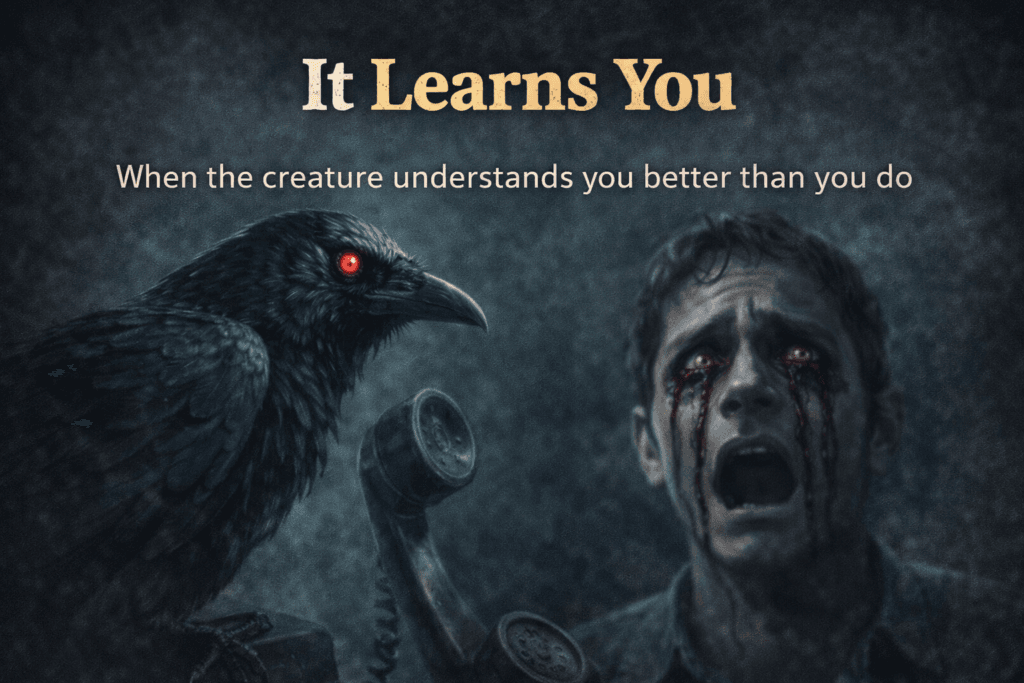
Here, the creature does not repeat mistakes. Instead, it records them. It watches reactions. It studies relationships. It maps behaviour long before it acts.
By the time you realise what is happening, the creature has already finished learning you.
Why Intelligent Creature Horror Feels Tactical
Unlike pursuit-based fear, intelligent creature horror creates tension through anticipation of correction.
You act.
The creature observes.
You adjust.
The creature adapts faster.
This imbalance generates tactical dread. Every choice feels provisional. Every strategy feels temporary. You are not solving a problem. You are feeding data to something that improves with every interaction.
This is why intelligent creature horror occupies a precise space within Creature Feature Horror Stories. The threat is not speed or strength.
It is comprehension.
The First Mistake: Believing Attention Is Neutral
Intelligent predators do not require proximity. They require access.
The earliest danger appears when the creature responds selectively. It does not react to everything. It reacts to you. Messages arrive at the right time. Interventions occur at moments of vulnerability.
At this stage, fear feels manageable. You assume coincidence. You assume curiosity. You assume limited awareness.
However, intelligent creature horror depends on delayed revelation. The creature does not show its hand early.
It waits until your responses reveal what matters to you.
When Observation Turns Into Influence
The shift happens quietly.
The creature stops responding directly and starts steering. Outcomes feel natural, yet strangely aligned with your fears. Conflicts escalate without your involvement. People behave against their own interests.
In Whispers from Beyond, the entity never needs to confront the protagonist physically. Instead, it studies power structures. It understands who torments whom. It identifies leverage points.
Most importantly, it recognises that humans are easier to manipulate than environments.
Once that lesson is learned, the creature does not need to threaten you.
It lets others do the damage.
Intelligence Is Revealed Through Indirection
True intelligence does not announce itself. It reveals itself through indirect outcomes.
When antagonists suffer consequences they engineered themselves, dread deepens. The creature did not attack. It arranged.
This is the defining feature of intelligent creature horror. The threat rarely acts in ways that can be traced back to a single decision. Instead, it orchestrates conditions where harm feels self-inflicted.
The protagonist remains physically unharmed, yet realises something worse.
The creature understands human behaviour better than humans do.
Why This Is Worse Than Being Hunted
Being hunted implies intent. Being hunted implies visibility. Being hunted implies a chase.
This cluster dismantles that framework.
At the point where you recognise intelligence, pursuit has already ended. The creature no longer needs to chase you because it can predict where you will go.
This realisation connects backward to Something Is Hunting You. What once felt like pursuit now reveals itself as reconnaissance.
The creature was not closing distance.
It was collecting patterns.
Learning Happens Faster Than Resistance
Human resistance depends on reaction time. You observe danger, then adapt. Intelligent creature horror removes that delay.
The creature processes faster. It integrates information continuously. Each emotional response teaches it something new.
Fear reveals priorities.
Anger reveals attachments.
Silence reveals thresholds.
Once the creature understands these variables, resistance becomes counterproductive. Every attempt to hide confirms what you value.
Every attempt to fight confirms what you fear losing.
When Timing Becomes the Weapon
Intelligent creatures rarely strike immediately.
They wait for maximum effect.
In Whispers from Beyond, the climax does not occur during confrontation. It occurs when the creature has fully understood the interpersonal dynamics surrounding the protagonist. The final outcome is not violence.
It is optimisation.
The creature allows humans to walk themselves into catastrophe because it knows exactly how they will respond under pressure.
This is why the fear is tactical, not emotional.
You are not overwhelmed.
You are outplayed.
Night Is No Longer the Threat — Precision Is
Earlier clusters taught readers to fear darkness and timing. Here, those elements become secondary.
The creature no longer relies on environmental advantage. It relies on knowledge. Day or night no longer matters.
However, this awareness links cleanly to It Comes at Night. What once felt like patience now reveals itself as study.
The creature waited not because it needed darkness.
It waited because it needed you to reveal yourself.
The Illusion of Outsmarting the Creature
At some point, you believe you have gained leverage.
You stop reacting.
You change routines.
You limit exposure.
For a moment, the creature goes quiet.
This silence is not retreat.
It is recalibration.
Intelligent creature horror teaches a brutal lesson: absence of response does not indicate failure. It indicates adjustment. The creature has already learned enough to proceed without further input.
When it acts again, the outcome feels disproportionate.
Because it is final.
Why Indirect Violence Feels Inevitable
Direct violence invites resistance. Indirect violence bypasses it.
The creature does not need to confront the protagonist because it understands that humans are already unstable systems. It introduces pressure at key points and lets behaviour cascade.
In this way, intelligent creature horror reframes morality. The creature is not cruel.
It is efficient.
That efficiency is what terrifies.
Survival Does Not Equal Victory Here
Unlike endurance horror, survival in this cluster feels hollow.
You live.
The creature succeeds anyway.
It has demonstrated superiority. It has proven that your behaviour is legible. It has shown that your environment is exploitable.
Even if the story ends without your death, certainty is gone.
You are no longer safe because you are known.
Why Tactical Predator Fear Converts Readers
Readers drawn to intelligent creature horror are not seeking gore or spectacle. They are drawn to asymmetry.
They fear being outmatched cognitively. They fear that preparation does not matter. They fear that awareness arrives too late.
Whispers from Beyond converts because it respects that fear. It does not rely on surprise.
It relies on comprehension.
The creature wins because it understands people better than people understand themselves.
Final Truth of Learning Creatures
Intelligent creature horror delivers a specific realisation:
You were not chosen at random.
You were not unlucky.
You were interesting.
The creature noticed you.
It studied you.
It waited until acting was unnecessary.
By the time you understood the threat, it had already moved beyond you.
And it will do so again.