Most horror stories begin with a mistake. Someone turns the wrong corner. Someone stays too long. Someone opens something that should have remained closed.
However, chosen victim horror begins long before any decision occurs.
Instead, it begins with recognition.
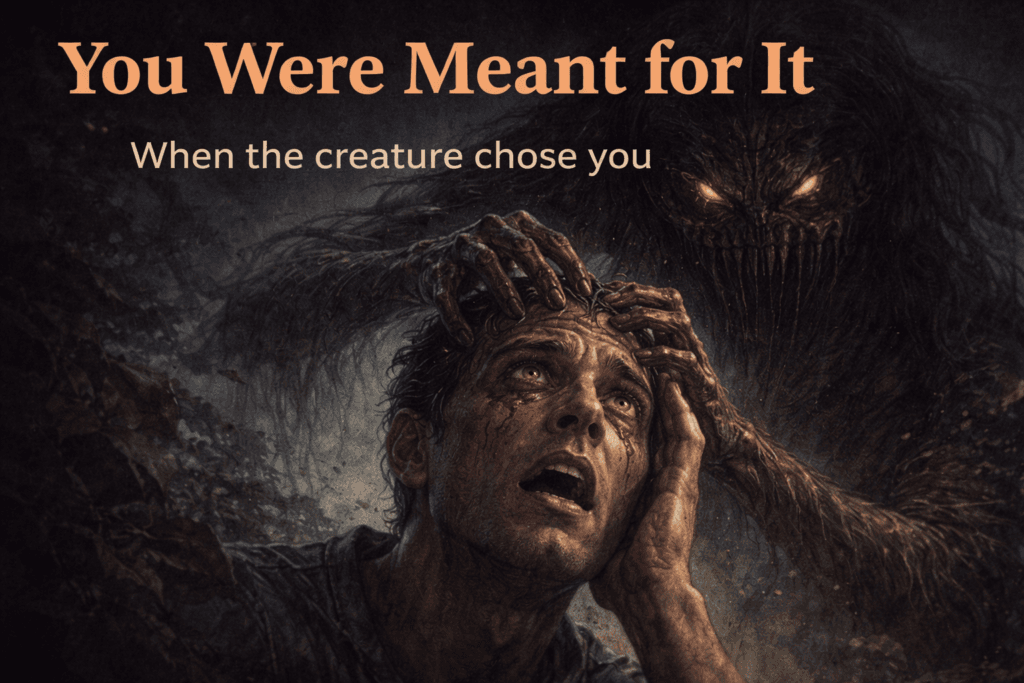
The creature does not arrive because of error. Rather, it appears because you already belong to its attention. Consequently, the fear does not build toward danger. It settles immediately into inevitability.
In chosen victim horror, the question is never what happens next.
Instead, the question becomes why it was always you.
Why Chosen Victim Horror Feels Inescapable
Most horror relies on cause and effect. A bad decision leads to exposure. Exposure leads to pursuit. Eventually, consequences follow.
Chosen victim horror dismantles that structure entirely.
Here, the creature does not react. Instead, it behaves as though the outcome was decided before the story began. Therefore, effort feels misaligned. Preparation feels irrelevant. Resistance feels symbolic rather than effective.
This is why chosen victim horror occupies a fatalistic tier within Creature Feature Horror Stories. The terror does not come from escalation. Instead, it comes from certainty.
The First Sign: Attention Without Explanation
At first, the threat does not behave aggressively.
Instead, attention appears where none should exist. Patterns centre on you rather than spreading outward. Encounters feel personal before they feel dangerous.
Initially, you search for logic. You assume coincidence. You blame proximity. You rationalise awareness.
However, chosen victim horror slowly removes those explanations. The focus does not widen. Instead, it tightens. Others remain untouched. Meanwhile, you remain watched.
That narrowing signals selection.
Selection Is Not Pursuit
Being hunted implies contingency. You might escape. You might hide. You might survive if you adapt quickly enough.
Being chosen removes that possibility.
The creature does not chase you because it already accounted for your movement. It does not test alternatives because it never required them. Therefore, strategy collapses early.
This distinction separates chosen victim horror from environmental threat narratives like Beneath the Surface, where location and circumstance determine survival.
Here, circumstance no longer matters.
Why Recognition Is More Terrifying Than Violence
Violence invites resistance. Recognition bypasses it.
Once the threat acknowledges you directly, fear deepens. You are not being punished. Instead, you are being addressed.
In Marked by the Deep, attention feels deliberate long before it becomes comprehensible. Encounters do not unfold as accidents. Instead, they feel confirmatory, as though something ancient is verifying a conclusion already reached.
The creature does not ask whether you qualify.
It behaves as though qualification already occurred.
Why Others Fade Into Irrelevance
Chosen victim horror isolates through specificity rather than absence.
Other people exist. They may even experience peripheral consequences. However, the creature’s interest never shifts. It does not diversify. It does not spread.
Consequently, delegation fails. You cannot redirect attention. You cannot hide behind numbers. Even in company, isolation persists.
The fear sharpens because focus never wavers.
Curiosity as Proof, Not Cause
One of the cruelest mechanics in chosen victim horror involves curiosity.
You believe investigation creates danger. You assume questions pull the threat closer. However, the narrative reveals the opposite.
Curiosity does not summon the creature. Instead, it confirms compatibility.
In Marked by the Deep, inquiry does not open the door. Rather, it exposes that the door already stood open. Each question aligns the protagonist more closely with the creature’s interest.
Therefore, knowledge becomes evidence, not protection.
When Choice Exists Only in Appearance
Chosen victim horror often presents options.
You can refuse.
You can delay.
You can walk away.
Yet every option funnels toward the same destination.
This is where Signed in Blood reinforces the cluster’s logic. The story frames engagement as consent, as though agreement grants control. However, the structure reveals that eligibility existed long before any choice appeared.
Choice exists.
Outcome does not.
Eligibility as a Form of Selection
Not all chosen victims are seized violently.
Some qualify quietly.
Criteria replace aggression. Structure replaces pursuit. You were not unlucky. Instead, you fit requirements that existed before you noticed them.
This variation deepens fatalistic dread because resistance no longer addresses the problem. You are not fighting a creature. You are confronting a system that already accounted for your presence.
Why Preparation Always Fails
Preparation assumes uncertainty.
Chosen victim horror removes uncertainty entirely.
The creature’s interest does not fluctuate. It does not respond to readiness. It does not adapt because adaptation is unnecessary. Therefore, planning feels hollow.
At this stage, fear transforms into resignation. You stop asking how to survive. Instead, you ask how long recognition will remain incomplete.
When the Body Confirms the Truth
Eventually, the body reacts.
Not as punishment, but as confirmation. Sensations shift. Boundaries blur. The environment responds differently to you than to others.
This transition intersects with You Are Becoming the Monster. However, here the body does not change through corruption.
It changes because it always belonged.
Why No One Can Take Your Place
Outside intervention fails for a simple reason.
Helpers misunderstand the threat.
They assume danger transfers. They believe sacrifice redirects attention. However, chosen victim horror denies substitution.
The creature does not want a victim.
It wants this one.
Therefore, rescue becomes impossible even when allies remain present.
Escape as Delay, Not Avoidance
Eventually, escape appears plausible.
Distance offers relief. Time dulls urgency. Refusal feels powerful.
Yet chosen victim horror reframes escape as postponement. Leaving does not erase recognition. It merely delays confrontation. Consequently, geography loses relevance.
Once chosen, you remain known.
Why This Fear Resonates
Readers drawn to chosen victim horror fear a specific truth: that identity itself can function as vulnerability.
They respond to stories where:
- danger feels personal rather than random
- inevitability replaces suspense
- resistance confirms alignment instead of defiance
Marked by the Deep and Signed in Blood resonate because they respect that fear. They do not soften it. They do not rationalise it.
They allow inevitability to stand.
When Understanding Arrives Too Late
The most devastating moment is not revelation.
It is confirmation.
You recognise that attention preceded action. That curiosity mirrored selection. That fear arrived late because it was unnecessary earlier.
The creature did not need urgency.
It already had you.
Final Truth of Being Chosen
Chosen victim horror delivers a brutal insight:
You were not selected because you failed.
You were not selected because you were careless.
You were selected because you fit.
Once that truth settles, fear stabilises into certainty. The story no longer asks what will happen.
Instead, it asks whether you ever had a different role available.