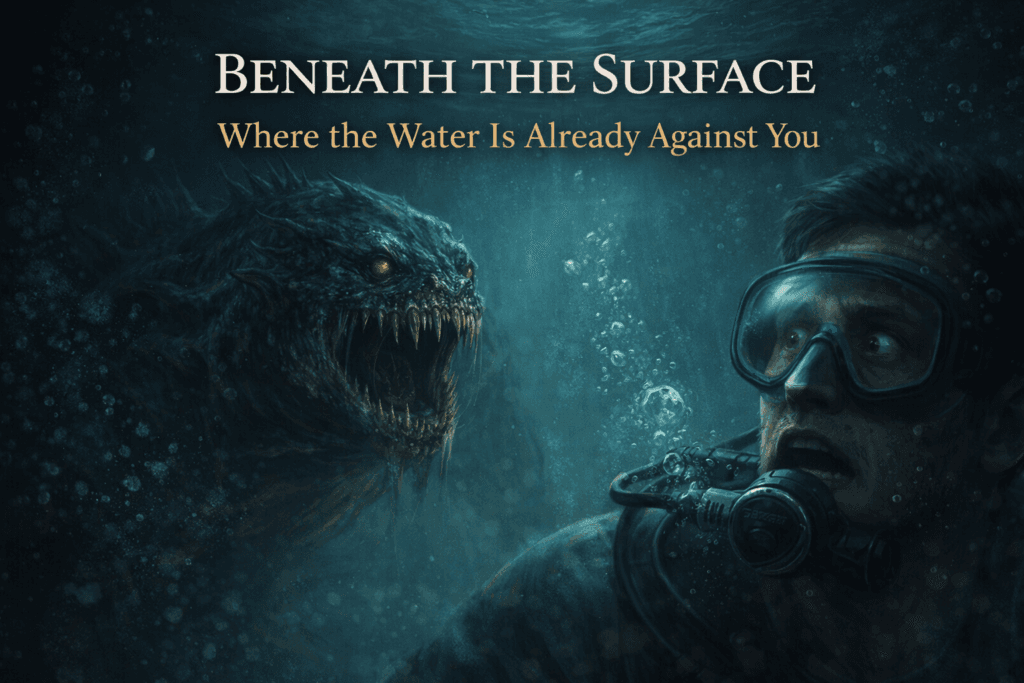
Water looks calm from above. It reflects light. It carries sound gently. It invites entry. Yet in underwater creature horror, that calm is not safety. It is camouflage.
The moment your body breaks the surface, the environment shifts its allegiance. Gravity loosens its grip. Sound bends. Vision blurs. Breath becomes finite. Therefore, before any creature appears, the water itself begins the hunt.
This is the foundation of underwater creature horror. The threat does not arrive suddenly. Instead, it surrounds you completely, long before you realise how exposed you have become.
Why Underwater Creature Horror Feels Inescapable
Unlike land-based fear, underwater creature horror removes balance immediately. You cannot stand your ground. You cannot move quickly. You cannot orient yourself without effort. Consequently, every action costs oxygen.
Because of this, underwater creature horror belongs to the broader framework of Creature Feature Horror Stories that strip safety away through environment rather than surprise. Here, the water collaborates with the creature. It limits escape. It delays awareness. And it ensures that mistakes compound rapidly.
On land, panic wastes energy. Underwater, panic steals breath. Therefore, the body enters countdown mode almost instantly.
Time does not pass underwater. It drains.
The First Vulnerability: Breath as a Deadline
Breathing is automatic on land. Underwater, it becomes a conscious transaction. Each inhale must be planned. Each exhale measured. And every movement accelerates depletion.
In underwater creature horror, this transforms breath into the first point of failure. The body becomes hyper-aware of its lungs. Anxiety tightens the chest. Panic increases consumption. Consequently, the creature does not need to attack immediately.
It only needs to wait.
As oxygen drops, coordination falters. Decision-making slows. Vision narrows. The body begins betraying itself long before the creature closes distance.
How Water Rewrites the Rules of Pursuit
Chases underwater do not look like chases. There is no sprint. No sharp turn. No sudden burst of speed. Instead, there is resistance.
Every movement pushes against pressure. Limbs feel heavier. Momentum fades quickly. Meanwhile, creatures adapted to depth move effortlessly.
Because of this imbalance, underwater creature horror transforms pursuit into inevitability. Distance does not widen. It stabilises. The creature does not rush. It shadows.
At that point, the water does the exhausting. The creature only needs to finish.
Vision Collapse and the Illusion of Seeing Clearly
Light behaves differently underwater. It fractures. It dims. It disappears faster than expected. Even clear water distorts shape and distance.
This distortion becomes lethal in underwater creature horror. Objects appear closer than they are. Shadows stretch unnaturally. Movement blends with debris. As a result, the body misjudges proximity.
You think the creature is farther away.
You think you have time.
You are wrong.
Because vision lies underwater, awareness arrives late. And late awareness is the most dangerous kind.
Depth as a Psychological Trap
Descending feels gradual. A few feet deeper. Then a few more. However, depth accumulates silently.
Pressure builds without warning. Ears strain. Sinuses ache. Muscles resist movement. Meanwhile, ascent grows more difficult with every second spent below.
In underwater creature horror, depth becomes containment. Once you descend far enough, returning to the surface is no longer a reflex. It becomes a calculated risk.
And calculation fails under fear.
When the Creature Does Not Chase — It Waits
Some creatures hunt through speed. Others hunt through patience. Underwater creature horror favours the latter.
In this environment, waiting is a weapon. Creatures understand that the body cannot remain submerged indefinitely. They position themselves between you and air. They control vertical space.
This tactic defines Marked by the Deep. The creature does not need to overwhelm. It only needs to mark and monitor. Once marked, the body’s options shrink dramatically.
You cannot surface freely.
You cannot descend safely.
You hover in borrowed time.
The Water as an Active Predator
One of the most unsettling truths of underwater creature horror is that the environment itself becomes hostile.
Currents pull unexpectedly. Visibility vanishes without warning. Temperature drops shock the body. Equipment malfunctions.
Because of this, even without a creature present, the body is already under threat. Add a predator, and the margin for error disappears entirely.
Dark Waters exploits this perfectly. The water conceals movement, masks sound, and swallows evidence. By the time danger becomes visible, the body is already compromised.
Why Fighting Back Fails Underwater
Violence underwater feels sluggish. Strikes lose force. Weapons resist movement. Coordination degrades rapidly.
Meanwhile, creatures strike with precision. They understand angles. They exploit drag. They use the environment rather than fighting against it.
As a result, fighting back rarely ends the encounter. It drains oxygen. It wastes energy. It accelerates exhaustion.
In underwater creature horror, resistance does not create advantage. It shortens the clock.
Panic as a Depth Multiplier
Fear underwater behaves differently than fear on land. It tightens muscles. It speeds breathing. It destroys rhythm.
Once panic sets in, everything accelerates in the wrong direction. Oxygen vanishes faster. Movement becomes erratic. Orientation collapses.
This is why underwater creature horror rarely relies on sudden shocks. Instead, it cultivates dread slowly, allowing panic to do the damage.
The creature does not need to scare you. The water does that for it.
When the Surface Stops Being Salvation
Instinct tells you to surface. Air equals safety. However, underwater creature horror undermines this belief deliberately.
Creatures learn the surface routes. They patrol ascent paths. They anticipate escape attempts.
At this point, the surface becomes another trap. Rising too fast causes pain. Rising too slowly allows interception. Either way, the body pays.
Once the creature positions itself between you and air, survival becomes theoretical.
How Environmental Vulnerability Replaces Chase Horror
Unlike pursuit-based fear, underwater creature horror does not rely on constant movement. Instead, it replaces speed with inevitability.
The environment restricts options so thoroughly that escape becomes less about action and more about endurance. And endurance has limits.
This contrasts directly with Something Is Hunting You, where movement dominates terror. Here, stillness becomes just as dangerous as motion.
Either choice leads to the same result.
The Body After Escape (If Escape Happens at All)
Even when a character surfaces, the body does not reset. Lungs burn. Muscles tremble. Disorientation lingers.
Underwater creature horror insists on consequence. Survival leaves residue. Fear rewires reflexes. Water becomes suspect forever.
You may live.
But the depth follows you.
Why Environmental Fear Converts Readers
Readers drawn to underwater creature horror are not seeking jump scares. They are drawn to vulnerability. To helplessness created not by weakness, but by environment.
Books like Marked by the Deep and Dark Waters resonate because they remove illusion. They show that preparation does not guarantee safety when the environment itself turns predatory.
These readers understand that the most terrifying monsters do not always chase.
Sometimes, they wait where you cannot breathe.
Final Truth Beneath the Surface
Underwater creature horror exposes a simple reality: the human body was never meant to live below the surface.
Once submerged, you are already compromised. Once marked, you are already counted. The creature does not need aggression. It has gravity, pressure, darkness, and time.
You entered the water willingly.
The environment did not.
And beneath the surface, it never lets you forget that.