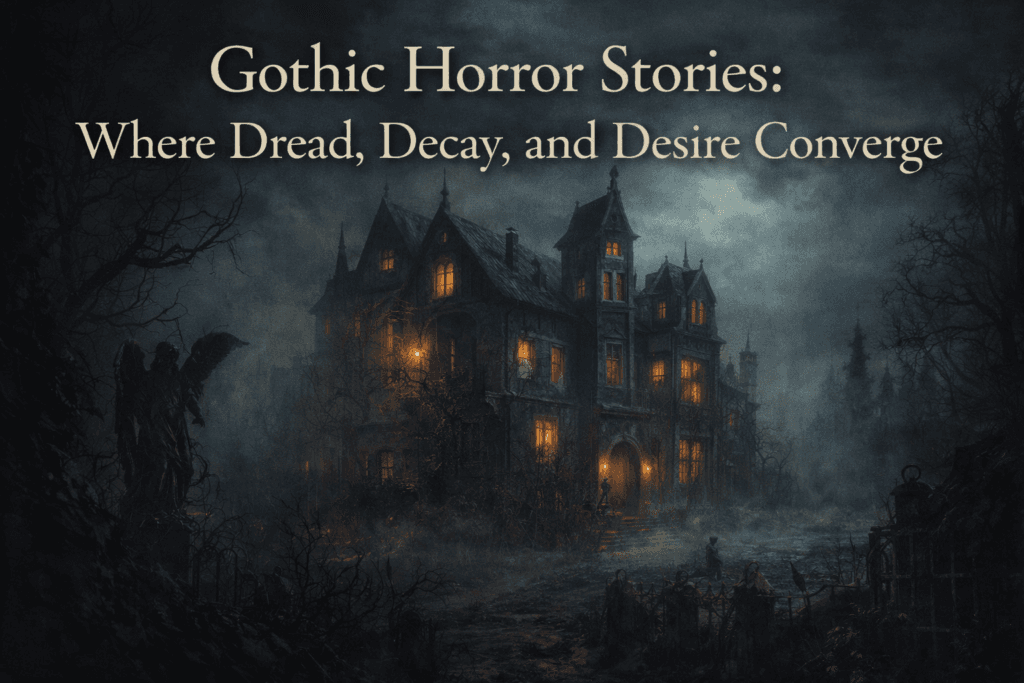
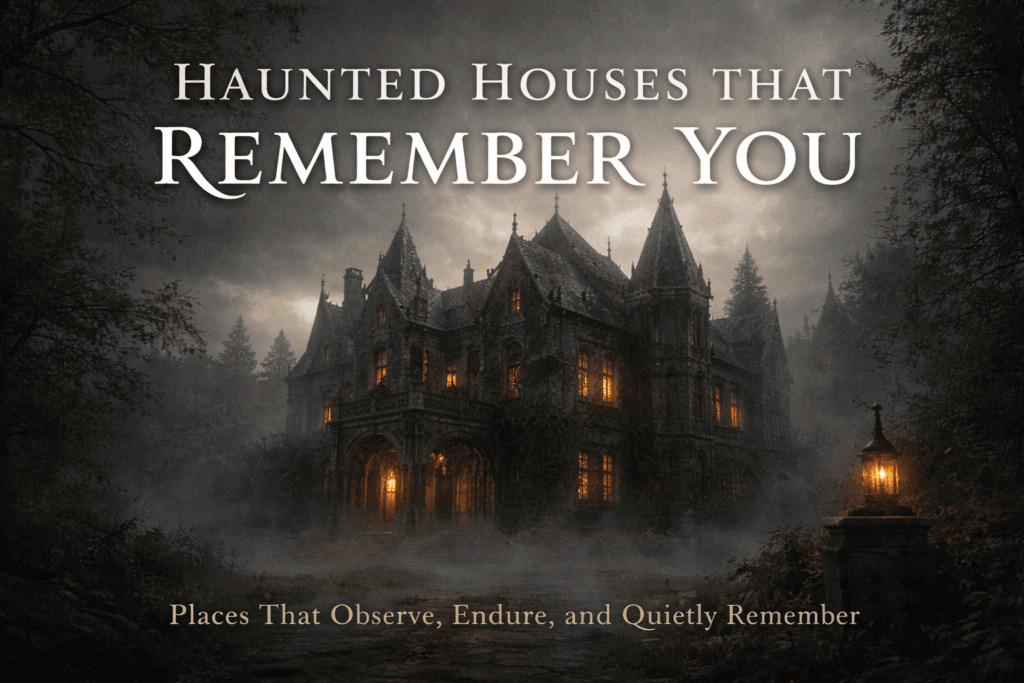
Some houses feel different the moment you cross the threshold.
Not because of what you see, but because of what the space seems to know. The air feels heavier. Sound behaves strangely. Silence stretches instead of settling. Even before anything overtly unsettling happens, a quiet recognition sets in: this place has a memory.
Gothic horror has always understood this feeling. Long before ghosts appeared or doors began to close on their own, gothic stories treated houses as presences rather than backdrops. They do not simply contain events. They observe them. They endure them. They outlive the people who try to leave them behind.
This is why haunted gothic houses remain one of the most enduring images in gothic horror. They do not frighten through violence or spectacle. Instead, they unsettle through familiarity—through the sense that the house has already adjusted to you.
When a House Becomes Aware
In gothic horror, a house does not need to move to feel alive.
Awareness reveals itself through subtler means. A hallway seems longer at night than it did in the morning. A room absorbs sound instead of echoing it. Windows feel less like openings and more like watching points. Over time, the house begins to feel less like shelter and more like a system.
This awareness unsettles because it removes neutrality.
A neutral space offers safety through indifference. A gothic house does not offer indifference. It notices patterns. It encourages repetition. It rewards compliance. Eventually, it begins to feel as though the house understands its occupants better than they understand themselves.
Importantly, gothic horror does not rush this process. The house does not announce itself as haunted. Instead, it waits for familiarity to set in. By the time the reader senses danger, the house already feels normal.
That normalisation is the true horror.
Atmosphere Before Explanation
Gothic horror stories rarely explain their houses immediately. In fact, explanation often arrives too late to matter.
Instead, atmosphere does the work. Fog gathers around the exterior. Dust clings to unused rooms. Light falls unevenly through tall windows. Silence grows dense in corners where no one stands.
Because atmosphere precedes logic, the reader feels unease before understanding it. This ordering matters. Gothic horror does not want the reader to analyse first. It wants the reader to inhabit.
At this stage, nothing explicitly supernatural must occur. The dread remains ambient. The reader senses that the house has a rhythm, and that entering it requires adjustment.
Adjustment, however, always carries a cost.
Houses That Outlive Their Occupants
One of the most unsettling truths gothic horror exposes is simple: houses endure.
People arrive with expectations. They bring hopes, regrets, relationships, and plans for renewal. The house remains unimpressed. It has hosted generations before them. It will host generations after.
This imbalance creates quiet tension. The occupants change. The house does not.
Over time, the house becomes a ledger. It records grief without comment. It absorbs conflict without reaction. When occupants leave—or disappear—the structure remains, unchanged yet heavier.
This endurance gives gothic houses their authority. They do not need to threaten. Their permanence speaks for them.
Readers respond to this dynamic because it reflects lived experience. Places often outlast the lives shaped within them. Childhood homes remain long after childhood ends. Old estates persist long after the families that defined them collapse.
Gothic horror simply refuses to look away from this imbalance.
Memory Embedded in Architecture
In gothic horror, memory does not exist only in people. It embeds itself into architecture.
Staircases remember footsteps. Bedrooms retain grief. Walls absorb arguments. Over time, memory becomes spatial rather than narrative. It does not announce itself as history—it manifests as pressure.
This pressure explains why gothic houses feel oppressive without being overtly violent. The house does not attack. Instead, it expects continuation. It assumes routine. It encourages repetition.
The longer someone stays, the more the house begins to feel inevitable.
This idea lies at the heart of The Foundation Beneath Us, where the house does not act as a threat in the conventional sense. Instead, it behaves as a legacy. Its foundations carry more weight than its occupants realise, and adapting to the space feels easier than resisting it.
The horror emerges slowly—not through fear, but through alignment.
Silence as a Form of Communication
Silence behaves differently inside haunted gothic houses.
Rather than offering calm, silence thickens. It presses inward. It lingers longer than expected. Sounds do not disappear; they sink.
This altered silence creates the impression that the house listens. Conversations feel exposed. Thoughts feel less private. Over time, occupants begin to speak less—not because they fear being overheard, but because silence feels more appropriate.
Gothic horror uses this quiet to strip away reassurance. Without noise, without interruption, the reader confronts atmosphere directly. The house fills the absence.
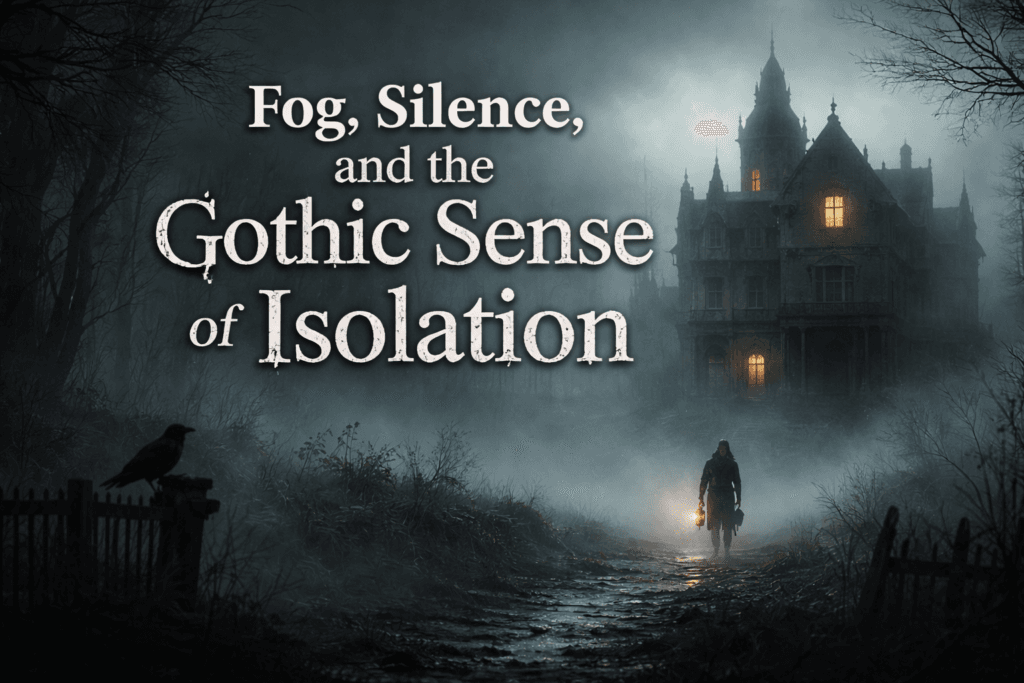
This silence often links naturally to broader gothic themes of isolation and withdrawal, which unfold further in Fog, Silence & Isolation. However, at this stage, the focus remains gentle. The reader does not feel trapped yet—only aware.
Awareness, after all, always comes first.
Why Leaving Feels Like Betrayal
One of the strangest effects of haunted gothic houses is emotional loyalty.
Leaving does not feel dangerous. It feels wrong.
Occupants may recognise discomfort, yet still hesitate to abandon the space. The house feels earned. Familiar. Leaving would mean admitting failure or disrespecting something older and more enduring.
Gothic horror does not frame this hesitation as foolishness. Instead, it presents it as natural. People remain in places that harm them all the time—because familiarity feels safer than uncertainty.
The house exploits this instinct without effort. It does not need to lock doors. Emotional obligation does the work.
Readers recognise this immediately, even if they cannot yet articulate why.
The Illusion of Choice
At Phase 1 of the gothic escalation, the illusion of choice remains intact.
Characters believe they can leave. Readers believe they are observing from a safe distance. The house has not closed its grip yet. It has merely made itself known.
This restraint matters. Gothic horror respects pacing. It allows the reader to settle into mood before confronting consequence. If the house claimed too early, resistance would remain high.
Instead, the house waits.
This waiting gives the reader time to acclimatise, to lower defences, to accept the environment as baseline reality. By the time tension deepens, escape already feels abstract.
Houses as Moral Witnesses
Many gothic houses feel judgmental—not because they punish, but because they remember.
They have witnessed betrayals. They have endured crimes. They have outlasted apologies. This makes them feel morally weighted, even when silent.
This sense of moral memory connects haunted houses to broader gothic themes of buried crimes and historical guilt, explored later in Old Estates, Old Crimes. However, at this stage, guilt remains ambient rather than explicit.
The house does not accuse.
It remembers.
That memory alone generates unease.
Why Haunted Gothic Houses Linger in the Mind
Haunted gothic houses endure in the reader’s imagination because they feel plausible.
Not realistic in a literal sense, but emotionally accurate. People know what it feels like to enter a place that carries history. They know how spaces can shape behaviour subtly and persistently.
Gothic horror magnifies this truth without distorting it.
By the time the reader finishes a story centered on a haunted gothic house, the fear does not feel resolved. Instead, it lingers as recognition. The reader carries the house with them, even after leaving the page.
This lingering is intentional. Gothic horror does not want closure. It wants continuity.
The First Door in the Corridor
Haunted gothic houses represent the first door in the gothic corridor.
They invite rather than trap. They observe rather than attack. They establish mood rather than escalate fear. At this stage, the reader feels immersed, not endangered.
This is precisely where Phase 1 should leave them.
If this atmosphere resonates—if the idea of places that remember feels familiar rather than frightening—then the corridor remains open. The reader may drift naturally toward deeper silences, heavier histories, and older crimes.
For now, however, the house simply waits.