Isolation in gothic horror does not arrive suddenly.
Instead, it settles.
It seeps in through fog that softens distance, through silence that lingers longer than it should, through spaces that feel inhabited yet unresponsive. Unlike other forms of horror, gothic isolation does not begin with danger. It begins with absence.
No reply.
No witness.
No assurance that anyone else remains close enough to matter.
This is solitude dread—the earliest psychological stage of gothic fear. And once it takes hold, everything that follows feels unavoidable.
Isolation Without Violence
Gothic isolation horror does not need threats, chases, or confinement to work. In fact, it thrives without them.
A character may stand in an open field, walk freely through a town, or occupy a house filled with rooms. Yet isolation persists—not because escape is impossible, but because connection has failed.
This distinction matters.
In survival horror, isolation is logistical. In gothic horror, isolation is existential. The fear does not arise from being alone in space, but from being alone in meaning.
Someone could speak.
But no one answers.
Therefore, speech loses its power.
Fog as Psychological Architecture
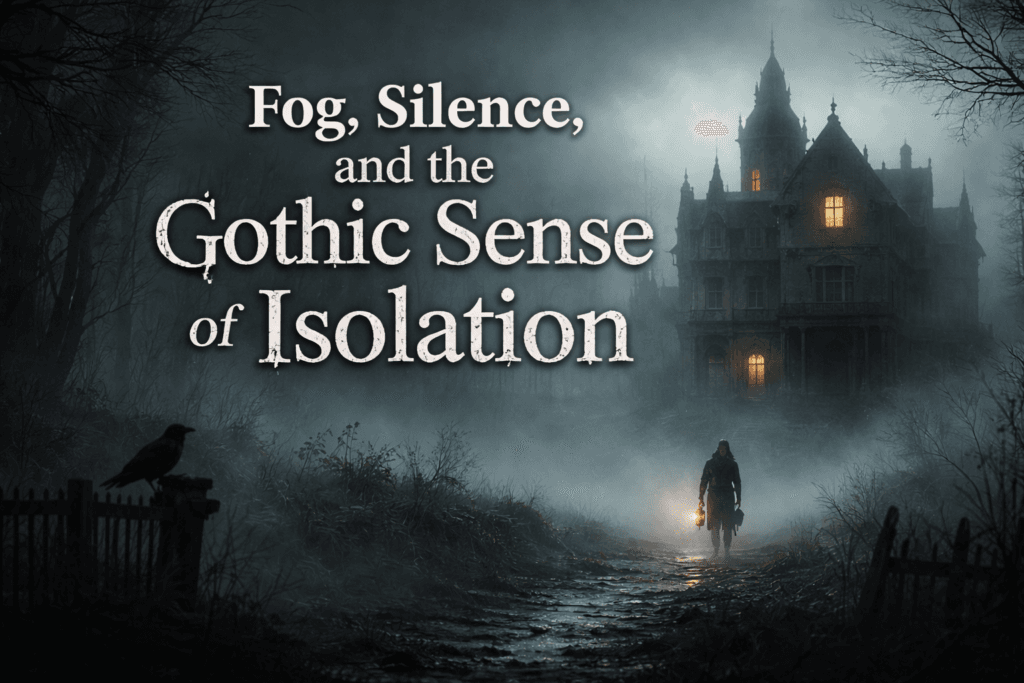
Fog occupies a unique position in gothic isolation horror because it alters perception without altering reality.
The road still exists.
The house still stands.
The town still surrounds you.
However, fog removes confirmation. Distance becomes uncertain. Shapes dissolve at the edges. Sound arrives late or distorted. As a result, the mind fills gaps instinctively—and often incorrectly.
This is why fog appears so early in gothic narratives. It does not trap characters physically. Instead, it undermines confidence. And once confidence erodes, isolation follows naturally.
Fog teaches the reader an early lesson:
what you cannot see may still be watching.
Silence That Does Not Reassure
Silence in gothic horror behaves differently than silence elsewhere.
It does not calm.
It does not rest.
It waits.
In isolation-driven gothic stories, silence becomes an active force. Sounds do not echo. Footsteps vanish mid-step. Voices feel exposed the moment they leave the mouth.
Because of this, characters begin to self-censor. They speak less. They listen more. And in doing so, they retreat inward.
Silence does not merely surround them.
It reshapes them.
This is where solitude dread begins to deepen—quietly, persistently, without warning.
Being Unseen as a Gothic Fear
One of gothic horror’s most persistent anxieties is not death—but unwitnessed existence.
To be unseen is to be unconfirmed.
To be unheard is to be unprotected.
Gothic isolation horror exploits this fear by removing acknowledgment rather than safety. Characters remain alive, yet unregistered by the world around them.
Phones fail.
Doors remain closed.
Messages vanish into nothing.
And so the question shifts from “Am I in danger?” to “Does anyone know I exist?”
That shift marks the transition from discomfort to dread.
Isolation That Exists Among Others
Perhaps the most unsettling form of gothic isolation occurs when people remain physically nearby.
The town bustles.
The building stays occupied.
Life continues.
Yet the character remains alone.
This form of isolation feels cruel because it denies validation. Help should be close. Witnesses should exist. However, none arrive—not because they cannot, but because they do not.
In gothic horror, this indifference feels intentional. The world has not collapsed. It has simply withdrawn attention.
This withdrawal creates a unique terror: suffering without acknowledgment.
The Environment Stops Responding
Gothic isolation deepens when the environment begins to behave inconsistently.
Doors that once opened resist.
Light behaves unevenly.
Sound refuses to travel correctly.
These changes do not scream supernatural interference. Instead, they suggest neglect. As if the world no longer prioritises coherence.
Fog thickens without reason.
Silence persists without explanation.
Movement loses consequence.
As a result, the character stops expecting response. And once expectation disappears, isolation becomes internalised.
Internalising Solitude
At Phase 1, gothic horror does not attack identity directly. Instead, it loosens its foundation.
Without witnesses, characters lose external reference points. They cannot confirm memory, intention, or consequence. Over time, this lack of confirmation destabilises certainty.
Was that sound real?
Did I imagine that movement?
Did anyone hear me speak?
These questions do not demand answers. They erode confidence quietly.
Isolation, therefore, does not imprison the body.
It isolates the mind.
Isolation as a Moral Vacuum
When no one watches, morality loses reinforcement.
Gothic isolation horror understands this instinctively. Once witnesses vanish, accountability follows. Actions feel unrecorded. Consequences feel abstract.
This does not immediately lead to violence or corruption. Instead, it creates permission.
Permission to linger.
Permission to stay silent.
Permission to accept things that would otherwise feel wrong.
Isolation softens resistance long before danger appears.
Why Gothic Isolation Appears Early
Phase 1 exists to prepare the reader—not to frighten them outright.
Isolation introduces vulnerability without trauma. It lowers defences. It encourages introspection. It invites the reader to settle into atmosphere rather than react.
This preparation matters because gothic horror escalates slowly. Without isolation, later themes—decay, guilt, obsession—would feel abrupt.
Solitude dread teaches the reader how to wait.
Silence as an Invitation
Silence does not merely suppress sound.
It invites interpretation.
When nothing responds, the mind fills space with speculation. That speculation grows heavier with time. Each unanswered moment compounds.
Gothic isolation horror relies on this compounding effect. Silence stretches moments until the reader feels pressure—not fear yet, but expectation.
Something should happen.
But nothing does.
That delay becomes unbearable.
Isolation and the Loss of Rescue
One of the defining features of gothic solitude dread is the absence of rescue—not because rescue fails, but because it never arrives.
No one hears the call.
No one intervenes.
No one remembers.
This absence does not yet feel final. Instead, it feels postponed. The reader believes help could still arrive—later.
That belief keeps them engaged.
Isolation functions as anticipation.
Where Whispers from Beyond Belongs
This precise form of solitude dread unfolds within Whispers from Beyond, where isolation does not emerge from distance or confinement, but from unanswered presence.
The fear does not arise because something speaks—but because something listens without replying.
Silence becomes a signal.
Fog becomes a boundary.
Isolation becomes confirmation that the world has stepped back.
The story does not escalate yet.
It waits.
The Role of Isolation in the Gothic Corridor
Isolation represents the first narrowing of the gothic corridor.
The world does not close abruptly. Instead, it grows quieter. Fewer voices remain. Fewer paths feel reliable. The reader continues forward because nothing has yet told them to turn back.
This is intentional.
Gothic horror never traps the reader immediately.
It invites them to proceed voluntarily.
The Threshold Has Been Crossed
By the end of Phase 1, something subtle but irreversible has occurred.
The reader no longer expects reassurance.
They no longer trust silence.
They no longer assume witnesses exist.
This shift is enough.
Once isolation settles, later horrors do not need to announce themselves. The reader has already learned how to feel alone inside the story.
Where the Path Leads Next
Isolation does not remain abstract forever.
It hardens into architecture in Haunted Houses That Remember You. It deepens into emotional decay in When Love Rots.
But for now, the fog remains unbroken.
The silence remains unanswered.
And the reader remains alone—yet still moving forward.