Some horror wounds the body.
Other horror steals command of it.
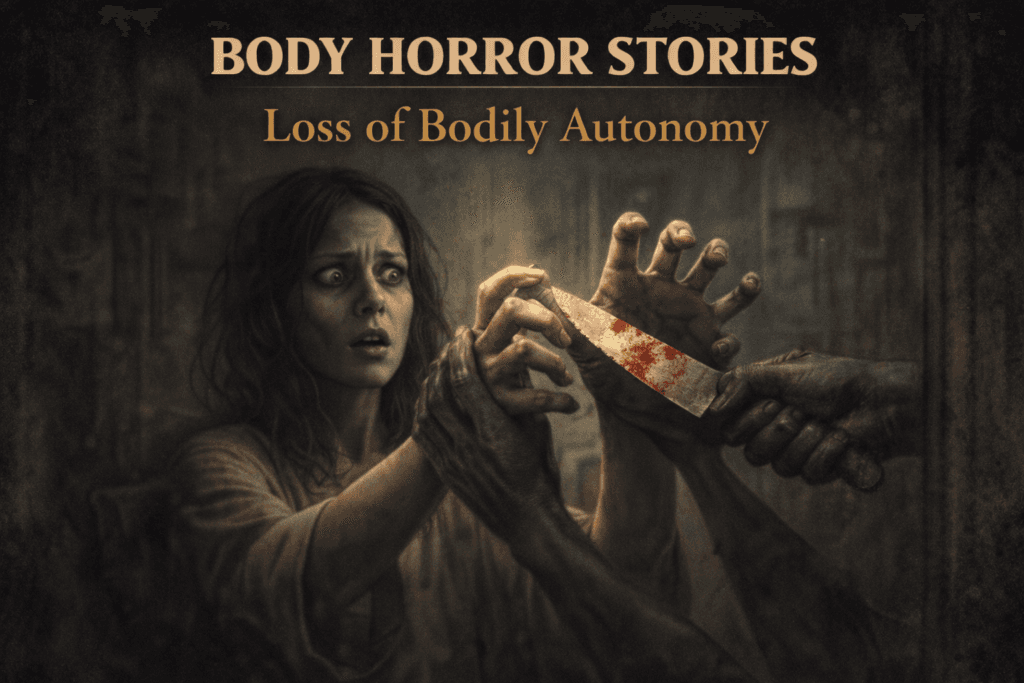
In the most disturbing horror fiction, fear does not come from visible injury or sudden transformation. Instead, it emerges when the body continues functioning but no longer listens. Movement happens without permission. Speech occurs without intent. The self remains conscious, yet authority is gone.
Loss of bodily autonomy is not about destruction. It is about override. The body becomes an object that still breathes, still walks, still acts—while the person inside is forced to watch.
Readers drawn to disturbing horror fiction of this kind are not seeking spectacle. They are seeking the terror of awareness without agency, where survival itself becomes a form of captivity.
What Loss of Bodily Autonomy Really Means in Horror
Loss of bodily autonomy horror focuses on control being removed while consciousness remains intact.
Unlike possession narratives, the threat may not be identifiable. Unlike transformation horror, the body does not need to change shape. Instead, the horror lies in the betrayal of command. The body responds to impulses the mind did not author.
This sub-genre consistently revolves around three conditions:
- Awareness persists
- Control erodes gradually or suddenly
- Resistance becomes meaningless
Because the body still appears normal, the horror becomes invisible to others. Only the victim understands what has been lost.
Why Control Is More Terrifying Than Injury
Pain can be endured. Damage can be rationalised. Control, once removed, leaves no refuge.
In disturbing horror fiction, loss of bodily autonomy strikes at the core assumption that the body is an extension of will. When that assumption fails, identity destabilises. The self no longer governs action. Instead, it becomes a witness.
Moreover, control loss introduces moral horror. If the body commits acts without consent, where does responsibility reside? The question lingers long after the scene ends.
Awareness as the Cruel Constant
In loss-of-autonomy narratives, unconsciousness would be mercy. Awareness is the punishment.
Characters feel their limbs move against intent. They hear their own voice speaking words they did not choose. However, nothing fully disconnects. The mind remains present as the body becomes unreliable.
This sustained awareness separates loss-of-autonomy horror from simple possession tropes. The point is not takeover—it is coexistence without consent.
The Body Turned Into a Tool
When autonomy disappears, the body becomes instrumental.
It performs functions. It follows instructions. It executes tasks. However, those tasks no longer originate from the self. The body becomes equipment rather than expression.
This dynamic aligns loss-of-autonomy horror closely with Extraction & Harvesting, where the body is treated as material to be used. In both cases, agency is irrelevant. Utility replaces consent.
The terror escalates because the body is still alive. Still responsive. Still capable.
Vulnerability Without Choice
Once control is lost, vulnerability becomes permanent.
Characters can no longer protect themselves through will alone. They cannot refuse, resist, or flee. Even instinct becomes unreliable. As a result, the body exists in a constant state of exposure.
This is why loss-of-autonomy horror naturally intersects with Vulnerable Body. Vulnerability is not situational here—it is structural. The body is open because control no longer seals it.
Disturbing Horror Fiction and the Fear of Compliance
One of the most unsettling aspects of disturbing horror fiction in this cluster is forced compliance.
The body does not simply act against will—it learns. Patterns emerge. Resistance weakens. Over time, compliance becomes automatic. The body adapts to being directed.
This adaptation introduces a deeper fear: the possibility that autonomy might not return even if the external force disappears. The body remembers what it learned.
The Illusion of Resistance
Many loss-of-autonomy narratives begin with resistance.
The character fights. They strain. They attempt to regain control. However, resistance proves futile. The body responds slower each time. Signals fail. Commands misfire.
Eventually, resistance becomes exhausting. The horror shifts from struggle to endurance. The character learns to live with partial control, which may be worse than total loss.
Everyday Motions, Extraordinary Terror
Loss-of-autonomy horror thrives on ordinary actions.
Walking. Speaking. Smiling. Touching.
When these actions occur without consent, they become violations. The mundane becomes hostile. Daily life turns into a minefield of involuntary acts.
This grounding is why disturbing horror fiction of this type feels so personal. The fear does not rely on rare events. It weaponises everyday motion.
When the Body Becomes Evidence
As control erodes, the body records what happens.
Bruises appear without memory. Fatigue settles without explanation. Objects move. Traces remain. The body becomes evidence of actions the self did not author.
In these moments, the horror expands outward. Others begin to notice changes. Explanations fail. Isolation deepens.
Loss of Autonomy Within Body Horror Stories
Loss-of-autonomy narratives occupy a critical position within Body Horror Stories.
They do not rely on extreme visuals. Instead, they destabilise the relationship between will and flesh. The horror unfolds internally, where no witness can intervene.
For readers who prefer psychological intensity over spectacle, disturbing horror fiction rooted in autonomy loss delivers sustained unease.
The Fear of Becoming Complicit
Perhaps the most disturbing element of loss-of-autonomy horror is complicity.
If the body acts, does the self share blame? If resistance fades, does that constitute surrender? These questions haunt both characters and readers.
Disturbing horror fiction uses this ambiguity deliberately. The horror does not end with loss of control. It deepens as guilt enters the equation.
Featured Horror Read: The Bedtime Story
Few stories explore loss of bodily autonomy with such precision as The Bedtime Story.
In this narrative, the terror does not arise from violence or transformation. Instead, it emerges through enforced participation. The body is compelled. Awareness remains. Choice disappears.
The horror unfolds quietly, making each moment feel unavoidable. Control is not seized violently—it is taken for granted, which makes its absence even more disturbing.
This makes The Bedtime Story a precise fit for disturbing horror fiction centred on autonomy loss.
Why Loss of Bodily Autonomy Endures as Horror
Loss-of-autonomy horror endures because it reflects a foundational fear:
that the body can continue without permission.
No monster is required. No mutation is necessary. The body works. Life proceeds. Yet control is gone.
For readers seeking disturbing horror fiction that lingers rather than shocks, loss of bodily autonomy remains one of the genre’s most unsettling expressions.