Some horror arrives suddenly.
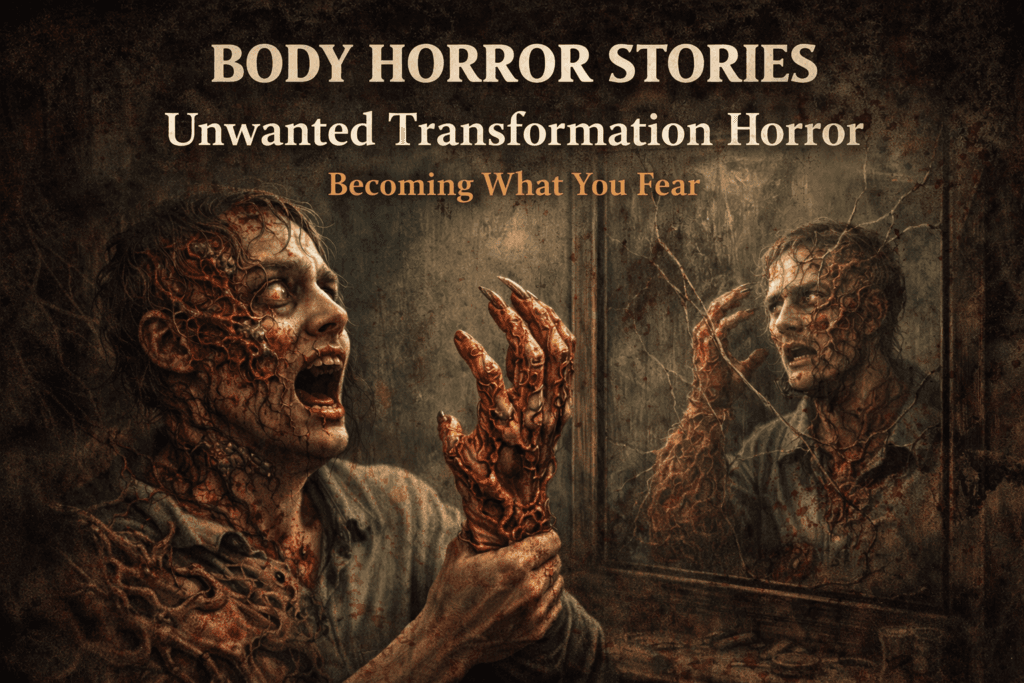
Unwanted transformation horror unfolds while the victim remains present.
In these narratives, the body does not collapse or get taken apart by force. Instead, it changes on its own, without permission and without pause. Skin thickens. Limbs distort. Sensation alters. Identity begins to erode. Consequently, the horror does not come from a single moment, but from sustained awareness.
Because the transformation unfolds gradually, the victim cannot deny it. They feel each change as it happens. They recognise what they are becoming long before the process completes. As a result, unwanted transformation horror traps the reader inside inevitability rather than surprise.
This cluster explores horror stories where the body becomes something else while the mind remains intact—and where escape disappears long before the transformation ends.
What Defines Unwanted Transformation Horror
Unwanted transformation horror centres on irreversible bodily change without consent.
Unlike extraction narratives, nothing is removed deliberately. Unlike infection narratives, no external agent necessarily invades. Instead, the body itself initiates the change. Therefore, the horror feels internal, intimate, and inescapable.
Several traits define this cluster clearly:
- Change begins subtly
- Progression accelerates over time
- Awareness persists
- Reversal never arrives
Because the victim remains conscious, denial becomes impossible. Meanwhile, anticipation replaces shock. Each stage confirms that the body no longer obeys intention.
Why Transformation Horror Feels Existential Rather Than Violent
Many horror sub-genres rely on threat. Transformation horror relies on identity collapse.
As the body changes, self-recognition weakens. Mirrors become hostile. Movement feels unfamiliar. Sensation no longer aligns with memory. Consequently, the victim loses more than flesh—they lose certainty.
Unlike violence-driven horror, transformation narratives do not require an aggressor. The body itself becomes the antagonist. As a result, blame dissolves. There is no one to fight. There is only progression.
Because the change continues regardless of resistance, readers experience dread rooted in inevitability rather than fear of attack.
The Slow Escalation That Defines Transformation Horror
Unwanted transformation rarely begins dramatically. Instead, it starts with anomalies.
At first, sensation feels wrong. Then movement stiffens. Later, shape alters. Meanwhile, the victim attempts rationalisation. They deny the changes. They hide them. They delay acknowledgment. However, the body continues changing regardless.
This escalation creates a layered dread:
- Initial confusion
- Rising awareness
- Desperate concealment
- Eventual acceptance
Because readers follow this progression step by step, the horror feels personal rather than spectacular.
Awareness as the Central Engine of Horror
Transformation horror depends on remaining aware.
If the victim lost consciousness, the fear would soften. Instead, awareness persists. They feel bones stretch. They feel skin tighten. They feel appetite shift. As a result, the horror becomes internalised.
Moreover, awareness allows memory to remain intact. The victim remembers who they were while becoming something else. Consequently, identity fractures rather than disappears.
This split between mind and body creates sustained psychological pressure without shifting into psychological horror territory. The body drives the terror. The mind only witnesses it.
Transformation Versus Infection: A Critical Distinction
Although both transformation and infection involve bodily change, their emotional logic differs.
In infection narratives, something enters the body.
In transformation narratives, the body changes itself.
Because of this difference, transformation horror feels more intimate. There is no invader to blame. The threat originates within. Therefore, resistance feels futile from the outset.
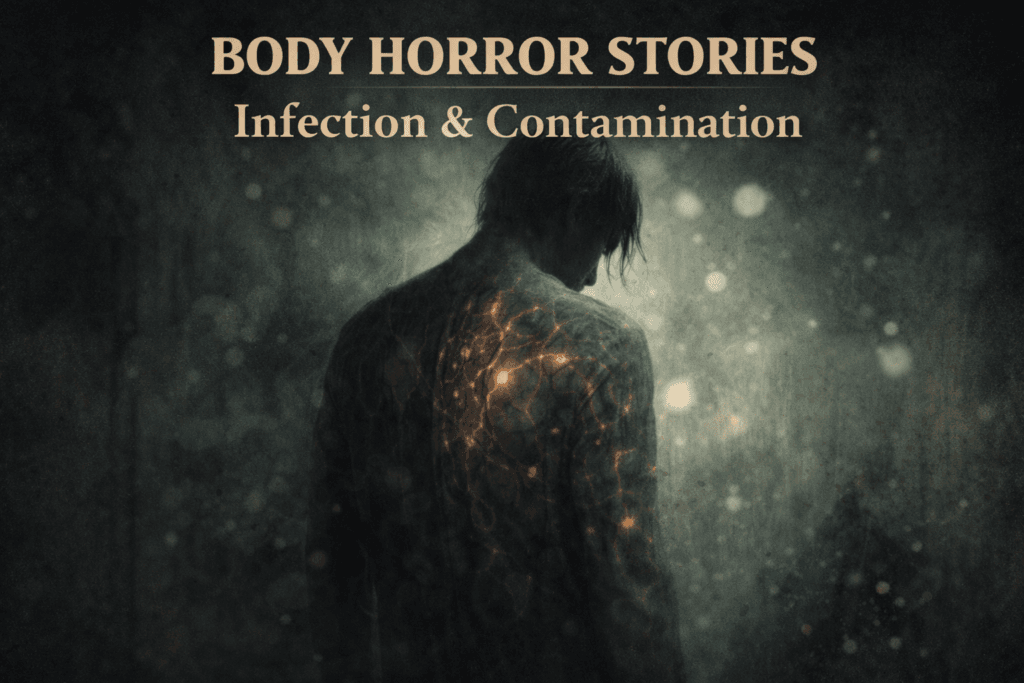
However, transformation horror often intersects thematically with Infection & Contamination, especially when progression mimics disease-like escalation. The distinction lies in agency, not appearance.
Transformation and the Fear of Becoming Other
At its core, unwanted transformation horror confronts the fear of becoming unrecognisable.
As the body shifts, social identity collapses. Relationships strain. Language fails. Eventually, the victim must confront the possibility that their former self no longer exists.
This fear resonates deeply because it mirrors real anxieties:
- Aging
- Chronic illness
- Disability
- Loss of autonomy
Transformation horror amplifies these fears without offering reassurance. Instead, it insists that change does not always come with adaptation.
The Body as a Host Without Invitation
Many transformation stories blur into occupation. Something else seems to shape the body from within. Marks appear. Patterns form. Movement feels guided rather than chosen.
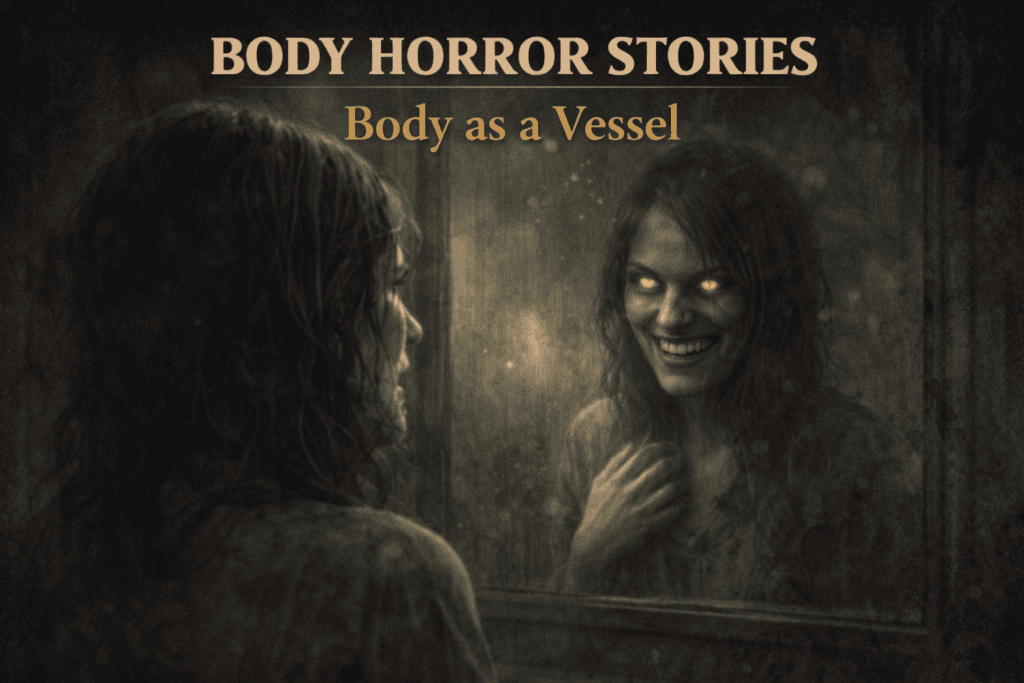
Because of this overlap, transformation horror naturally connects to The Body as a Vessel Horror, where the body serves another presence entirely. In both cases, ownership erodes.
The difference lies in perception: transformation feels internal, while occupation feels invasive. Yet both trap the victim inside an altered body.
Irreversibility as the Point of No Return
Unwanted transformation horror gains power from permanence.
Once the body crosses a certain threshold, reversal disappears. Even hope fades. The story no longer asks if the change will stop, but how much will remain when it ends.
This irreversibility separates transformation horror from temporary mutation narratives. Readers understand that what is lost will not return. As a result, tension never releases.
Common Motifs in Unwanted Transformation Horror
Although stories vary widely, several motifs recur consistently.
Gradual Revelation
The body changes slowly, forcing sustained awareness.
Concealment
Victims hide symptoms to preserve normalcy.
Mirrors and Reflections
Self-recognition fractures as appearance shifts.
Loss of Language
The victim struggles to describe what is happening.
Each motif reinforces the same truth: the body no longer aligns with identity.
Why Readers Seek Transformation Horror Specifically
Readers drawn to transformation horror seek existential dread, not spectacle.
They value:
- Slow escalation
- Sustained awareness
- Identity erosion
- Irreversible consequence
Moreover, these readers often prefer stories where the horror unfolds internally rather than through confrontation. As a result, transformation horror attracts readers who appreciate subtlety without safety.
Featured Transformation Horror Read
Few stories capture unwanted transformation as precisely as Marked by the Deep.
In this story, change unfolds gradually and without consent. The body responds to forces it does not understand. Marks appear. Sensation shifts. Identity strains under pressure.
The horror does not explode. It accumulates. Each change compounds the last. Nothing resets. Nothing returns to normal.
This is transformation horror at its most effective: quiet, internal, and irreversible.
How Unwanted Transformation Fits Within Body Horror Stories
Unwanted transformation narratives form one of the most psychologically devastating paths into Body Horror Stories.
They establish:
- Bodily betrayal
- Identity collapse
- Awareness without control
For many readers, this mechanism represents the purest form of body-focused dread.
Aftermath: Living Inside the Changed Body
The most disturbing transformation stories do not end with completion. They linger on aftermath.
Movement feels wrong. Appetite shifts. Social interaction collapses. The body no longer functions as expected. As a result, the victim must adapt to something they never chose.
This focus on aftermath prevents catharsis. Instead, it reinforces permanence.
Why Unwanted Transformation Horror Endures
Unwanted transformation horror persists because it confronts a fundamental fear:
that the body can change beyond recognition while the self remains trapped inside.
No negotiation stops it. No justification explains it away. Acceptance becomes the only option.
For readers who want horror that respects consequence and identity loss, unwanted transformation remains one of the genre’s most unsettling experiences.