Some horror arrives violently.
Infection horror arrives quietly—and refuses to leave.
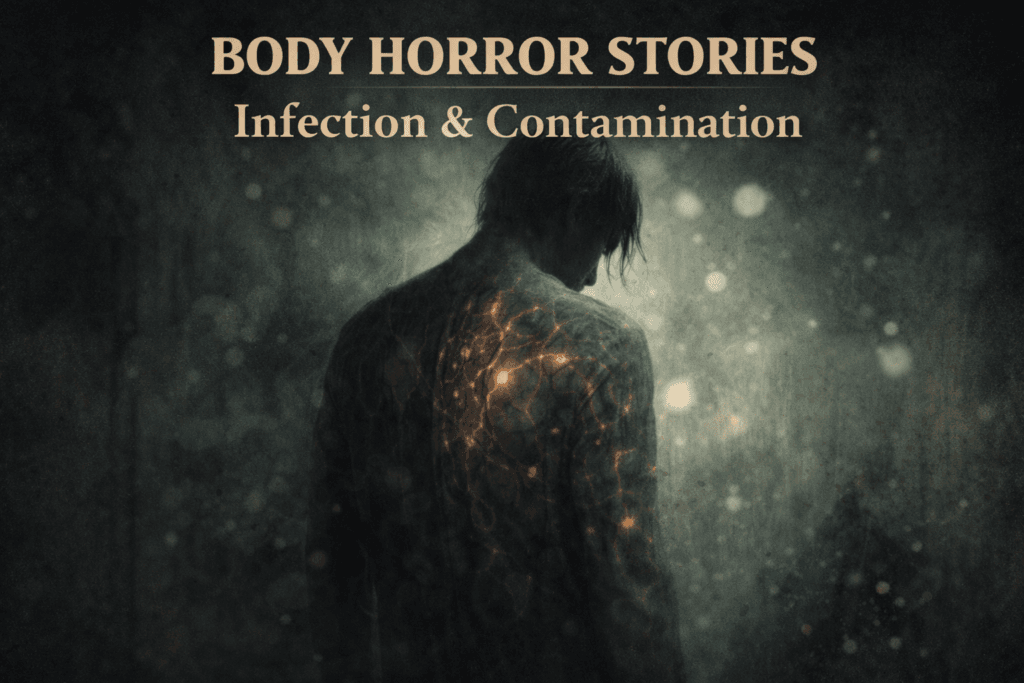
In infection horror stories, fear does not announce itself. Instead, it settles unnoticed. The body continues functioning. Appetite remains. Movement feels normal. However, beneath the surface, something has already begun. A parasite embeds itself. A sickness takes root. Contamination spreads invisibly, without urgency and without permission.
Rather than collapsing suddenly, the body turns inward. It becomes a host for something that does not belong there. Consequently, the horror does not erupt in a single moment. It advances incrementally, each stage confirming that the body has begun serving something else.
Readers drawn to infection horror stories are not seeking spectacle. Instead, they want inevitability. They want narratives where the body betrays itself while awareness remains intact and escape disappears gradually.
What Defines Infection & Contamination Horror
At its core, infection and contamination horror centres on bodily corruption through invasion and spread.
Unlike extraction narratives, nothing is removed deliberately. Unlike some transformation narratives, change does not begin as a visible mutation. Instead, something enters the body quietly and begins altering it from within. Therefore, the horror feels invasive rather than subtractive.
Several traits consistently define infection horror stories:
- Progression unfolds gradually
- Symptoms escalate rather than stabilise
- Awareness deepens alongside decay
- Removal becomes impossible
Because deterioration occurs in stages, anticipation replaces shock. The reader understands what is happening long before the process completes. As a result, dread accumulates rather than spikes.
Why Infection Horror Feels Unavoidably Personal
Infection horror attacks trust.
The body exists to protect the self. When contamination takes hold, that trust collapses. Barriers weaken. Systems fail. The body stops defending and starts accommodating.
Moreover, infection horror stories mirror real fears: illness, invisible spread, internal failure. Because these anxieties already exist in everyday life, the horror feels plausible rather than fantastical. Consequently, fear settles early and refuses to leave.
Rather than relying on external monsters, infection horror turns the familiar into the threat. The body becomes unreliable in ways readers already recognise.
The Slow Escalation That Defines Infection Horror Stories
Infection horror stories rarely begin with pain. Instead, they begin with anomalies.
A cough lingers. A rash spreads. Sensation dulls. Appetite shifts. Meanwhile, the victim rationalises symptoms. They delay action. They hide progression. However, the body continues deteriorating regardless.
This escalation follows a recognisable rhythm:
- Initial denial
- Rising concern
- Visible corruption
- Acceptance without cure
Because readers recognise this pattern from real life, the horror feels intimate rather than distant. Each stage reinforces the sense that intervention arrived too late.
Infection as the First Step Toward Transformation
Although infection and transformation represent different mechanisms, infection often initiates transformation.
As contamination spreads, flesh begins responding in unfamiliar ways. Skin reacts. Organs adapt. Structure shifts. At this stage, infection horror intersects naturally with Unwanted Transformation.
The difference lies in origin. Infection introduces change from outside. Transformation completes it from within. Together, they form a continuous descent rather than separate events.
The Body as a Vessel for Something Else
In many infection horror stories, the body does not merely change—it begins serving another presence.
Parasites feed. Organisms reproduce. Contamination spreads with purpose. Meanwhile, the body adapts to sustain the invader. Therefore, survival mechanisms become tools of violation.
This dynamic places infection horror in direct conversation with Body as a Vessel. In both cases, the body loses ownership. It becomes a container rather than a self.
The horror intensifies because the victim remains aware while the body fulfils a function it never consented to perform.
Awareness and the Terror of Bodily Betrayal
In infection horror stories, awareness grows alongside decay.
Characters feel internal movement. They sense changes before others notice. They recognise progression without understanding its full extent. As a result, isolation intensifies. The body becomes a private battleground.
Furthermore, awareness transforms discomfort into dread. If contamination continues, something else will follow. Therefore, each symptom becomes a warning rather than an isolated event.
This sustained awareness ensures the horror never releases its grip.
Irreversibility and the Collapse of Hope
Most infection horror stories remove the possibility of cure.
Treatments fail. Interventions arrive too late. Time runs out. Consequently, the narrative shifts from prevention to endurance.
This irreversibility separates infection horror from medical thrillers. The point is not recovery. The point is progression. Once contamination stabilises, the horror changes form but does not end.
From Living Body to Aftermath
As infection reaches its final stages, the body no longer feels transitional.
Decay stabilises. Damage persists. Function returns imperfectly—or not at all. At this point, infection horror intersects with Corpses & Aftermath.
Whether the body survives or dies becomes secondary. What matters is what remains. The body tells the story even when the person cannot.
In these narratives, the aftermath is not closure. It is confirmation.
Infection Horror Within Body Horror Stories
Infection and contamination narratives form one of the most grounded paths into Body Horror Stories.
They establish:
- Bodily betrayal
- Progression without cure
- Awareness without control
For many readers, infection horror stories feel disturbingly plausible—and therefore unforgettable.
Featured Infection Horror Read
Few stories explore contamination as intimately as Marked by the Deep.
In this story, change begins subtly. Marks appear. Sensation shifts. The body responds to forces it does not understand. Each progression deepens isolation and dread.
The horror does not explode. It spreads. Nothing resets. Nothing heals completely.
Why Infection & Contamination Horror Endures
Infection horror stories persist because they reflect a fundamental fear:
that something invisible can enter the body and never leave.
No negotiation stops it. No authority fixes it. Survival itself becomes complicity.
For readers who want horror grounded in inevitability and physical betrayal, infection and contamination narratives remain among the genre’s most unsettling expressions.