Homes are supposed to protect us.
They hold routines, memories, and repetition. They provide structure. They promise safety through familiarity. When something goes wrong inside a home, the damage feels different. It isn’t just frightening—it’s destabilising.
Psychological horror understands this instinctively.
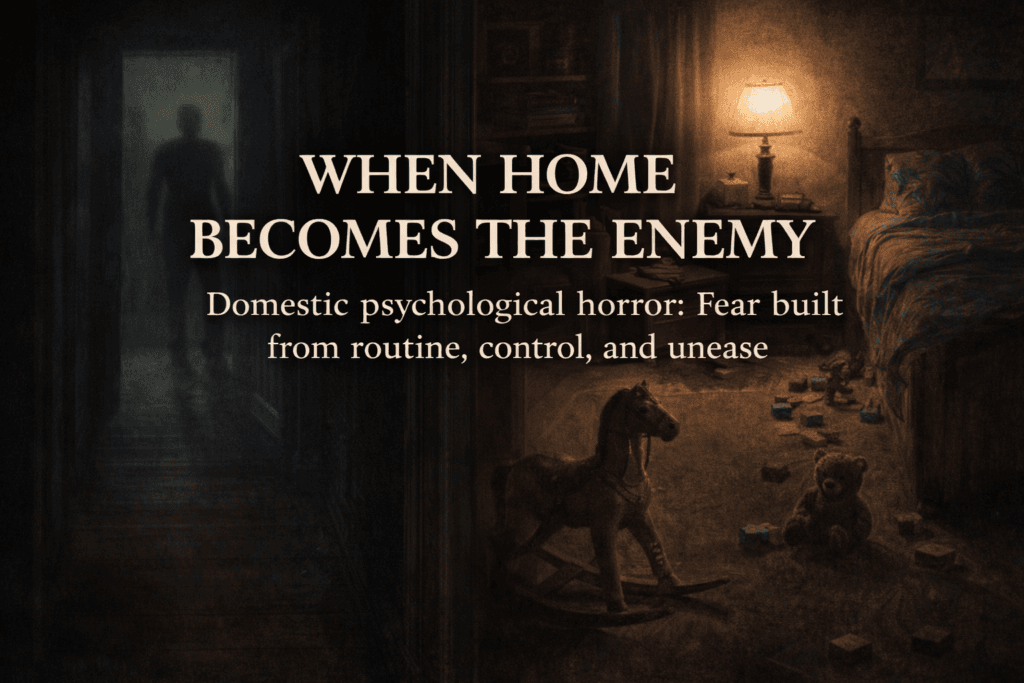
When horror turns the home against its occupants, fear doesn’t arrive as invasion. It arrives as betrayal. The walls remain standing. The furniture doesn’t move. Everything looks the same.
That’s what makes it unbearable.
Why Domestic Horror Cuts Deeper
External threats feel containable. You can flee them. You can fight them. You can name them.
Domestic horror removes those options.
The threat exists where escape should feel unnecessary. The place meant to calm the nervous system instead activates it. Every familiar object becomes suspect—not because it changes, but because it doesn’t.
This is why domestic psychological horror sits at the core of psychological horror. The genre isn’t interested in breaking down doors. It’s interested in breaking down trust.
Familiarity Becomes a Weapon
Domestic horror rarely relies on dramatic events.
It relies on repetition.
The same hallway.
The same bedtime ritual.
The same room entered every night.
When something feels wrong, repetition amplifies it. The reader doesn’t experience fear once—they experience it again and again, with no relief.
This is why domestic horror resonates so strongly with readers who already gravitate toward psychological horror for readers who hate gore. The fear never needs spectacle. Familiarity does the work.
The house doesn’t attack.
It endures.
Control Often Masquerades as Care
Some of the most unsettling domestic horror revolves around care.
Protection becomes surveillance.
Routine becomes restriction.
Comfort becomes control.
These stories rarely announce cruelty. Instead, they let it hide inside good intentions. The characters may even defend the behaviour causing their fear.
This dynamic overlaps strongly with when innocence turns unsettling,
where the horror comes from recognising harm in places designed to nurture.
The reader sees the danger before the character does—and waits helplessly for awareness to arrive.
The House as a Psychological Mirror
Domestic spaces don’t just contain horror. They reflect it.
Rooms hold memory.
Walls absorb routine.
Silence amplifies internal conflict.
As a character’s mental state deteriorates, the home begins to feel complicit. Not because it acts—but because it remembers.
This psychological mirroring links domestic horror to found-text horror, where evidence accumulates quietly and refuses to explain itself.
The house doesn’t need to speak.
Its presence says enough.
When Leaving Feels Impossible
What makes domestic horror especially suffocating is the absence of urgency.
The characters don’t feel trapped. They feel settled. Leaving feels excessive. Irrational. Wrong.
That false normality keeps them in place long after danger becomes apparent. The house doesn’t lock the doors—the routine does.
The longer the characters stay, the harder it becomes to imagine an outside at all.
A Story Where Safety Decays Slowly
This approach defines The Bedtime Story.
The horror doesn’t arrive as violence or spectacle. It grows through routine, reassurance, and misplaced trust. Acts of care become sources of unease. Familiar spaces tighten rather than relax.
The story unsettles because nothing appears overtly wrong—until it clearly is. By then, the reader understands how easily safety can become something else entirely.
Why Domestic Horror Feels Personal
Domestic psychological horror doesn’t rely on imagination alone.
Everyone understands homes.
Everyone recognises routine.
Everyone trusts familiarity.
When those elements betray expectation, fear feels intimate rather than abstract. The reader doesn’t need to imagine a new threat. They only need to imagine something slightly off in a place they already know.
That closeness makes domestic horror linger.
The House Doesn’t Disappear at the End
Unlike many horror settings, the home rarely collapses or burns.
It remains.
The routine continues.
The rooms still exist.
The environment persists.
This unresolved presence feeds directly into horror that lingers, where fear survives because the setting never truly leaves the reader’s mind.
Nothing ended.
It simply stopped being observed.
Who Domestic Psychological Horror Is For
Domestic psychological horror resonates with readers who:
- Feel unsettled by familiarity turning hostile
- Prefer emotional unease over spectacle
- Recognise control disguised as care
- Want horror rooted in everyday life
If monsters feel distant but betrayal feels immediate, this is the horror that stays with you.
Where This Path Leads
Once the home itself becomes threatening, the fear rarely needs escalation.
It only needs time.
The longer familiarity persists, the deeper the unease grows—and the harder it becomes to imagine safety anywhere else.
If This Feels Uncomfortably Familiar
If this post unsettled you, that reaction matters.
Domestic psychological horror works because it doesn’t invent danger. It reframes what already exists.
The Bedtime Story was written for readers who understand that the most frightening spaces aren’t abandoned houses—they’re occupied ones. If this kind of dread feels too close for comfort, that recognition is exactly the point.