Some horror ends when the story does.
The danger passes.
The mystery resolves.
The final page closes cleanly.
Psychological horror rarely offers that relief.
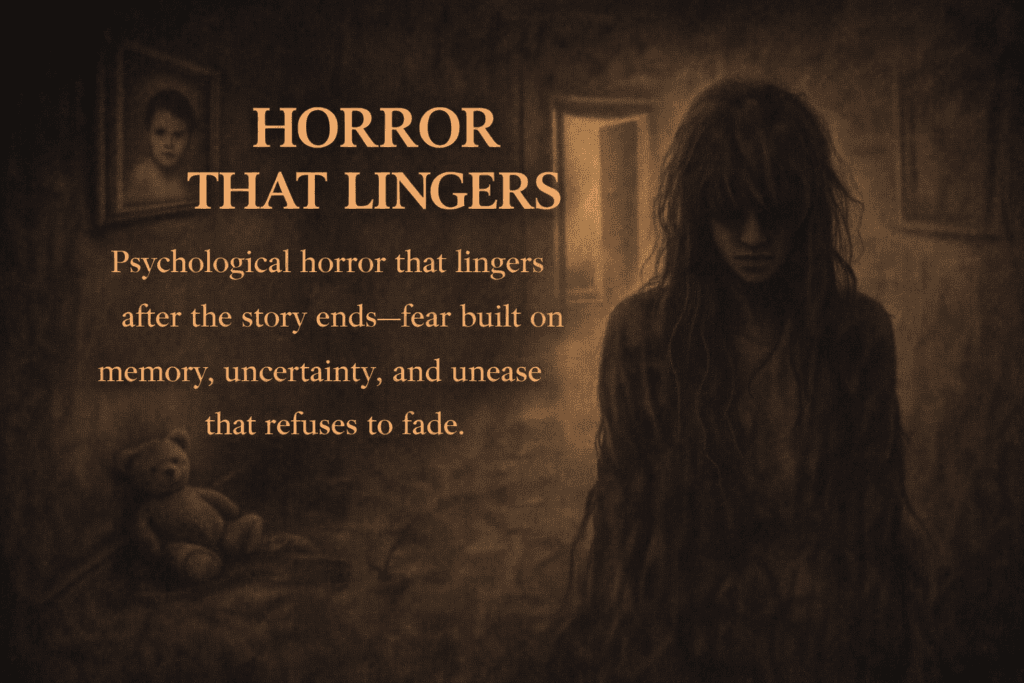
Instead, it leaves something behind. A thought. A sensation. A memory that refuses to settle. Horror that lingers doesn’t shout for attention—it waits, quietly resurfacing long after the story ends.
That persistence is not accidental. It’s the point.
Why Lingering Horror Feels Different
Immediate fear fades. Shock burns out quickly.
Lingering horror behaves differently.
Rather than overwhelming the reader in the moment, it embeds itself slowly. Days later, a scene resurfaces. A choice feels wrong in hindsight. A line of dialogue refuses to stay forgotten.
Gradually, unease reconnects itself to memory.
This delayed response places lingering dread firmly within psychological horror. Here, fear doesn’t rely on climax. It survives through absence.
Lingering Horror Begins With Restraint
Horror that lasts rarely announces itself.
Instead, it withholds.
There is no clear escalation.
No definitive threat.
No moment of release.
This restraint often begins with quiet terror, where almost nothing happens, yet tension never dissipates. The reader waits for escalation that never arrives.
When a story ends in that state, the tension has nowhere to go.
So it remains.
When Certainty Never Arrives
Lingering horror depends on unresolved doubt.
Not confusion—but ambiguity that feels permanent.
Stories shaped by unreliable narration excel at this. When perception collapses without confirmation, the reader inherits the instability.
You don’t know what was real.
You don’t know what mattered.
You don’t know what you missed.
That lack of resolution becomes the fear itself.
Familiar Spaces Make Fear Persistent
Lingering horror attaches itself to familiarity.
If a setting feels distant, fear fades with distance. However, when horror inhabits everyday spaces, it follows the reader beyond the page.
That’s why when home becomes the enemy produces such lasting unease. You don’t abandon your home after finishing a story. You return to it.
Memory overlays reality. Normal spaces feel subtly altered.
The horror doesn’t stay contained.
Innocence Makes Lingering Worse
When horror corrupts innocence, its aftereffects deepen.
In when innocence turns unsettling, fear resurfaces unexpectedly—often in moments that should feel safe. That contradiction is difficult to reconcile, so the mind keeps returning to it.
Lingering horror thrives on that dissonance.
It doesn’t demand attention immediately.
It resurfaces when you least expect it.
Lingering Horror Resists Explanation
Explanation neutralises fear.
Once something is fully understood, it loses power. Lingering horror avoids explanation deliberately. It offers just enough information to provoke interpretation—but never enough to settle it.
As a result, the reader continues working on the story after it ends, attempting to impose order on what refuses to resolve.
That effort sustains the dread.
A Story That Refuses to Let Go
This slow persistence defines The Diary of Cabin 313.
The horror doesn’t rely on confrontation or revelation. Instead, it unfolds through repetition, isolation, and gradual acceptance. The narrative offers records rather than conclusions, leaving gaps the reader instinctively tries to fill.
By the end, nothing feels resolved—yet everything feels finished.
That contradiction is where lingering horror lives.
Why Lingering Horror Feels Personal
Lingering horror doesn’t rely on scale.
It doesn’t require epic stakes or dramatic endings. One unresolved thought is enough. One unanswered question is enough.
Because of that intimacy, readers don’t simply remember these stories—they internalise them. Fear doesn’t feel external anymore. It feels remembered.
That memory is difficult to dismiss.
When the Story Ends but the Fear Doesn’t
Many lingering horror stories conclude quietly.
Nothing changes.
Nothing improves.
Nothing escalates.
The narrative simply stops observing.
That lack of closure isn’t frustrating—it’s unsettling. The reader understands that the horror didn’t end. It merely continued without them.
This acceptance, rather than resolution, is what allows fear to persist.
Who Lingering Psychological Horror Is For
This cluster resonates with readers who:
- Think about stories long after finishing them
- Feel unsettled without knowing why
- Prefer implication over explanation
- Recognise fear that survives without escalation
If you’ve ever closed a book and felt uneasy rather than frightened, lingering horror has already done its work.
The Fear That Waits
Horror that lingers doesn’t demand attention.
It waits.
It returns in quiet moments. In familiar places. In thoughts you didn’t invite. Its strength lies not in intensity, but in persistence.
That endurance is not a flaw. It’s the design.
If This Stayed With You
That reaction matters.
Psychological horror reaches its full strength not when it frightens you—but when it refuses to leave.
The Diary of Cabin 313 was written for readers who understand that the most unsettling stories are the ones that don’t end cleanly. If this post stayed with you longer than expected, that lingering discomfort is exactly the point.