Some horror stories ask you to suspend disbelief.
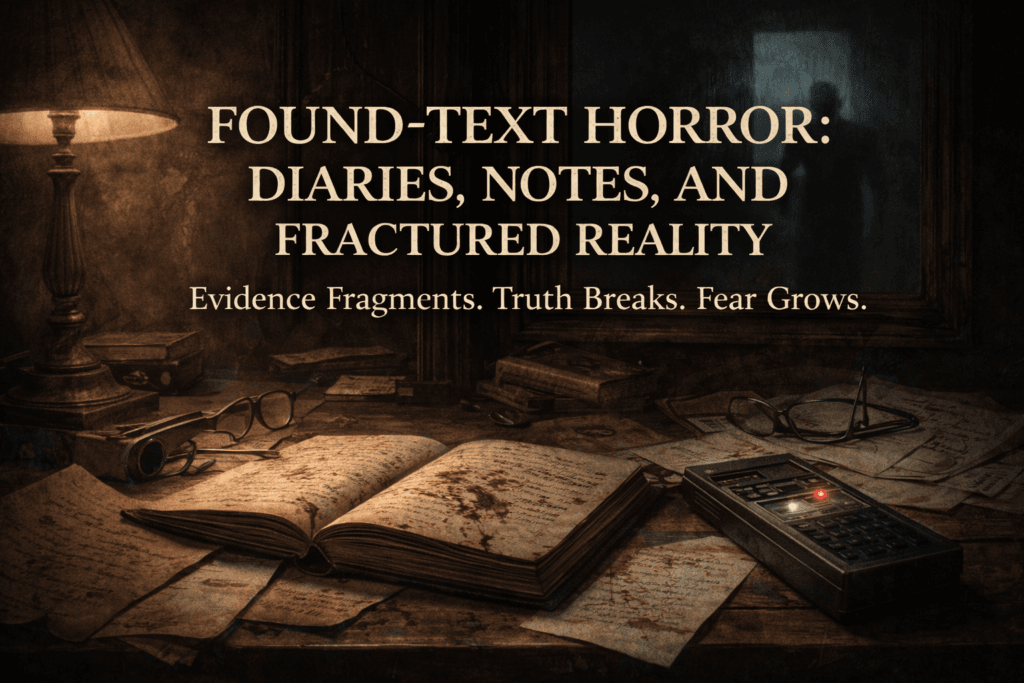
Found-text horror asks you to trust the evidence.
A diary feels private.
A note feels urgent.
A recording feels objective.
These formats don’t present themselves as fiction. They pose as artifacts—things that weren’t meant to be read, but survived anyway. That illusion of authenticity makes found-text horror uniquely disturbing.
You aren’t watching a story unfold.
You’re uncovering one.
Why Documentation Feels Safer Than Memory
Human memory shifts under pressure. We accept that instinctively.
Documents feel different.
A written record suggests permanence. A date implies order. A signature implies responsibility. Found-text horror exploits that trust before the story itself even begins.
That’s why this form sits so naturally within psychological horror. The genre already attacks perception. Found-text horror simply hands that attack a physical shape.
Fragmentation Is the Point, Not a Gimmick
Found-text horror rarely arrives intact.
Pages go missing.
Entries skip days—or years.
Sentences trail off mid-thought.
These gaps force participation. The reader must assemble meaning from fragments while knowing the picture will never fully align.
Unlike traditional narration, found-text horror refuses continuity. It breaks reality into pieces and hands them to the reader without instructions.
That act of reconstruction becomes part of the fear.
When Authority Begins to Erode
At first, the text feels grounded.
Dates line up.
Details feel mundane.
The voice sounds reasonable.
Then contradictions appear. A memory changes. A name shifts. An event repeats with new details.
Because the format feels official, the reader works harder to rationalise the inconsistencies. You don’t want to abandon the document—you want to fix it.
This collapse mirrors what happens in when you can’t trust the narrator. The difference is that here, the narrator wears the mask of documentation.
When the Text Becomes the Only Witness
Found-text horror often isolates its characters without stating it outright.
There’s no one left to explain the entries.
No voice outside the record to provide clarity.
No authority beyond the page.
The document becomes the final witness.
That shift pushes the story toward isolation without escape, where mental collapse feels inevitable because no external truth remains.
Once the text stands alone, doubt has nowhere to go but inward.
Domestic Spaces as Evidence
Found-text horror frequently embeds itself in ordinary places.
Notes left on kitchen counters.
Journals hidden under beds.
Recordings made in hallways and bedrooms.
These are intimate spaces, not neutral ones.
That proximity links found-text horror closely with when home becomes the enemy, where familiarity doesn’t protect the characters—it implicates them.
The home doesn’t just witness the horror.
It records it.
Time Stops Behaving Inside Documents
Another defining trait of found-text horror is temporal instability.
Entries appear out of order.
Dates repeat.
Time folds in on itself.
Because documentation implies chronology, these distortions feel profoundly wrong. The reader senses that reality itself has lost sequence.
This destabilisation doesn’t rely on spectacle. It relies on recognition. We know how records should behave.
When they don’t, something fundamental breaks.
A Story That Refuses to Add Up
This approach defines The Diary of Cabin 313.
The story unfolds through records that promise clarity but deliver contradiction. Each entry feels sincere. Each detail feels precise. And yet the whole never resolves into certainty.
The fear doesn’t come from revelation.
It comes from realising that documentation decays just like memory.
By the time the reader recognises the collapse, it’s already complete.
Why Found-Text Horror Feels Personal
Found-text horror never feels like it’s addressing an audience.
It feels discovered. Accidental. Unintended.
That distance creates intimacy. You feel like an intruder rather than a reader. The act of reading becomes morally uncomfortable.
You weren’t meant to see this.
You weren’t meant to know.
That discomfort lingers long after the final entry.
Closure Would Destroy the Effect
Found-text horror rarely explains itself fully.
There’s no final authority.
No clean resolution.
No voice to confirm what really happened.
Instead, the fragments remain—unfinished, contradictory, unresolved.
That unresolved state feeds directly into horror that lingers, where fear survives because the mind refuses to stop searching for answers.
The story doesn’t end.
It disperses.
Who Found-Text Horror Is For
Found-text psychological horror resonates with readers who:
- Enjoy piecing meaning together from fragments
- Feel unsettled by contradiction rather than action
- Trust atmosphere over explanation
- Prefer cognitive unease to spectacle
If certainty comforts you, this format exists to dismantle it.
Where This Path Leads Next
Once horror abandons linear narration, it often moves closer.
The fragments stop feeling distant.
The space shrinks.
The fear becomes intimate.
That progression continues in when home becomes the enemy, where proximity replaces fragmentation—and safety dissolves completely.
If Discovered Stories Disturb You
If this post made you uneasy about records, journals, and written proof, that reaction matters.
Found-text horror works because it undermines the systems we trust most.
The Diary of Cabin 313 was written for readers who believe documentation equals truth—until they realise that belief is fragile. If the fragments in this post stayed with you, they’ve already done their work.