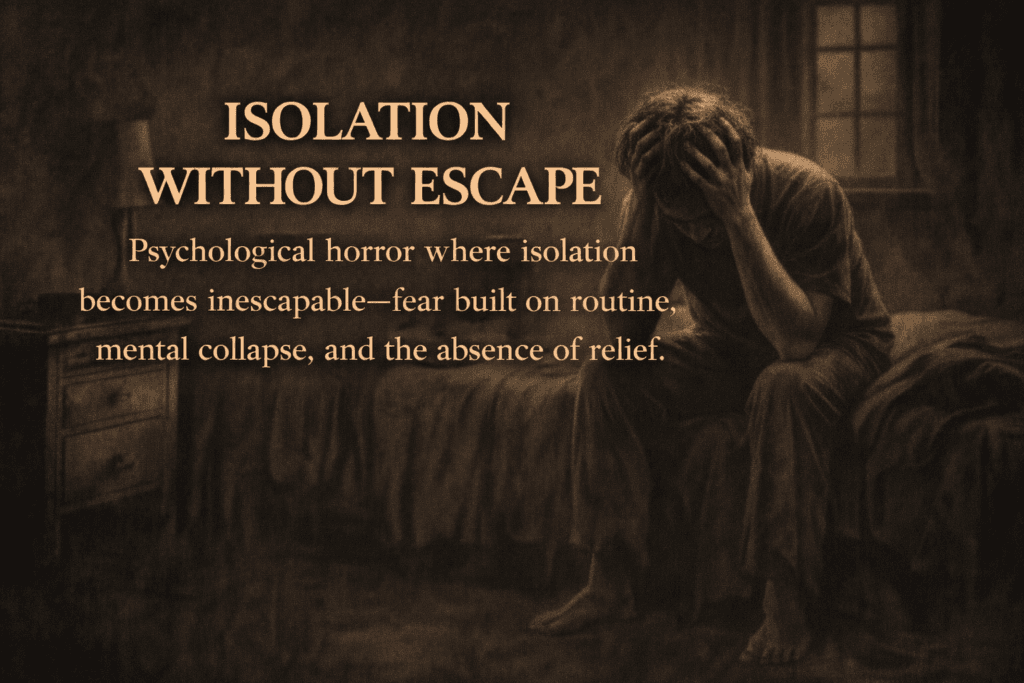
Isolation doesn’t always arrive as abandonment.
Sometimes, it arrives as continuity.
The same room.
The same routine.
The same thoughts repeating without interruption.
Psychological horror understands that isolation doesn’t require distance from others. It only requires the absence of relief. When escape feels unnecessary—or impossible—the mind begins to fold inward.
That inward collapse is where true isolation begins.
Why Psychological Isolation Is More Effective Than Physical Confinement
Physical confinement announces itself. Locked doors demand resistance. Barriers invite confrontation.
Psychological isolation does the opposite.
It convinces characters that escape would be irrational. Excessive. Unwarranted. As a result, no one leaves—not because they can’t, but because they don’t believe they should.
This is why isolation sits at the core of psychological horror. The genre doesn’t trap bodies. It traps interpretations.
Isolation Often Begins With Routine
Isolation rarely feels sudden.
Instead, it settles in gradually.
Days blur together.
Conversations repeat.
Silence stretches without tension—at first.
This slow narrowing often begins in quiet terror, a state where almost nothing happens, yet unease quietly takes hold. Nothing escalates. Nothing resolves. The mind waits for interruption that never comes.
Isolation without escape is what follows when that tension is never broken.
When Familiar Spaces Offer No Exit
Isolation intensifies when it occurs in spaces meant to comfort.
Homes, rooms, workplaces—places designed for stability—become psychological loops. You move through them repeatedly, yet never progress.
This makes isolation a natural continuation of when home becomes the enemy. Once the environment stops offering reassurance, it also stops offering escape.
The walls don’t close in.
They remain exactly where they’ve always been.
The Absence of Witnesses
Isolation horror often removes witnesses quietly.
Not through disappearance, but through irrelevance.
Other people exist—but they don’t see.
They listen—but they don’t hear.
They respond—but never to the right thing.
As a result, characters experience fear alone, even in company. Validation never arrives. Confirmation never appears.
That absence pushes isolation toward mental erosion rather than panic.
Thought Becomes the Only Companion
Once isolation settles, thought fills the vacuum.
The mind loops.
Memories replay.
Interpretations harden.
Without interruption, doubt transforms into certainty—even when it’s wrong. Fear stops asking questions and starts providing answers.
This internal enclosure mirrors the collapse seen in when you can’t trust the narrator, where perception deteriorates not through madness, but through unchecked reflection.
The danger isn’t distortion.
It’s reinforcement.
Silence Is Not Peaceful Here
In isolation-based psychological horror, silence doesn’t soothe.
Instead, it amplifies.
Without external noise, internal sensations grow louder. Thoughts echo. Small disturbances feel enormous because nothing competes with them.
This makes isolation a natural escalation after when horror begins with a sound. Once sound disappears—or becomes meaningless—the mind turns inward completely.
Fear no longer needs a trigger.
Time Loses Its Shape
Isolation distorts time.
Minutes stretch.
Days collapse.
Events lose sequence.
Without external markers, the mind struggles to measure progress. As a result, fear feels endless—not because it escalates, but because it doesn’t move.
This temporal stagnation deepens dread more effectively than urgency ever could.
A Story Where Leaving Never Happens
This psychological enclosure defines The Diary of Cabin 313.
The horror doesn’t rely on physical restraint. Instead, it unfolds through repetition, isolation, and the quiet certainty that nothing outside the current space matters anymore.
By the time the reader recognises confinement, the character has already accepted it.
That acceptance is the most frightening moment of all.
Why Isolation Feels Intimate
Isolation horror doesn’t rely on scale.
There’s no need for vast emptiness or dramatic abandonment. One room is enough. One voice is enough. One unchallenged thought is enough.
Because of that intimacy, readers don’t observe isolation—they experience it.
The fear doesn’t feel external.
It feels internalised.
When Escape Feels Illogical
One of the defining features of this cluster is resistance to escape.
Characters don’t try to leave. Or, if they do, they quickly abandon the effort. The idea feels disruptive. Inconvenient. Wrong.
This false logic keeps them contained without force. Isolation persists not because of barriers, but because of belief.
That mental lock is far harder to break.
Isolation Doesn’t End. It Persists
Even when isolation-based stories conclude, the state often remains.
The environment doesn’t change.
The routine doesn’t break.
The perspective doesn’t widen.
Instead, the story stops observing the character.
That unresolved persistence feeds directly into horror that lingers, where fear survives because nothing definitively ended.
Isolation doesn’t resolve.
It stabilises.
Who Isolation Horror Is For
This cluster resonates with readers who:
- Feel disturbed by stagnation rather than threat
- Recognise fear that grows through repetition
- Prefer psychological enclosure over physical danger
- Understand that loneliness isn’t always absence
If you’ve ever felt trapped without knowing why, this horror speaks directly to you.
Where This Path Leads Next
Once isolation becomes the norm, fear stops demanding attention.
It waits.
The final step isn’t escalation—it’s endurance.
That inevitability brings us naturally to horror that lingers, where dread survives long after the story ends because it never required resolution.
If This Felt Uncomfortably Familiar
That reaction matters.
Isolation-based psychological horror works because it reframes stillness as threat and routine as confinement.
The Diary of Cabin 313 was written for readers who understand that the most terrifying prisons aren’t locked—they’re accepted. If this post felt close to home, that recognition is exactly the point.