Some horror destroys the body.
Possession horror preserves it.
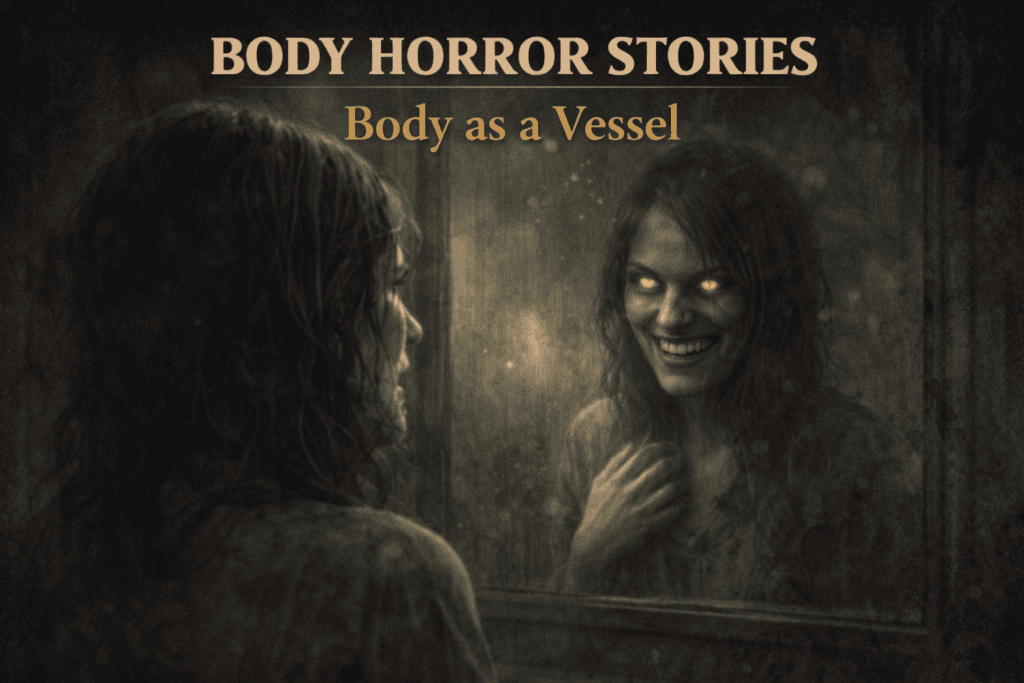
In possession body horror, the body does not collapse, mutate beyond recognition, or disappear. Instead, it remains functional, recognisable, and intact. However, it no longer belongs exclusively to the person inside it. Something else arrives, settles, and begins to use the body as if it were designed for occupation.
That distinction matters. Possession body horror is not about becoming monstrous. It is about becoming useful. The terror does not come from visible damage but from the quiet realisation that the body is now a shared space—and the owner no longer has final authority.
Readers drawn to possession body horror are not looking for shock. Instead, they seek sustained unease, awareness without agency, and the slow horror of being present while something else takes control.
What Defines Body-as-a-Vessel Horror
Body-as-a-vessel narratives focus on occupation rather than alteration.
Unlike transformation-driven horror, the body does not need to change dramatically. Unlike extraction narratives, nothing is removed. Instead, the body becomes a container, conduit, or interface for an external presence.
Several traits define possession body horror consistently:
- The body remains structurally intact
- Awareness persists throughout occupation
- Control erodes gradually rather than instantly
- The invading presence is internal and ongoing
Because the body survives, the horror lasts longer. The reader is forced to sit with the consequences rather than escaping through destruction or death.
Why Possession Horror Feels Intimately Violating
Possession horror attacks the idea of ownership.
The body is assumed to be private. When something else enters and refuses to leave, that assumption collapses. The horror is not rooted in pain alone but in the violation of boundaries that were never meant to be crossed.
Moreover, possession body horror reflects a fear that is deeply human: the fear of being conscious while overridden. The self remains present, yet decision-making power slips away. As a result, the body becomes a stage rather than a sanctuary.
This is why possession horror feels quieter than other body-horror modes—and far more invasive.
Awareness Without Control
In possession body horror, awareness is not mercy. It is the punishment.
Characters feel their bodies respond to impulses they did not initiate. Hands move. Words emerge. Actions unfold without consent. However, consciousness never fully disappears. The victim remains trapped behind their own eyes.
This dynamic places possession horror in direct conversation with Loss of Bodily Autonomy. In both cases, control erodes while perception remains sharp. The body continues functioning, but authority has been reassigned.
The horror intensifies not because something happens once, but because it keeps happening.
Possession Versus Transformation
Possession body horror is often mistaken for transformation horror, yet the distinction is crucial.
Transformation horror focuses on becoming.
Possession horror focuses on hosting.
In transformation narratives, identity erodes through physical change. In possession narratives, identity remains intact but powerless. The body does not need to look different to feel alien.
However, possession frequently intersects with Unwanted Transformation when occupation begins to reshape behaviour, posture, or instinct. The key difference lies in origin. Transformation grows from within. Possession arrives from elsewhere.
Together, they form a progression rather than a contradiction.
The Body as Infrastructure
In many possession body horror stories, the body becomes infrastructure.
It breathes, walks, speaks, and reacts in service of another presence. Muscles obey unfamiliar rhythms. Reflexes adjust to external priorities. Survival systems are repurposed.
This reclassification is deeply unsettling. The body is no longer an expression of self. It is a resource being managed.
Because the body continues functioning effectively, resistance becomes harder to justify. From the outside, everything appears normal. Only the person inside understands the extent of the occupation.
Consent and the Illusion of Invitation
Some possession narratives complicate the horror by suggesting consent.
A door was opened. A ritual completed. A choice made under duress. However, in possession body horror, consent is always partial or manipulated. The consequences exceed the agreement.
What begins as cooperation becomes captivity. The presence does not leave when asked. Instead, it settles deeper.
This erosion of consent reinforces the core terror: the body is no longer a private domain. Agreements dissolve. Boundaries fail.
Permanence and the Fear of Continuation
Possession body horror rarely offers clean resolution.
Exorcism fails. Separation proves temporary. Even when the presence recedes, traces remain. Habits persist. Thoughts echo. The body remembers being used.
As a result, possession horror often ends not with freedom, but with accommodation. Life continues in a compromised state. The body adapts to occupation rather than expelling it.
This permanence separates possession horror from momentary scares. The reader leaves knowing the damage is ongoing.
Possession Body Horror Within Body Horror Stories
Possession narratives occupy a unique position within Body Horror Stories.
They require:
- Awareness without escape
- Control without consent
- Function without ownership
Because the body survives, the horror lingers. There is no visual climax to release tension. Instead, dread accumulates quietly.
For readers who prefer psychological weight over spectacle, possession body horror delivers sustained discomfort.
The Emotional Geometry of Being Used
What ultimately defines possession horror is emotional geometry.
The body is present.
The mind is present.
Authority is absent.
That triangle creates a form of horror that is difficult to resolve. The self cannot leave. The body cannot resist. The presence cannot be ignored.
Every action becomes suspect. Every movement raises doubt. The body no longer guarantees intention.
Featured Possession Horror Read
Few stories explore occupation with such restraint as Marked by the Deep.
In this narrative, the body responds to an external presence that does not announce itself loudly. Changes emerge through behaviour, instinct, and compulsion rather than visible damage. Awareness remains intact, even as priorities shift.
The horror unfolds through use rather than violence. The body becomes an interface—reacting, adapting, and responding to something that does not fully belong to the human world.
This makes Marked by the Deep a precise fit for possession body horror grounded in atmosphere rather than spectacle.
Why Possession Body Horror Endures
Possession body horror persists because it reflects a foundational fear:
the fear that the body can be occupied without being destroyed.
No monster needs to appear. No mutation needs to finish. The body works. Life continues. Yet ownership is gone.
For readers who want horror rooted in awareness, permanence, and violation without release, possession body horror remains one of the genre’s most unsettling modes.