Decay is not always a tragedy.
In gothic horror, collapse often feels inevitable long before it arrives. The structure was never stable. The foundation was never sound. The ending—whether emotional, architectural, or generational—unfolds slowly, not because evil intervenes, but because decline was always woven into the design.
This is the quiet truth at the heart of gothic decay horror: ruin is not failure.
It is destiny.
Gothic horror does not argue with collapse. Instead, it observes it with patience, allowing the reader to understand that some things were never meant to endure.
Decay as an Aesthetic, Not an Accident
Unlike genres that frame deterioration as loss, gothic horror treats decay as meaningful.
Cracked walls carry more truth than polished facades. Fading estates reveal more than restored ones. Rot exposes history rather than erasing it. Because of this, gothic decay horror does not rush toward repair. It lingers in damage, examining what the damage reveals.
The reader does not ask how to stop the collapse.
They ask what the collapse was always trying to say.
This perspective explains why gothic settings feel mournful rather than chaotic. The decay unfolds slowly, deliberately, as if guided by an internal logic that no longer needs justification.
Ruin as a Form of Continuity
Gothic horror rarely presents ruin as an endpoint.
Instead, decay functions as continuation.
A family declines but persists.
A house crumbles but remains occupied.
A relationship erodes but does not end.
In this way, gothic decay horror aligns closely with emotional collapse explored earlier in When Love Rots. Just as intimacy can corrode without disappearing, environments and legacies can decay without vanishing.
The horror lies not in destruction, but in endurance.
Why Gothic Horror Rejects Restoration
Modern storytelling often frames restoration as moral victory. Gothic horror resists this impulse.
Repair feels dishonest in a world shaped by inherited damage. Restoration would erase evidence. It would deny history. Gothic horror prefers exposure.
Ruin tells the truth.
Preservation lies.
This is why gothic decay horror often unfolds in places that remain unrepaired—old estates, abandoned wings, coastal ruins, collapsing foundations. These spaces do not ask to be saved. They ask to be witnessed.
When Decay Becomes Identity
Over time, decay stops feeling external.
It becomes internalised.
Characters begin to align themselves with the ruin around them. They move more carefully. They expect less. They adjust their desires to fit what remains possible.
This adjustment marks a crucial gothic shift: collapse no longer feels tragic. It feels appropriate.
In Marked by the Deep, this alignment becomes unmistakable. The environment does not destroy the characters outright. Instead, it reshapes their expectations until resistance feels unnatural. Decay does not attack. It absorbs.
Here, gothic decay horror reveals its most unsettling truth: surrender often feels like relief.
The Comfort of Inevitability
One reason ruin resonates so deeply in gothic horror is that inevitability offers a strange comfort.
When collapse feels destined, responsibility dissolves. Guilt softens. Struggle feels unnecessary. Characters stop asking “What went wrong?” and begin asking “How long has this been waiting?”
This emotional shift mirrors the earlier erosion of intimacy in When Love Rots, where decay becomes tolerable because it unfolds gradually. In both cases, the reader recognises a dangerous peace: acceptance without healing.
Gothic horror does not condemn this peace.
It examines it.
Ruin Without Rescue
Unlike survival horror, gothic decay horror does not promise escape.
There is no intervention.
No rebuilding phase.
No outside force arriving in time.
The ruin stands because nothing arrives to stop it.
This quiet acceptance of collapse often mirrors what unfolds across generations, where ruin no longer feels personal but inherited. That progression deepens further in Cursed Bloodlines, where decay stops belonging to places and begins living inside family names
Decay thrives in silence.
When Beauty and Destruction Converge
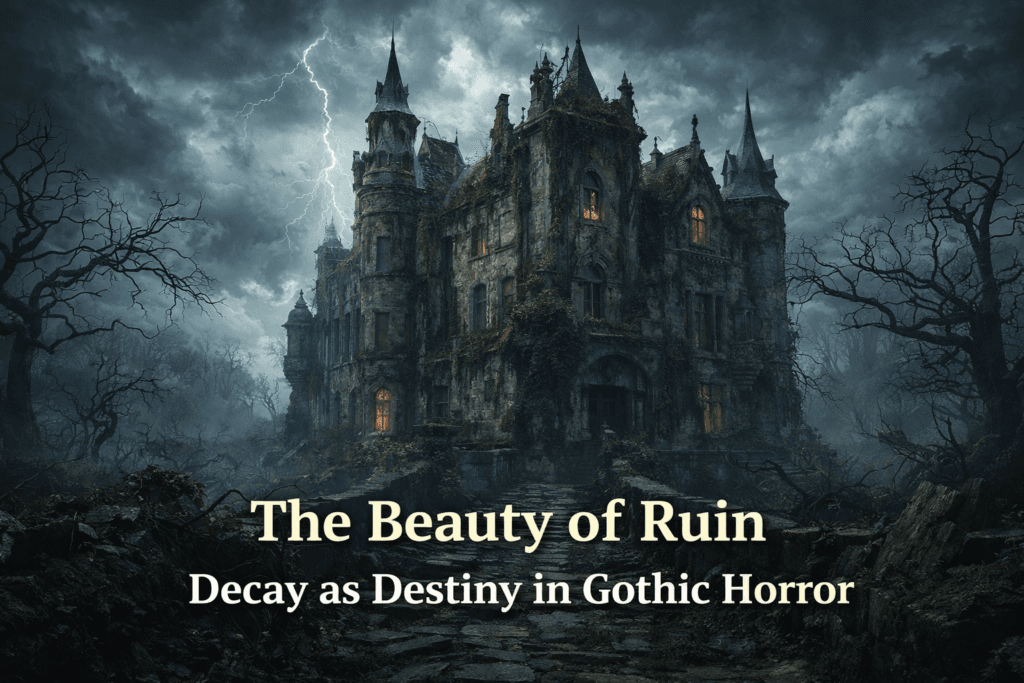
Gothic horror does not shy away from the beauty of ruin.
Moss-covered stone.
Faded tapestries.
Weathered facades.
These images do not romanticise decay—they aestheticise truth. They show what remains after resistance ends.
In gothic decay horror, beauty emerges not despite collapse, but because of it. The ruin feels honest. It no longer pretends to be whole.
This honesty draws the reader closer rather than pushing them away.
Decay as Inheritance
Ruin rarely begins in the present.
It arrives through lineage—through decisions made long ago, through foundations laid carelessly, through damage passed forward rather than repaired. Collapse, in gothic horror, often belongs to the family rather than the individual.
This inherited ruin connects naturally to cursed bloodlines, where decay feels prewritten rather than accidental. The present generation does not cause the collapse. They merely inherit its final stage.
Understanding arrives too late to matter.
The Reader’s Recognition
Gothic decay horror resonates because it mirrors lived experience.
People remain in failing structures all the time—relationships, families, institutions—because collapse unfolds slowly. The damage feels manageable until it isn’t. By the time clarity arrives, departure feels impossible.
Gothic horror does not judge this recognition.
It validates it.
That validation is what keeps readers engaged. The genre does not promise salvation. It offers understanding.
Where Ruin Leads
Decay does not end the gothic journey. It deepens it.
Once decay feels inevitable, the reader is prepared for what follows. Not rescue, but inheritance. In Cursed Bloodlines, ruin no longer waits patiently in walls or relationships; it travels through blood, memory, and obligation.
Ruin becomes the ground on which everything else stands.