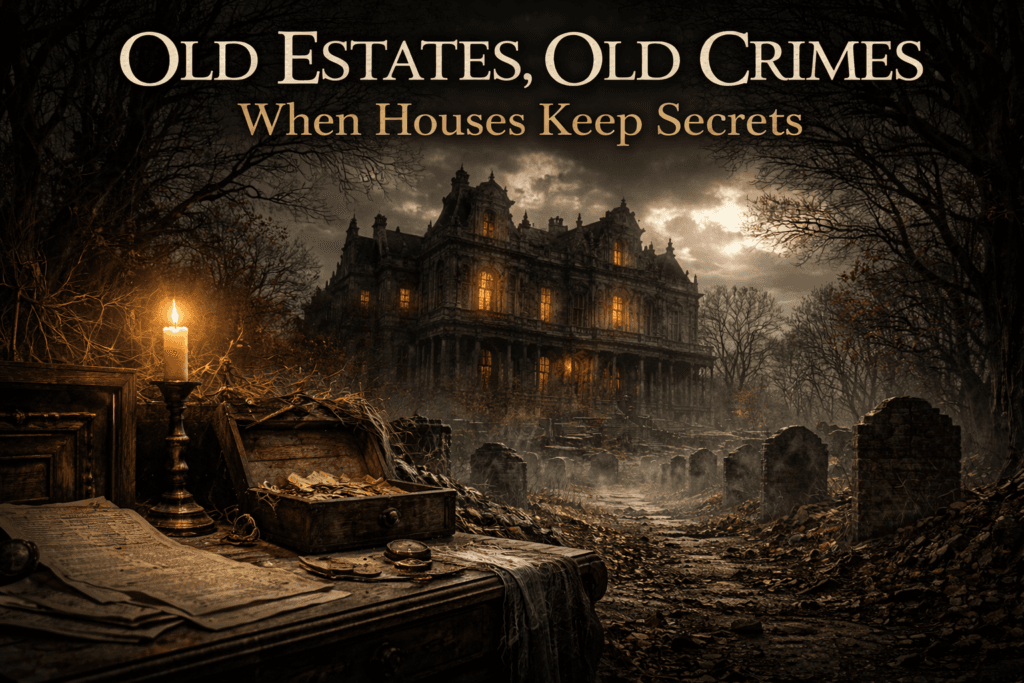
Old estates do not simply stand.
They keep.
They keep records without paper. They keep arguments without voices. They keep grief pressed into wallpaper and guilt sealed beneath floorboards. In the world of gothic horror, an estate is not a backdrop—it is a witness that never forgets, and a judge that never leaves.
That is why gothic haunted estates feel different from ordinary haunted houses. The fear does not come only from what moves in the dark. It comes from what has already happened—what was concealed, softened, renamed, and buried too poorly to stay buried.
History refuses burial.
So the house remembers for everyone.
Estates as Moral Archives
An ordinary home holds memories because people lived there.
An estate holds memories because generations did.
Time thickens in such places. Layers accumulate. The past does not recede—it compresses. As a result, the present begins to feel borrowed, as though the current occupants live on top of something unfinished.
This is the distinct pressure gothic haunted estates create: not immediate danger, but an awareness of weight. The reader senses that the building carries a story that was never concluded. The estate feels intact, yet unresolved.
Gothic horror returns to this structure again and again because it mirrors a familiar truth: some places are too old to be innocent.
When Luxury Becomes Suspicious
Estates often appear beautiful at first glance.
Tall windows. Grand halls. Family portraits. Carefully maintained grounds. Yet gothic horror trains the reader to distrust beauty, because beauty can serve concealment. A polished corridor can still lead to a locked door. A restored ballroom can still sit above rot.
In gothic haunted estates, grandeur becomes a mask. The house looks preserved, but preservation often means something has been kept from view. The question shifts from “What is wrong here?” to “What has been hidden so long that it became part of the structure?”
That suspicion creates historical unease—the feeling that the past is present, not as a ghost, but as a system.
Secrets Built into Architecture
Gothic estates are not only haunted by what happened.
They are shaped by it.
A sealed wing suggests a choice. A bricked staircase suggests urgency. A room that no one enters suggests agreement. Even when no one speaks of the past, the building’s design keeps speaking.
This is why gothic haunted estates feel intentional. The house appears arranged around concealment, as though its corridors were designed to guide occupants away from truth and toward routine.
Over time, routine becomes obedience. The estate does not need to threaten anyone. It simply needs occupants to keep living as if nothing happened.
The Foundation That Will Not Settle
This is where The Foundation Beneath Us becomes the perfect companion to old-estate dread. It understands the most gothic truth of all: if the foundation is compromised, everything above it becomes a performance.
In that story’s spirit, the estate does not merely host secrets—it relies on them. The occupants may renovate, repaint, and rearrange furniture, yet the deeper structure remains unchanged. They live atop damage they did not cause, yet must still bear.
In gothic haunted estates, this is the terror: the past is not a chapter. It is load-bearing.
Old Crimes That Outlive the Criminal
Gothic horror rarely focuses on crime in a procedural way. Instead, it focuses on consequence.
The criminal may be dead. The witnesses may be gone. Yet the crime persists because it reshaped the place. It reorganized relationships. It demanded silence. It generated inherited behaviors that continue long after the original event fades from memory.
Here, the estate becomes the lasting participant.
It holds what people refuse to hold.
It repeats what families refuse to repeat.
It insists on continuity when everyone else attempts forgetting.
This is why the core fear lands so cleanly in old-estate gothic: history refuses burial not because of supernatural power, but because concealment never completes itself.
Why Families Protect Houses That Harm Them
A strange loyalty often surrounds gothic estates.
Families defend them. Inhabitants justify them. Even outsiders may treat them with respect. This reverence creates unease because it suggests the estate holds authority, and authority often protects wrongdoing.
People say:
- “It’s always been this way.”
- “We don’t go in there.”
- “That’s private.”
Those phrases function like locks. They keep the past in place.
This family protection connects naturally to inherited guilt and ancestral consequence, explored in Cursed Bloodlines . In that corridor, the estate becomes more than property. It becomes identity. Leaving it feels like betrayal. Questioning it feels like treason.
And so the house continues—undisturbed.
Witness Without Mercy
What makes gothic haunted estates so unnerving is that the house does not care about comfort.
It cares about continuity.
It will host celebrations on top of buried grief. It will hold weddings in rooms that once held confessions. It will accept laughter as easily as it accepted screams. The estate witnesses everything, yet offers no moral relief.
That neutrality becomes frightening, because neutrality makes concealment easier. If the house does not punish wrongdoing, then the wrongdoing can persist across generations, absorbed into tradition.
This is not a haunted house that attacks.
It is an estate that endures.
How Silence Becomes Part of the House
Silence in an estate is never empty.
It becomes structure: the unasked question, the unvisited room, the photo turned facedown, the story cut short. Over time, the silence becomes so consistent that it begins to feel normal.
This normalization is the mechanism through which secrets survive. People stop noticing gaps. They stop asking why certain corridors feel colder, why certain doors remain locked, why certain names are avoided.
Eventually, silence stops being a decision.
It becomes inheritance.
That is why old-estate dread pairs so naturally with the atmospheric pressure explored in Haunted Houses That Remember You, where the house “remembers” not through spectacle, but through felt awareness—through the way presence persists.
The Estate as a Story That Will Finish Itself
Gothic horror treats estates like unfinished narratives.
They contain beginnings without endings. They preserve clues without resolution. They sustain pressure until someone finally acknowledges what the estate has been holding.
However, acknowledgment in gothic horror rarely liberates. It usually confirms that the present has been living inside a lie.
The estate does not want truth for justice.
It wants truth for completion.
That difference matters. Completion does not guarantee healing. Often, it guarantees consequence.
This is where gothic haunted estates become especially effective for historical unease: the reader senses the house will finish the story eventually—whether anyone wants it finished or not.
Why Readers Return to Old Estates
Readers return to old-estate gothic because it feels emotionally plausible.
Not because everyone lives in a manor, but because everyone understands inherited environments—places shaped by old decisions, old conflicts, old compromises. Many people live inside structures built by choices they did not make.
Gothic horror intensifies this recognition. It makes the hidden visible. It makes the buried heavy. It makes the house feel like a ledger that refuses to close.
That recognition is what the pillar frames at the highest level in Gothic Horror Stories: the genre does not ask “What will happen?” so much as “What has already happened—and why is it still here?”
The Secret Isn’t That Something Happened
The secret is that it never stopped.
The estate remains because the silence remains. The house keeps its shape because the family keeps its story unfinished. The rooms remain locked because the truth remains unspoken.
And so the house does what gothic houses always do:
It holds the past in place long enough for the present to become complicit.
That is the core fear of gothic haunted estates—history refuses burial, because burial would require honesty, and honesty would require tearing the house apart.
The Corridor Continues
If you feel the particular unease of old estates—beauty sharpened by suspicion, tradition stained by silence—then the next doors in the corridor open naturally through:
- Cursed Bloodlines where inheritance becomes obligation
- Haunted Houses That Remember You where place becomes presence
- Gothic Horror Stories where dread, decay, and legacy converge
In gothic horror, the past does not fade.
It settles into the architecture—until the house decides it has held enough.