Some horror arrives from outside.
However, the most disturbing horror begins after the body has already acted.
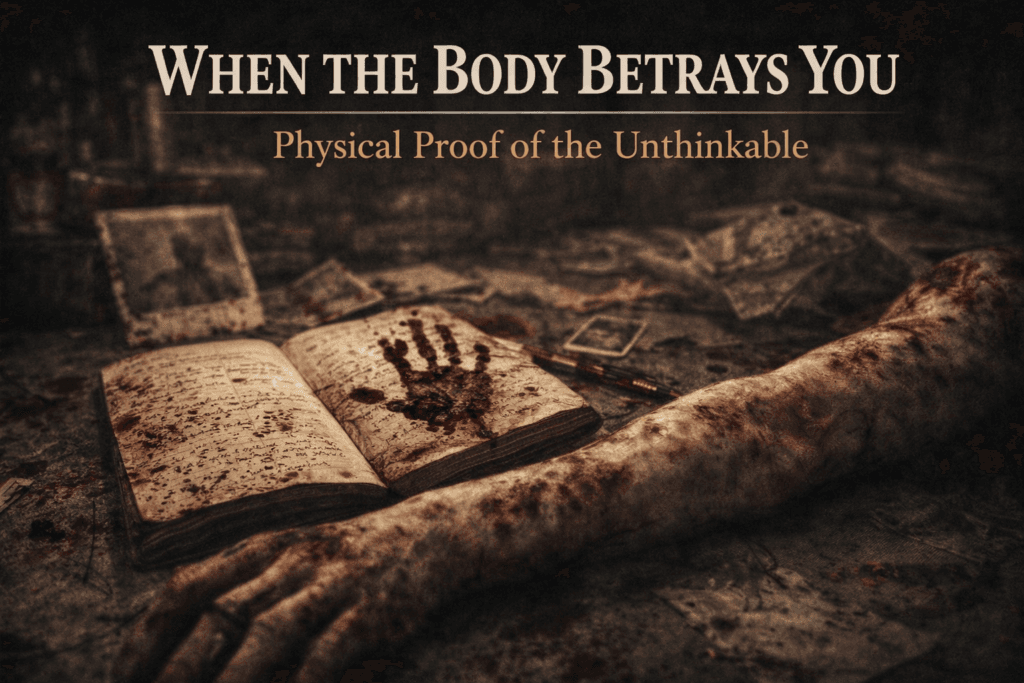
In the most unsettling disturbing horror stories, terror does not come from monsters, infection, or punishment alone. Instead, it emerges when the body leaves evidence behind—bruises, wounds, blood, altered spaces—and the mind cannot remember creating any of it. The body has done something. The self was not there to stop it.
Body betrayal horror centres on this rupture. Awareness returns too late. Memory collapses. Proof remains. The body stands as witness against the mind.
Readers drawn to disturbing horror stories of this kind seek a specific fear: the possibility that the body can act independently, decisively, and destructively—without consent, without recollection, and without explanation.
What Body Betrayal Horror Actually Is
Body betrayal horror explores mind–body collapse.
Unlike possession narratives, there may be no external force to blame. Unlike loss-of-control stories, the event has already occurred. The horror begins in retrospect, not anticipation. The body has moved, harmed, or killed—and the mind arrives afterward.
Several elements consistently define body betrayal horror:
- Physical evidence without memory
- Actions discovered rather than witnessed
- The body acting while the self was absent
- Attempts to reconstruct what happened
Because the act is already complete, the horror unfolds through investigation rather than survival.
Evidence Without Memory
The core fear of body betrayal horror is simple and devastating: the body remembers what the mind cannot.
Marks appear where there should be none. Objects are out of place. Spaces feel wrong. The body aches as if it has endured something significant. However, memory offers no explanation.
In disturbing horror stories, this gap becomes unbearable. The reader is forced to imagine what the body might be capable of when unobserved. The absence of memory turns the self into a suspect.
Why Body Betrayal Is More Disturbing Than Control Loss
Loss of control implies awareness during the act.
Body betrayal removes even that.
When control disappears, the self still witnesses harm. In body betrayal horror, the self arrives only after the damage is done. There is no moment of resistance. There is no opportunity to intervene. Responsibility becomes ambiguous.
This ambiguity corrodes identity. If the body committed the act, does the self share guilt? If the mind was absent, does innocence still apply?
Disturbing horror stories exploit this uncertainty relentlessly.
Reconstruction as Horror
Body betrayal horror forces reconstruction.
Characters retrace steps. They examine wounds. They search environments for clues. Each discovery deepens dread. Every piece of evidence suggests intention, effort, and duration.
Because the act required time, the reader understands that the body did not simply twitch or react. It acted.
Reconstruction replaces pursuit. The story does not ask whether the body will betray again. It asks what the body has already done.
The Body as an Unreliable Ally
In body betrayal narratives, the body becomes unreliable.
Sleep no longer offers rest. Blackouts feel dangerous. Gaps in time feel predatory. The body transforms into a potential threat—not because it is hostile, but because it is autonomous.
This collapse of trust distinguishes body betrayal horror from earlier clusters in Body Horror Stories. The fear is no longer external or procedural. It is internal and existential.
The self cannot escape the body. Therefore, the self cannot escape the threat.
From Punishment to Betrayal
Body betrayal often follows punishment.
After suffering has been inflicted—through judgment, ritual, or consequence—the body may internalise the damage. Healing refuses to occur. Pain resurfaces without cause. Injuries worsen overnight.
This progression links body betrayal to Flesh as Punishment. Once the body has been sentenced, it may continue enforcing that sentence on its own.
The punishment no longer needs an enforcer. The flesh remembers.
When Aftermath Turns Inward
Body betrayal also extends the logic of aftermath.
In Corpses & Aftermath, bodies remain as evidence of violence. In body betrayal horror, the body remains alive, yet still functions as evidence.
The difference is proximity. The evidence walks, breathes, and speaks. The reader cannot distance themselves from it. The body carries its own crime scene everywhere it goes.
This inversion intensifies dread by removing the boundary between investigator and suspect.
Documentation as a Survival Attempt
Many disturbing horror stories use documentation to manage betrayal.
Characters keep journals. They photograph injuries. They record timestamps. These records function as anchors—attempts to stabilise reality when memory fails.
However, documentation rarely saves them. Instead, it confirms the scale of the betrayal. Pages fill with proof. Patterns emerge. The body has a history the mind cannot access.
The horror escalates not through action, but through accumulation.
The Fear of What Comes Next
Body betrayal horror rarely ends with understanding.
Even if the past becomes clear, the future remains unstable. The body has proven capable. Therefore, it may act again. Sleep becomes a risk. Unconsciousness becomes a threat.
In disturbing horror stories, this anticipation eclipses fear of discovery. The question is no longer what happened, but what will happen next.
The self lives inside an unreliable machine.
Body Betrayal Within the Series Arc
Within the body horror series, body betrayal functions as the terminal fear.
- Vulnerability exposed the body
- Punishment judged it
- Aftermath documented damage
- Body betrayal reveals that the body no longer requires an external trigger
This cluster does not escalate violence. It escalates uncertainty. The horror no longer needs an event. It exists permanently.
Featured Disturbing Horror Read: The Diary of Cabin 313
Few disturbing horror stories embody body betrayal as precisely as The Diary of Cabin 313.
Told through fragmented records, the narrative centres on evidence discovered after the fact. The body’s actions emerge through documentation rather than memory. Each entry confirms that something has occurred—without granting understanding.
The horror grows through absence. What is missing becomes more terrifying than what is described. The reader shares the character’s position: piecing together a history the body remembers but the mind cannot.
This makes The Diary of Cabin 313 the definitive companion for body betrayal horror.
Why Body Betrayal Horror Endures
Body betrayal horror endures because it attacks the final assumption of safety:
that the self and the body are aligned.
When that alignment fails, no refuge remains. The body becomes an unknown variable. Identity fractures. Guilt becomes unavoidable.
For readers seeking disturbing horror stories rooted in evidence, memory loss, and internal collapse, body betrayal remains one of the genre’s most unsettling expressions.