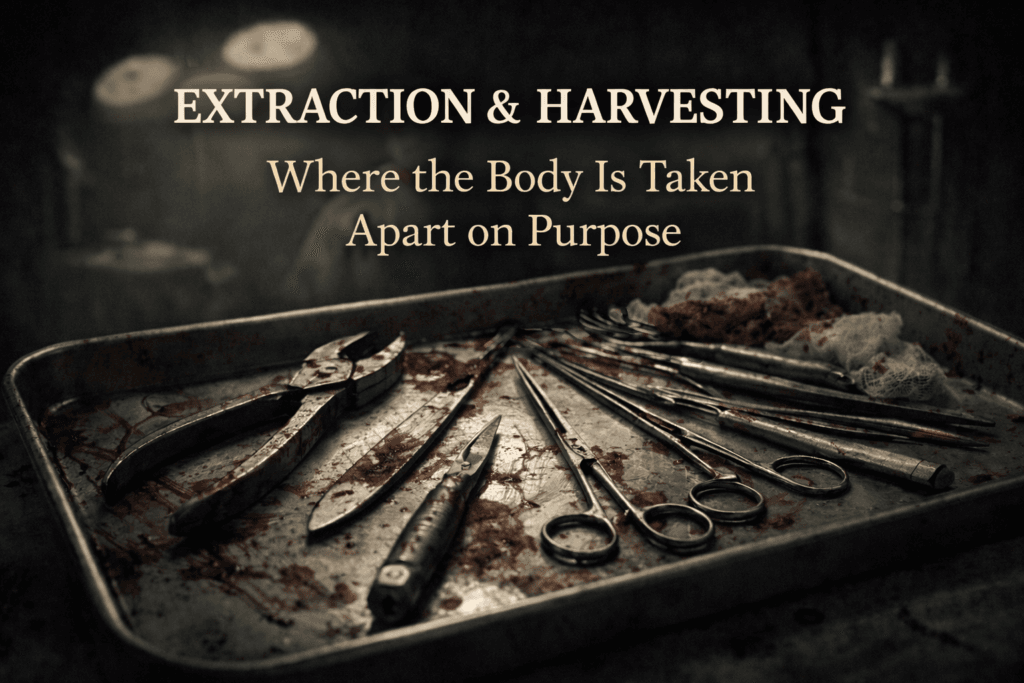
Some horror happens by accident.
However, extraction horror never does.
In the most unsettling body horror short stories, fear does not emerge from chaos or mutation alone. Instead, it grows from intention. Someone decides to take something from a living body. They plan the act. They prepare for it. Consequently, the body becomes a source of material rather than a self.
Extraction and harvesting horror thrives on this clarity. There is no misunderstanding. There is no natural progression. Instead, the story establishes purpose early and refuses to soften it. The body is violated because someone needs what it contains.
Readers drawn to body horror short stories of this kind do not seek spectacle. Rather, they want precision. They want to understand why removal happens and why the body becomes expendable.
What Defines Extraction & Harvesting Horror
Extraction horror focuses on deliberate bodily removal.
Unlike infection narratives, nothing spreads on its own. Unlike transformation horror, change is not the goal. Instead, the story revolves around taking something specific: teeth, organs, blood, tissue, or function. As a result, the body loses its status as a whole and becomes a collection of parts.
Several elements consistently define extraction-driven body horror short stories:
- Removal happens intentionally
- The body remains alive or aware
- The extractor understands the process
- The act serves a clear purpose
Because the story removes chance from the equation, the horror feels colder. The reader does not wonder if something will be taken. Instead, they wonder how much will remain afterward.
Why Extraction Horror Feels Transactional
Extraction horror reframes the body as currency.
First, someone assigns value. Then, someone calculates cost. Finally, someone collects. This sequence transforms flesh into inventory. Consequently, the body stops being personal and starts being practical.
In body horror short stories built around harvesting, the most disturbing element is usefulness. The story does not destroy the body in anger. Instead, it dismantles the body to gain something.
That purpose may involve ritual, survival, profit, or belief. Regardless, intention drives the act. Therefore, the reader cannot dismiss the violence as chaos.
Control Must Disappear Before Removal Begins
Extraction requires control.
Before anyone can remove anything, they must neutralise resistance. They restrain movement. They silence refusal. As a result, extraction horror naturally intersects with Loss of Bodily Autonomy.
In these narratives, autonomy does not vanish accidentally. Instead, someone removes it deliberately. Only then can the body become accessible.
This sequencing intensifies the fear. The reader understands that extraction represents the final stage of a process, not the beginning. First control disappears. Then the body opens.
Flesh as Punishment, Not Accident
Extraction horror rarely frames removal as random.
Instead, the story presents removal as consequence. A rule was broken. A debt remains unpaid. A ritual demands flesh. Therefore, the body absorbs punishment directly.
This logic aligns extraction horror with Flesh as Punishment. In both cases, the body becomes the medium through which judgment operates. The story uses removal to enforce meaning.
Because the removal carries moral weight, the act feels heavier. The reader does not simply witness harm. They witness sentencing.
Awareness During Removal
Extraction horror often preserves awareness.
The victim knows what is coming. They recognise the tools. They understand the sequence. Meanwhile, they cannot intervene. Consequently, anticipation replaces shock.
In short-form body horror, this awareness often carries more power than graphic detail. The moment before removal stretches longer than the act itself. The reader inhabits that waiting space.
As a result, extraction horror feels intimate. The reader experiences the violation through expectation rather than aftermath.
Why Short Fiction Amplifies Extraction Horror
Extraction & harvesting horror works especially well in short form.
Short narratives eliminate distraction. They remove side plots. They narrow focus. As a result, the story moves directly toward the act.
Many body horror short stories end immediately after removal. They refuse closure. Instead, they abandon the reader in the moment following extraction. This abruptness reinforces the transactional nature of the horror. The body served its purpose. The story owes nothing further.
When the Body Becomes Inventory
Extraction horror frequently introduces categorisation.
Characters list what can be taken. They note what remains. They measure recovery time. Consequently, the story strips the body of identity and replaces it with accounting.
These moments disturb readers because they resemble real systems. Medical charts. Industrial processes. Ritual tallies. The horror does not rely on fantasy. Instead, it mirrors familiar structures.
Therefore, extraction horror feels plausible even when it feels extreme.
Extraction Horror Within Body Horror Stories
Extraction & harvesting narratives occupy a central place within Body Horror Stories.
They mark the point where fear becomes procedural. The body no longer faces threat. Instead, someone processes it.
This shift separates extraction horror from chaos-driven violence. Everything follows a plan. That plan removes humanity piece by piece.
For readers seeking body horror short stories that feel intentional and merciless, extraction horror delivers sustained dread without spectacle.
Featured Body Horror Short Story: The Tooth Collector
Few body horror short stories depict extraction as cleanly as The Tooth Collector.
In this story, removal does not erupt impulsively. Instead, it unfolds methodically. Teeth do not symbolise pain alone. They carry value. Therefore, the story treats the body as a source rather than a victim.
Each extraction feels inevitable because preparation precedes it. The horror does not surprise the reader. Instead, it convinces the reader that nothing else could have happened.
This restraint makes The Tooth Collector an ideal example of extraction-driven body horror short stories.
Why Extraction & Harvesting Horror Endures
Extraction horror endures because it reflects an uncomfortable truth:
someone can take the body apart for reasons that make sense to them.
No accident triggers the act. No misunderstanding delays it. Someone removes flesh because it proves useful.
For readers who seek body horror short stories rooted in intention, control, and irreversible loss, extraction & harvesting remains one of the genre’s most disturbing expressions.