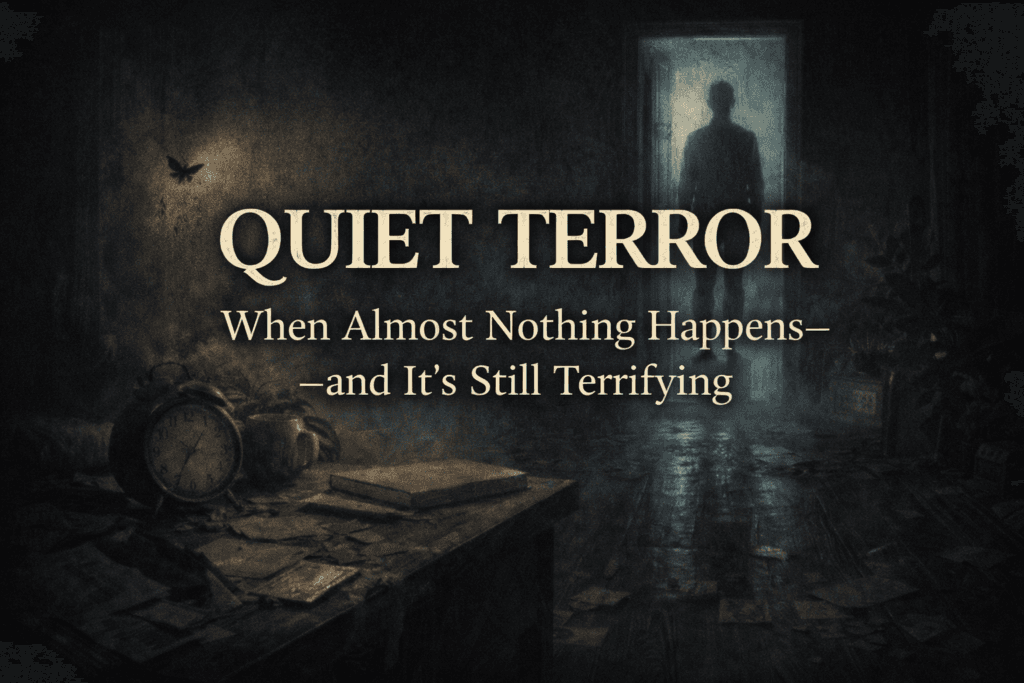
Some horror announces itself.
Doors slam. Figures appear. Violence escalates. The story makes sure you know exactly when to be afraid.
Quiet terror works differently.
In these stories, almost nothing happens. No sudden shocks. No dramatic reveals. Yet the tension never loosens. The unease grows not because events escalate—but because they don’t.
For many readers, this is where horror becomes unbearable in the best possible way.
When Silence Does the Work
Quiet terror relies on restraint.
Scenes linger longer than expected. Moments end without resolution. The story refuses to reassure the reader that everything is fine.
Instead of guiding emotion, it withholds it. That absence forces attention inward. You start scanning for meaning. You notice details that shouldn’t matter—but do.
This is why quiet terror often appeals to readers who already prefer psychological horror for readers who hate gore. The fear never comes from what’s shown. It comes from what refuses to clarify itself.
Nothing Happens… And That’s the Point
Psychological horror can take many forms. In quiet psychological horror, tension builds through delay.
A character waits.
A sound repeats.
A routine continues unchanged.
The lack of escalation becomes its own threat. You sense that something should break—but it doesn’t. The longer the story holds back, the more oppressive the atmosphere becomes.
This slow pressure distinguishes quiet terror from stories that rely on spectacle. Fear grows through anticipation rather than action.
Why Quiet Terror Feels More Intimate
When horror stays quiet, the reader has nowhere to hide.
There’s no distraction. No release. No external chaos to absorb attention. Every pause becomes heavy. Every silence feels deliberate.
Because the story refuses to explain itself, the reader begins to participate—testing theories, questioning motives, filling gaps.
That intimacy links closely with stories when you can’t trust the narrator, where doubt becomes the central source of fear.
Sound, Absence, and Repetition
Quiet terror often leans on subtle sensory cues rather than visual shocks.
A sound heard too often.
A laugh that shouldn’t be there.
A presence suggested but never seen.
Repetition replaces violence. The same detail appears again and again, each time slightly heavier than before.
This technique overlaps strongly with horror that begins with a sound, where fear persists because it never fully arrives.
When Quiet Becomes Inescapable
As quiet terror deepens, it often isolates its characters.
Social contact fades. Explanations disappear. The world narrows until the character has nowhere to turn except inward.
That collapse leads naturally into stories about isolation without escape, where silence stops feeling temporary and starts feeling permanent.
At that stage, the horror doesn’t need to act. The environment itself becomes oppressive.
A Story That Barely Raises Its Voice
This approach defines The Midnight Giggles.
The story doesn’t rush toward explanation or violence. It allows sound, repetition, and timing to carry the fear. The horror arrives quietly, then refuses to leave—proving that restraint can be far more disturbing than spectacle.
For readers drawn to stories where silence does most of the work, this kind of horror feels almost personal.
Who Quiet Terror Is For
Quiet terror resonates with readers who:
- Prefer atmosphere over action
- Feel unsettled by waiting rather than shock
- Enjoy stories where tension never fully releases
- Want fear to grow slowly and persist
If you’ve ever finished a story wondering why it disturbed you so deeply, quiet terror is likely the reason.
Where This Path Leads
Once readers become comfortable with quiet terror, the next fracture often appears in perception itself.
Stories begin to question memory.
Voices become unreliable.
Truth feels unstable.
That shift marks the move toward when you can’t trust the narrator, where silence gives way to uncertainty—and certainty disappears entirely.
If Quiet Horror Stays With You
If this post felt heavier than expected, that reaction matters.
Quiet terror doesn’t demand attention.
It earns it.
The Midnight Giggles was written for readers who understand that fear doesn’t need to shout to be overwhelming. If silence unsettles you more than noise, that story may already be echoing in your mind.