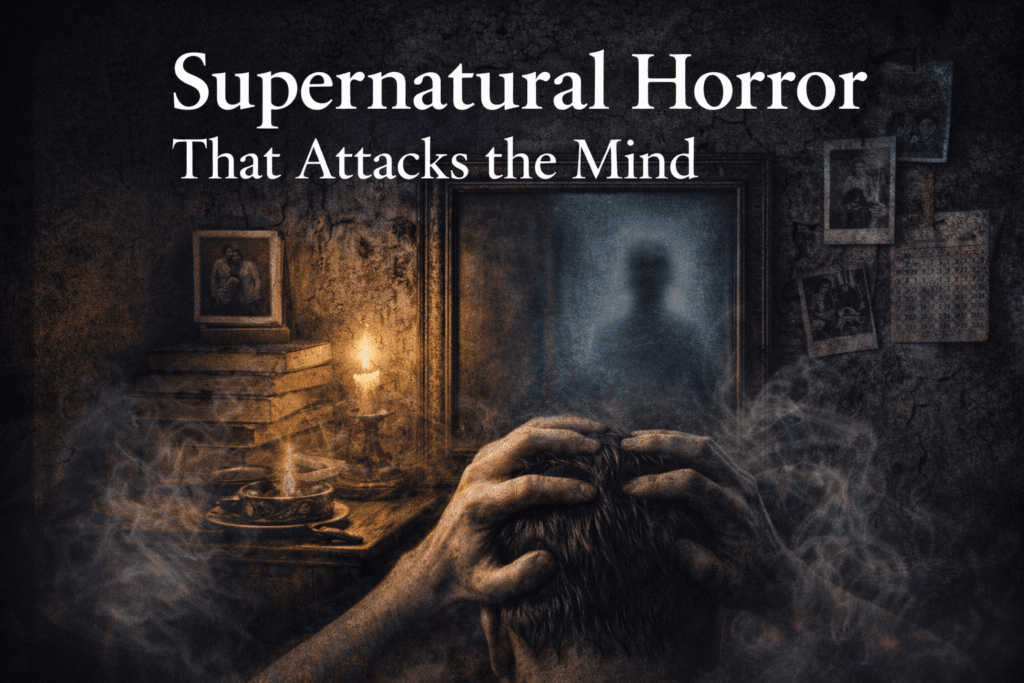
Some horror threatens the body.
Other horror destabilizes the mind.
In supernatural horror, the most unsettling stories are often those that dismantle perception rather than confront it directly. Instead of presenting a visible enemy, these narratives erode certainty itself. Memory becomes unreliable. Interpretation falters. Reality begins to feel provisional. As a result, fear does not remain contained within the story—it follows the reader into their own thoughts.
For experienced readers, this branch of supernatural horror frequently proves the most disturbing. It does not rely on spectacle or shock. Instead, it works quietly, patiently, and persistently.
What It Means When Horror Attacks the Mind
Supernatural horror that attacks the mind rarely announces its intentions.
It infiltrates.
Rather than introducing an obvious external threat, these stories destabilize internal reference points. Characters question what they saw, what they remember, and whether their reactions make sense. The supernatural may be present, but its most damaging effects occur internally.
This inward focus transforms fear from reaction into erosion. The reader does not brace for an event. Instead, they experience a slow collapse of certainty.
Why Psychological Destabilization Produces Deeper Fear
Fear intensifies when interpretation fails.
When characters lose confidence in their perception, the reader loses footing as well. Events no longer resolve cleanly. Motives remain unclear. Cause and effect blur. The story refuses to provide stable ground.
This uncertainty creates a feedback loop. Doubt feeds fear. Fear distorts perception. Distorted perception deepens doubt. Because the loop never fully breaks, the reader remains suspended inside it.
The Role of Ambiguity in Mental Horror
Ambiguity is not a side effect of psychological supernatural horror.
It is the engine.
Rather than clarifying what is happening, these stories allow multiple interpretations to coexist. Is the threat supernatural, psychological, or both? The refusal to answer becomes the source of unease.
This ambiguity forces active engagement. Instead of consuming the story passively, the reader negotiates meaning continuously. That effort deepens immersion while increasing vulnerability.
Why This Horror Often Feels Uncomfortably Real
Supernatural horror that attacks the mind resonates because it mirrors lived fear.
In real life, anxiety rarely arrives with certainty. It grows through second-guessing, intrusive thoughts, and gradual erosion of trust in one’s own judgment. Psychological supernatural horror replicates that experience with precision.
Because the emotional progression feels authentic, the supernatural elements feel plausible even when they defy logic. This overlap explains why readers drawn to this style often respond strongly to stories that feel real rather than theatrical or exaggerated.
When the Familiar Becomes Mentally Unsafe
One of the most disturbing aspects of mental horror is its use of familiar environments.
Homes, relationships, and routines become sources of unease. Because these elements normally anchor stability, their corruption feels personal. The horror does not arrive from outside—it reveals itself within what was already trusted.
This internal betrayal removes the final refuge. The reader recognizes that safety cannot be restored simply by escape.
The Power of Inescapable Awareness
In many psychological supernatural stories, terror emerges not from violence, but from awareness.
The sense of being observed, judged, or entangled in a history that cannot be escaped creates profound unease. The threat does not need to act. Its presence alone destabilizes.
This dynamic defines psychological supernatural horror where inherited spaces and emotional history become inescapable. By anchoring the haunting in legacy, memory, and domestic space, the story attacks the mind through inevitability rather than confrontation. The fear comes not from what appears, but from what refuses to release its hold.
Why Jump Scares Undermine Mental Horror
Jump scares resolve uncertainty by forcing reaction.
Mental horror depends on preserving it.
Sudden shocks collapse ambiguity into momentary release. As a result, they undermine the slow destabilization that psychological supernatural horror requires. Each interruption restores certainty, even if briefly.
This structural conflict explains why readers drawn to mental horror often seek out supernatural horror for readers who hate jump scares. Both styles reject interruption in favor of sustained unease.
The Relationship Between Mental Horror and the Unseen
Mental horror often overlaps with unseen horror.
When the threat never fully appears, doubt intensifies. Characters cannot externalize fear. Instead, they internalize it. The mind becomes the battleground.
Readers who respond strongly to this effect often gravitate toward horror stories where you never see what’s haunting you, where absence itself becomes the source of terror.
Why Slow Escalation Is Essential
Psychological destabilization cannot rush.
If doubt arrives too quickly, it feels artificial. Instead, effective mental horror introduces inconsistency gradually. Small contradictions accumulate. Confidence erodes over time.
This pacing ensures that the reader adapts alongside the character, making the collapse of certainty feel earned rather than imposed.
When Memory Becomes Hostile
In supernatural horror that attacks the mind, memory often turns against the character.
Past events resurface with altered meaning. Familiar moments feel corrupted. The boundary between recollection and invention blurs. Because memory anchors identity, its destabilization removes the last point of stability.
The reader experiences this erosion directly, sharing the character’s uncertainty about what can be trusted.
The Aftereffect of Psychological Supernatural Horror
Mental horror rarely ends cleanly.
Even when the narrative concludes, questions remain unresolved. Was the threat external? Was it internal? Does the distinction matter?
Because clarity never fully returns, the reader continues processing the story afterward. The fear lingers not as image, but as doubt.
How This Style Fits Into the Larger Genre
Supernatural horror that attacks the mind sits at the intersection of several fear mechanisms: realism, ambiguity, unseen threat, and restraint.
Readers drawn to this style often move fluidly between related branches, building a deeper relationship with the genre. These connections converge most clearly in supernatural horror reader’s guide, where psychological, unseen, and atmospheric approaches intersect.
Who This Style of Horror Is For
This branch of supernatural horror suits readers who value ambiguity over explanation, psychological tension over action, and reflection over reaction.
It does not suit readers seeking clear answers or immediate payoff. Understanding this distinction deepens satisfaction and prevents disappointment.
Final Thought
Supernatural horror that attacks the mind does not overpower.
It destabilizes.
By eroding perception rather than confronting it directly, this style of horror creates fear that lingers quietly and persistently. The threat does not vanish when the story ends—it relocates.
For readers who want horror that unsettles thought itself, this remains the genre’s most intimate and disturbing form.