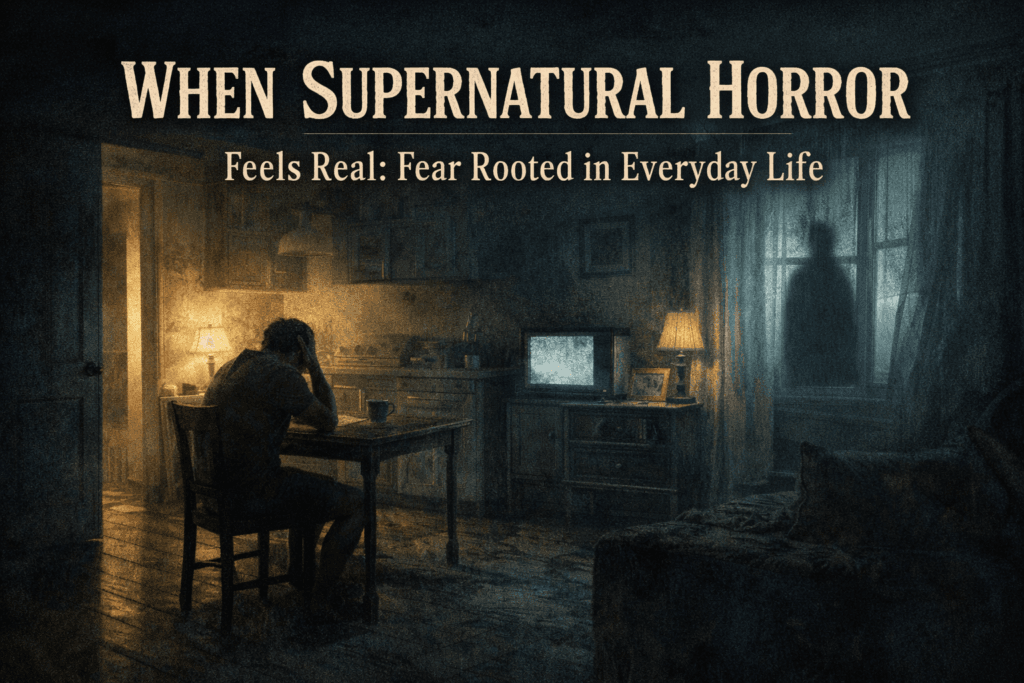
Some supernatural horror unsettles because it feels impossible.
The most disturbing stories unsettle because they feel plausible.
In realistic supernatural horror, fear does not rely on distant worlds or exaggerated circumstances. Instead, it emerges from recognisable spaces, believable emotions, and situations that mirror everyday life closely enough to provoke discomfort. The supernatural intrudes quietly, without spectacle, forcing the reader to confront fear that feels uncomfortably close to home.
This realism changes how fear operates. Rather than remaining contained within the story, it bleeds into the reader’s own environment. Ordinary routines begin to feel fragile. Familiar interactions carry tension. The line between fiction and experience thins.
For many readers, realistic supernatural horror proves more unsettling than any overt spectacle—not because it is louder, but because it is harder to dismiss.
What It Means When Supernatural Horror “Feels Real”
When realistic supernatural horror works, it does not announce itself through scale or intensity.
It reveals itself through familiarity.
The settings are ordinary. The emotional responses feel authentic. Fear unfolds in ways that resemble how unease grows in real life: gradually, inconsistently, and often without a clear trigger. The supernatural does not replace reality—it distorts it.
Because reactions feel believable, the reader does not observe fear from a distance. Instead, they inhabit it. The question shifts from “What will happen next?” to “How would I respond?”
That shift removes safety.
Why Realism Makes Supernatural Fear More Potent
Fear intensifies when it feels transferable.
In exaggerated horror, the reader maintains distance. However, realistic supernatural horror collapses that distance by grounding fear in recognisable emotional logic. Even when events defy explanation, the reactions remain plausible.
This plausibility matters. If fear can arise here—within familiar routines and believable behaviour—it can arise anywhere. The story no longer feels contained. It follows the reader.
As a result, the horror does not end when the book closes.
Everyday Life as the Perfect Conduit for Horror
In realistic supernatural horror, everyday life becomes the medium through which fear travels.
Routine interactions feel subtly altered. Conversations carry tension without explanation. Ordinary spaces feel slightly wrong, though never dramatically enough to justify alarm. Nothing extreme occurs, yet everything feels compromised.
Because these elements mirror daily experience, the reader cannot easily separate fiction from reality. The horror borrows credibility from the mundane.
Normalcy becomes vulnerability.
Why Realistic Horror Rejects Spectacle
Spectacle creates distance.
Realism destroys it.
Stories rooted in realistic supernatural horror avoid dramatic reveals and excessive escalation because such elements break plausibility. Instead, fear builds through accumulation rather than interruption.
This approach aligns naturally with why slow-burn supernatural horror is more disturbing, where tension escalates through patience rather than urgency. Both rely on continuity of unease rather than momentary shock.
The reader is not startled. They are conditioned.
When Fear Arrives Through Attention
In many examples of realistic supernatural horror, fear emerges not through attack, but through awareness.
The sense of being observed—without proof—creates deep unease. Attention becomes invasive. Privacy dissolves. The threat does not need to act. Its awareness alone destabilises.
This dynamic defines supernatural horror where being noticed becomes the source of fear. By grounding the haunting in observation rather than violence, the story destabilises self-perception and autonomy. The reader never sees the threat clearly, yet feels implicated by it.
The horror feels real because attention itself is a recognisable vulnerability.
Why the Unseen Strengthens Realism
Visibility introduces boundaries.
Absence removes them.
In realistic supernatural horror, withholding the threat often strengthens plausibility. Visible monsters invite analysis. Unseen presences invite imagination. The lack of confirmation forces the reader to fill gaps using personal fears and assumptions.
This overlap explains why realistic supernatural horror often intersects with horror stories where you never see what’s haunting you. Both rely on implication rather than explanation, allowing fear to remain fluid.
The less the story clarifies, the more the reader participates.
Emotional Authenticity Over Narrative Certainty
In realistic supernatural horror, emotional truth outweighs narrative clarity.
Characters do not always understand what is happening. Their reactions fluctuate. Doubt competes with fear. Rational explanations coexist with unease. This emotional inconsistency mirrors real experience.
Because the story prioritises authenticity over answers, the reader accepts ambiguity as part of the process. Fear feels earned rather than imposed.
The supernatural unsettles not because it defies logic, but because it disrupts emotional stability.
When Reality Becomes Unreliable
As fear deepens, perception begins to fracture.
Characters question what they saw, what they heard, and what they remember. Minor inconsistencies accumulate. Confidence erodes gradually. The supernatural may or may not be the cause, but its impact is undeniable.
This erosion connects directly to supernatural horror that attacks the mind, where fear destabilises cognition rather than confronting the body. In realistic supernatural horror, this effect intensifies because reactions remain believable even as certainty collapses.
The reader experiences the same disorientation.
Why Realistic Horror Avoids Clear Answers
Clear answers restore control.
Realistic supernatural horror removes it.
Once a story defines the threat—what it is, how it behaves, why it exists—fear becomes manageable. Stories grounded in realism resist this closure. They allow uncertainty to persist.
This refusal mirrors real fear, which rarely resolves neatly. Anxiety lingers. Doubt remains. The reader is left processing rather than concluding.
By denying resolution, realistic supernatural horror ensures fear survives beyond the final page.
Isolation as a Believable Catalyst for Fear
Isolation amplifies plausibility.
Characters often experience fear privately, without validation or assistance. When they attempt to articulate what they feel, others dismiss it. That dismissal intensifies dread.
In real life, people frequently question their reactions when no one else shares them. Realistic supernatural horror exploits this tendency, turning self-doubt into vulnerability.
The reader recognises this pattern instinctively.
Why This Horror Lingers Longer
The defining strength of realistic supernatural horror lies in its afterlife.
Because the story draws from everyday experience, the reader carries its unease forward. Familiar spaces feel altered. Silence feels heavier. Routine moments invite reflection.
The fear does not remain fictional. It becomes contextual.
This lingering quality explains why many readers gravitate toward realistic supernatural horror over more extreme alternatives. The fear does not burn out—it embeds itself.
How This Style Fits Into the Larger Genre
Realistic supernatural horror occupies a central position within the genre.
It intersects with slow escalation, unseen threat, psychological destabilisation, and restraint. Readers who respond to this approach often explore related fear mechanisms, deepening their engagement.
These connections converge most clearly in supernatural horror reader’s guide, where realism functions as a core amplifier rather than a stylistic aside.
Who This Style of Horror Is For
This branch of supernatural horror suits readers who value emotional authenticity over spectacle, implication over explanation, and psychological unease over shock.
It does not suit readers seeking immediate payoff or clear answers. Understanding this distinction enhances satisfaction and prevents mismatch.
Final Thought
Realistic supernatural horror does not frighten by exaggeration.
It frightens by recognition.
By grounding fear in everyday life and believable emotion, it removes the distance that usually protects the reader. The horror does not need to convince—it only needs to resemble.
For readers who want fear that follows them into familiar spaces, realistic supernatural horror remains one of the genre’s most unsettling forms.