Fear doesn’t always announce itself visually.
Sometimes, it arrives as a noise you can’t explain.
A footstep where no one should be.
A whisper without a speaker.
A hum that never quite stops.
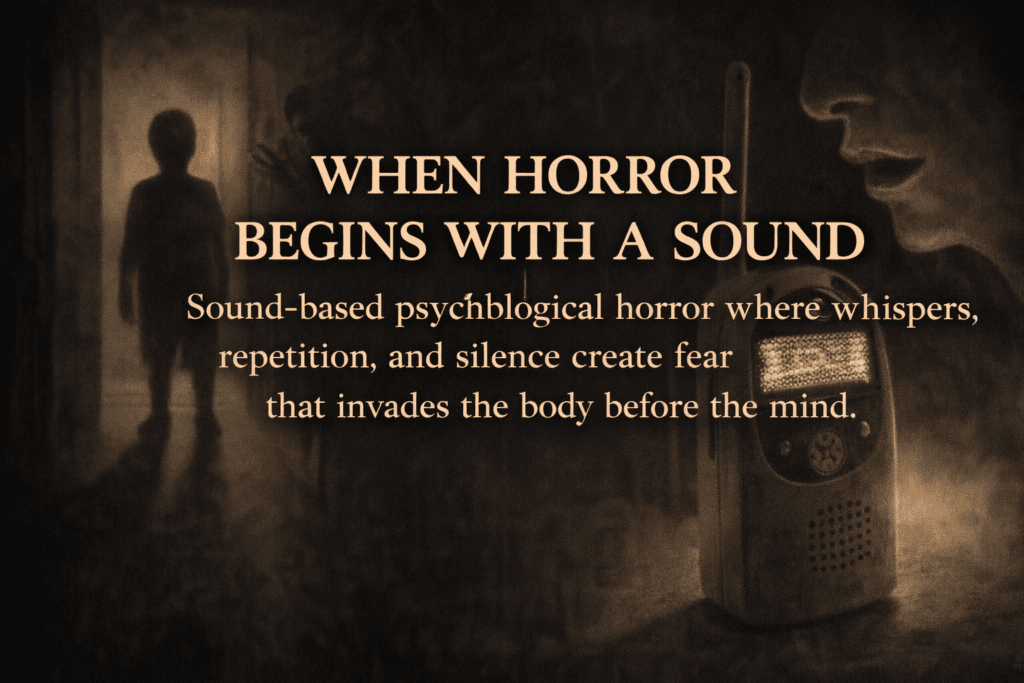
Sound-based psychological horror understands something fundamental: you can close your eyes, but you can’t close your ears. Because of that, sound bypasses reason and strikes the nervous system directly.
That immediacy makes it one of the most invasive forms of psychological horror.
Why Sound Is So Hard to Ignore
Vision allows distance. You can look away. You can rationalise what you see.
Sound doesn’t offer that luxury.
It fills space. It leaks through walls. It follows you from room to room. Even when you try to ignore it, your body reacts before your mind can intervene.
This is why sound-driven dread fits so naturally within psychological horror. The genre thrives on experiences that destabilise perception rather than confront it head-on.
Sound Creates Presence Without Proof
One of the most unsettling qualities of sound-based horror is implication.
A noise suggests something is there—without confirming what it is.
Because there’s no visual anchor, the mind fills the gap. Consequently, imagination becomes more frightening than any reveal could be.
This restraint mirrors the unease found in quiet terror, where fear grows not from action, but from anticipation.
Nothing appears.
Something is implied.
The tension intensifies.
Repetition Turns Noise Into Threat
At first, a sound feels incidental.
Then, it repeats.
Eventually, it becomes expected.
Repetition transforms harmless noise into pattern. Once a pattern forms, the mind assigns intent. As a result, even neutral sounds begin to feel deliberate.
This escalation doesn’t require volume or violence. Instead, it relies on persistence. The longer the sound continues, the harder it becomes to dismiss.
The Home Amplifies Every Noise
Sound-based horror becomes especially effective inside familiar spaces.
Homes are full of expected noises—pipes, floorboards, wind against windows. When an unfamiliar sound enters that environment, it doesn’t just stand out. It disrupts the mental map of safety.
This makes sound horror a natural extension of when home becomes the enemy. The house doesn’t just shelter the noise—it magnifies it.
Every creak feels intentional.
Every silence feels charged.
Innocence Makes Sound More Disturbing
Some sounds feel harmless on their own.
A giggle.
A nursery rhyme.
A soft tapping.
However, when those sounds appear at the wrong time—or without a source—they become deeply unsettling. Innocence turns into camouflage.
That overlap connects sound-based horror with when innocence turns unsettling. The horror doesn’t come from what the sound is. It comes from where and when it occurs.
The context does the damage.
Sleep Makes Sound Inescapable
Sound-based horror often targets moments of vulnerability.
At night, the world quiets. Background noise fades. As a result, even small sounds feel amplified.
Sleep becomes fractured. Rest turns shallow. The mind hovers between waking and dreaming, unable to categorise what it hears.
Fear arrives before thought.
A Story Built Entirely on What You Hear
This tension defines The Midnight Giggle.
The story doesn’t rely on spectacle or explanation. Instead, it uses repetition, timing, and sound itself to create dread. The noise arrives first. Meaning follows too late.
The fear escalates not through revelation, but through endurance. By the time certainty feels necessary, it’s already impossible.
Sound Leaves Residue
Unlike visual horror, sound doesn’t end when the page turns.
Readers remember the sensation of listening. The waiting. The anticipation. The inability to relax into silence.
That residue feeds directly into horror that lingers, where fear survives because the body remembers it even when the mind wants to move on.
You don’t recall what you saw.
You recall what you heard.
When the Noise Can’t Be Escaped
Unlike visual threats, sound follows.
You leave the room—it continues.
You close the door—it persists.
You cover your ears—it vibrates through you.
That inescapability pushes sound-based horror toward isolation without escape, where confinement isn’t physical—it’s sensory.
The sound becomes the environment.
Who Sound-Based Psychological Horror Is For
This cluster resonates with readers who:
- Feel uneasy about silence rather than darkness
- Are disturbed by implication more than revelation
- Experience fear physically before cognitively
- Prefer dread that persists rather than explodes
If you’ve ever listened for something you hoped wasn’t there, this horror speaks your language.
Where This Path Leads
Once sound becomes unavoidable, fear stops escalating.
It settles.
That transition leads naturally into horror that lingers, where fear isn’t resolved—it’s retained.
If This Made You Listen More Closely
That reaction matters.
Sound-based psychological horror works because it bypasses logic and embeds itself in the body.
The Midnight Giggle was written for readers who understand that the most frightening moments often begin with listening. If this post made you aware of the sounds around you, it has already done its work.