Some horror stories scare you because of what happens.
Others scare you because you can no longer trust who is telling the story.
An often pivoting aspect of psychological horror, unreliable narration doesn’t announce itself. It creeps in quietly. Details contradict each other. Memories shift. Events feel slightly misaligned. At first, you assume the problem lies in interpretation.
Then you realise the problem may be perception itself.
This is where psychological horror becomes deeply unsettling.
Doubt Is the Real Monster
An unreliable narrator doesn’t lie outright. That would be too obvious.
Instead, the story allows small fractures to form. A recollection changes. A certainty dissolves. A moment that felt clear suddenly feels questionable.
Because the narrator remains close—often speaking directly to the reader—the doubt feels intimate. You’re not watching confusion from the outside. You’re inside it.
This technique often appeals to readers who already gravitate toward quiet psychological horror, where restraint and ambiguity do most of the work.
When Perspective Starts to Slip
Unreliable narration destabilises the reading experience.
You begin tracking inconsistencies. You reread passages. You second-guess conclusions you felt confident about moments earlier.
That mental effort creates tension without requiring action. The fear doesn’t come from threat—it comes from instability.
Stories like this don’t ask, What will happen next?
They ask, What actually happened before?
That shift changes everything.
Fragmentation Makes Uncertainty Worse
Many unreliable narrator stories use fractured structures to deepen doubt.
Entries appear out of order. Information arrives incomplete. Key details surface too late—or not at all.
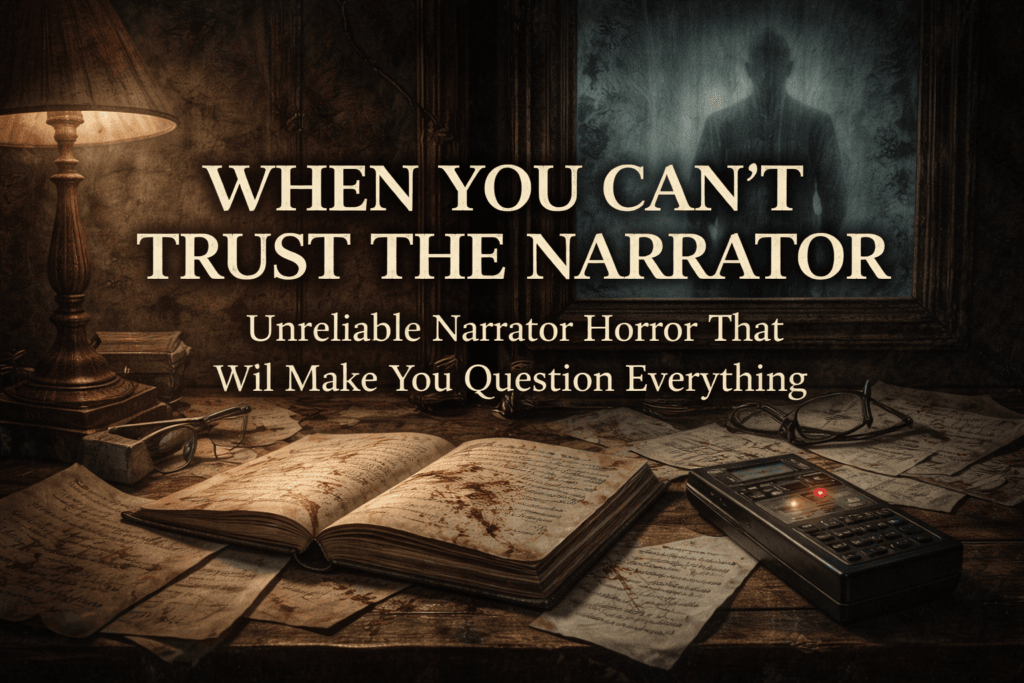
This overlap becomes especially potent in found-text psychological horror, where journals, reports, or recordings feel authoritative until they don’t.
The more the format promises truth, the more disturbing its collapse becomes.
Isolation Amplifies the Breakdown
As trust erodes, isolation often follows.
Other characters fade into the background. Explanations disappear. The narrator becomes the sole lens through which events are filtered.
That narrowing of perspective leads naturally into isolation without escape, where mental collapse feels inevitable rather than sudden.
Once the narrator stands alone, doubt has nowhere to go but inward.
A Story Built on Uncertainty
This approach defines The Diary of Cabin 313.
The story never asks the reader to accept confusion passively. It invites scrutiny, then undermines it. Memories, records, and certainty fracture slowly, forcing the reader to question not only the narrator—but their own conclusions.
The fear doesn’t come from revelation.
It comes from realising how little can be trusted.
Why This Kind of Horror Lingers
Unreliable narrator horror doesn’t resolve cleanly.
Even when the story ends, doubt remains. You replay scenes. You reconsider motives. You wonder which moments—if any—were solid.
That lingering uncertainty connects closely with horror that lingers, where the fear survives beyond the final page.
The mind keeps working long after the book is closed.
Who This Horror Is For
Unreliable narrator psychological horror resonates with readers who:
- Enjoy questioning reality rather than witnessing violence
- Feel unsettled by ambiguity and contradiction
- Prefer mental unease to physical threat
- Like stories that reward attention and re-reading
If certainty makes you comfortable, these stories will dismantle it.
Where This Path Leads
Once narration itself becomes unstable, the next fracture often appears in structure.
Stories abandon linear progression. Records contradict each other. Truth scatters across fragments rather than forming a whole.
That shift continues in found-text horror, where documentation promises clarity—and delivers confusion instead.
If Uncertainty Pulls You In
If doubt feels more disturbing than danger, you already understand the appeal of unreliable narrators.
The Diary of Cabin 313 was written for readers who want fear to emerge through contradiction, isolation, and gradual mental collapse—not through spectacle or violence.
If this post made you question what you were reading, that discomfort is the point.