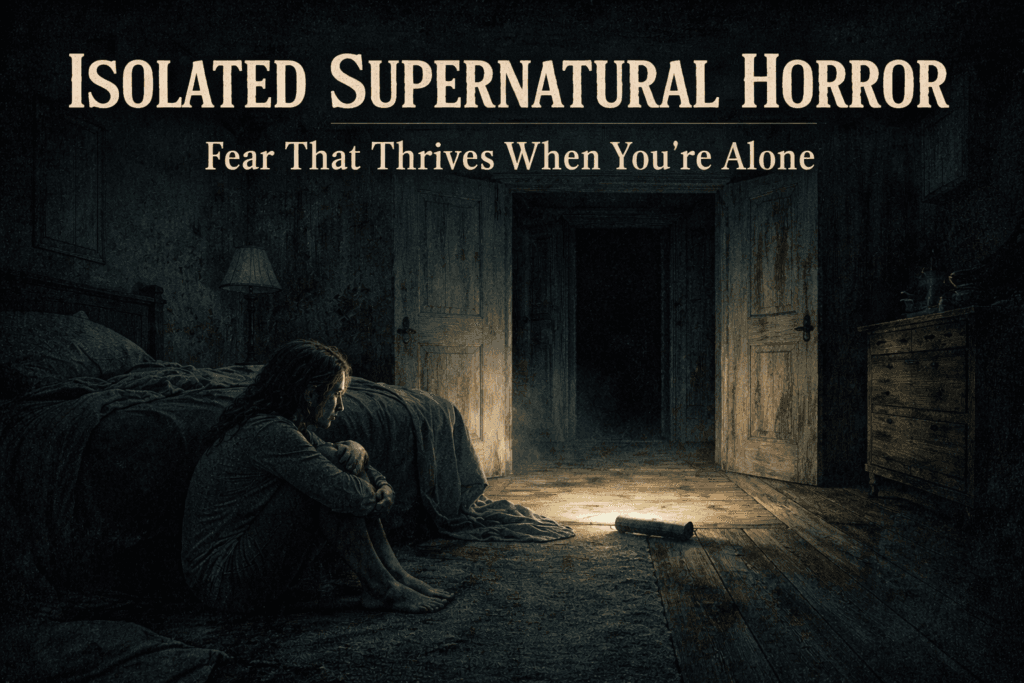
Some supernatural horror terrifies through confrontation.
Isolated supernatural horror terrifies through absence.
In this branch of the genre, fear does not arrive with spectacle or violence. Instead, it emerges when help is unavailable, witnesses are absent, and the character must endure fear alone. The supernatural threat may be subtle or overt, but its most unsettling feature is isolation itself. No one arrives. No one intervenes. Nothing interrupts.
As a result, the reader experiences dread without relief. The story offers no reassurance, no external validation, and no rescue. Fear becomes a closed system.
For many readers, isolated supernatural horror proves more disturbing than any other form, precisely because it removes the safety net that most stories rely on.
What Defines Isolated Supernatural Horror
Isolated supernatural horror is not simply horror that happens in solitude.
It is horror structured around the absence of support.
Characters face fear without witnesses, allies, or authority figures who might intervene. Even when others exist in the world of the story, they are inaccessible, unresponsive, or incapable of helping. The isolation may be physical, emotional, or psychological, but it is always inescapable.
This structure forces the character—and the reader—to confront fear without external mediation. There is no shared experience to soften the impact. Fear remains personal and uncontained.
Why Isolation Amplifies Supernatural Fear
Fear intensifies when it cannot be shared.
In everyday life, distress becomes manageable once it is acknowledged by others. Isolation removes that relief. When characters cannot explain what they are experiencing—or are not believed when they try—fear compounds internally.
Isolated supernatural horror exploits this dynamic. The reader recognises the vulnerability immediately. Without confirmation or assistance, doubt grows alongside fear. The character begins questioning their own perception, which deepens unease.
Isolation does not merely heighten fear. It reshapes it.
The Absence of Help as a Narrative Weapon
In many horror stories, the promise of intervention provides comfort, even if it never arrives. Isolated supernatural horror removes that promise entirely.
There is no moment when help is “almost” there. No authority figure investigates. No outside force restores balance. The story never signals rescue.
This absence becomes a source of dread in itself. The reader understands early that nothing will interrupt what is happening. Fear does not escalate toward resolution—it deepens toward inevitability.
When Isolation Feels Uncomfortably Real
Isolated supernatural horror resonates because isolation is familiar.
People experience fear privately far more often than they admit. Anxiety, dread, and unease frequently occur without witnesses. When supernatural horror mirrors that emotional reality, it feels plausible.
This overlap explains why isolated supernatural horror often intersects with stories that feel real. The fear does not rely on extraordinary circumstances. It relies on recognisable emotional responses to being alone with something unexplainable.
The reader does not need to imagine isolation. They remember it.
Why Isolation Forces Fear Inward
Without external reference points, characters turn inward.
They replay events. They analyse reactions. They question memory and perception. The supernatural threat may be external, but its impact manifests internally. The mind becomes the battleground.
This inward pressure connects directly to supernatural horror that attacks the mind, where fear destabilises cognition rather than confronting the body. Isolation intensifies this effect by removing external validation.
The reader experiences the same destabilisation, sharing the character’s uncertainty.
When Being Seen Replaces Being Attacked
In some isolated supernatural horror, the fear does not come from physical harm, but from awareness.
The sense of being noticed, watched, or acknowledged by something unseen becomes unbearable when no one else is present. Attention replaces violence as the threat. The character is alone with the knowledge that something is aware of them.
This dynamic defines isolated supernatural horror where observation becomes invasive. By grounding fear in attention rather than attack, the story removes the possibility of confrontation. There is nothing to fight—only something that watches.
Isolation turns awareness into a trap.
Darkness as an Extension of Isolation
Many isolated supernatural stories use darkness not as a visual tool, but as a structural one.
Darkness limits perception. It narrows focus. It reinforces the sense of being cut off from others. When fear unfolds primarily in darkness, isolation feels complete.
This approach aligns naturally with supernatural horror where darkness isolates rather than conceals. Darkness does not hide the threat—it separates the character from reassurance.
The reader senses that nothing exists beyond the immediate space. Isolation becomes total.
Why Isolation Rejects Traditional Horror Escalation
Traditional horror escalates through confrontation.
Isolated supernatural horror escalates through endurance.
Rather than increasing action, the story increases pressure. Time stretches. Silence grows heavier. The lack of intervention becomes increasingly oppressive.
Because nothing interrupts the fear, the reader remains suspended in it. There is no release, only persistence.
This endurance is what makes isolated supernatural horror so difficult to shake.
The Role of Space in Isolated Horror
Space matters in isolated supernatural horror.
Rooms feel larger or smaller than they should. Distances feel distorted. Boundaries feel porous. The environment reinforces the character’s separation from others.
Isolation does not need vast landscapes. It thrives in confined, familiar spaces where escape feels possible but unreachable.
The reader feels the claustrophobia even in ordinary settings.
Why Isolation Prevents Closure
Closure requires confirmation.
Isolation denies it.
When no one else experiences the fear, there is no shared resolution. The story cannot end with understanding or validation. Even if the supernatural threat recedes, its impact remains unresolved.
This lack of closure ensures that fear lingers beyond the final page. The reader is left with unanswered questions and unresolved unease.
Isolation guarantees that nothing fully ends.
How Isolated Supernatural Horror Fits the Genre
Isolated supernatural horror occupies a core position within the genre.
It intersects with realism, psychological destabilisation, darkness, and restraint. Readers drawn to it often seek stories that respect vulnerability rather than overwhelm with spectacle.
These connections converge most clearly in supernatural horror reader’s guide, where isolation functions as a foundational fear mechanism rather than a stylistic choice.
Who Isolated Supernatural Horror Is For
This branch of supernatural horror suits readers who:
- prefer psychological dread to action
- value realism over spectacle
- respond strongly to themes of isolation
- want fear that persists without explanation
It does not suit readers seeking rescue, resolution, or reassurance. Knowing this distinction deepens satisfaction.
Final Thought
Isolated supernatural horror does not ask what will happen next.
It asks what happens when nothing arrives.
By removing help, witnesses, and intervention, it forces fear to exist without interruption. The horror does not escalate toward relief—it settles into permanence.
For readers who want supernatural horror that traps rather than shocks, isolation remains the genre’s most unforgiving weapon.